
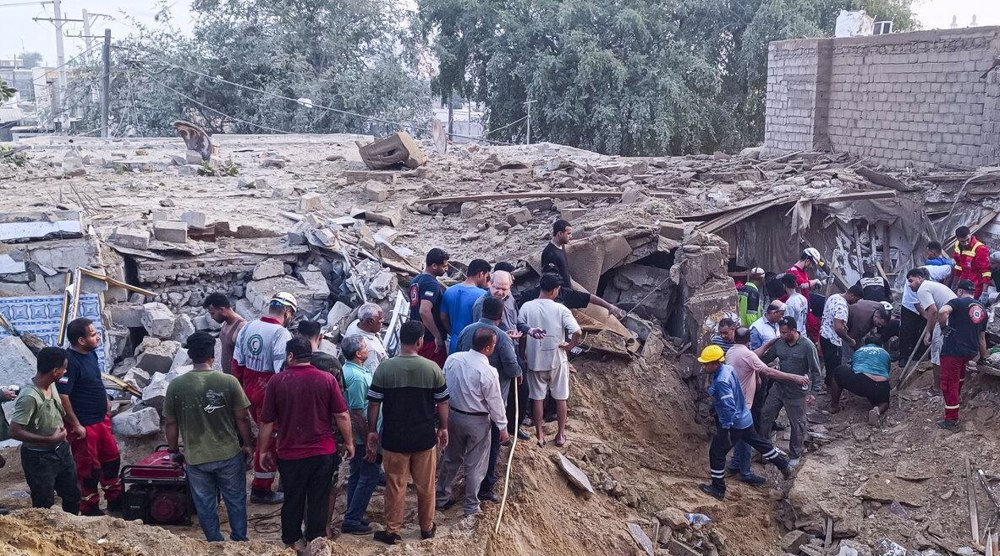
The U.S. bombed southern Iran again the night of July 29, killing a father, mother and their two-year-old child in a home on Qeshm Island, at the mouth of the Strait of Hormuz. Two more children, ages seven and nine, were wounded. Hormozgan provincial official Ahmad Nafisi identified those killed. More explosions struck Bushehr province to the north.
U.S. Central Command called the assault a “powerful response” to Iranian strikes on U.S. forces stationed across West Asia — part of the same military network Washington used to open Operation Epic Fury on Feb. 28.
Washington launched that war to overthrow Iran’s government and take back control of Iran’s oil, which the 1979 revolution pulled out of imperialist hands. The opening strike assassinated Supreme Leader Ali Khamenei and members of his family. The war planners expected the state to collapse within weeks. It did not. Iran named a new supreme leader, and its missile forces kept striking U.S. bases across the region.
Five months later, Washington is looking for a way out of a war it cannot win. Iran will not give it one on Washington’s terms.
The terms for reopening
Iran answered the opening U.S. assault by closing the Strait of Hormuz to normal commercial traffic. About a fifth of the world’s oil moves through the waterway, and Iran has controlled passage through it ever since. Tehran’s terms for reopening it are plain: the U.S. must withdraw from the region completely, release the billions of dollars in Iranian assets it has seized, and lift the sanctions it has piled on Iran for 46 years. Until then, the door stays shut.
That is the trap Washington built for itself. It cannot bomb its way to its war aims, and it cannot meet Iran’s terms without admitting the war failed. So it keeps bombing — homes on Qeshm, a railway here, a power station there — to prove it still can.
Iran sets the tempo
Through the early months of the war, Tehran struck back only in direct response to specific U.S. attacks. That restraint is over.
When Washington paused its bombing in late July, Iran continued striking U.S. forces. On July 28, it hit Al Azraq Air Base in Jordan. Washington then resumed its bombing, including the July 29 attack on Qeshm. Iran answered with another strike on Al Azraq — the base Washington had used to bomb Qeshm. The Islamic Revolutionary Guard Corps said the missiles destroyed three F-35 fighter jets, damaged three more and hit the maintenance shed the aircraft depend on to keep flying.
Iran had taken hold of the war’s tempo. Washington no longer decides when the fighting stops and starts.
The pause itself measured U.S. weakness. Gen. Dan Caine, chairman of the Joint Chiefs of Staff, told President Donald Trump that the military’s shrinking munitions stockpile could limit operations against Iran, the Associated Press reported, citing a U.S. official. It was no isolated warning. The Pentagon has fired Patriot interceptors and other missiles faster than U.S. arms factories can build them — by late April it had expended more than 1,200 Patriots, at over $4 million apiece. Decades of guaranteed profits, monopoly pricing and neglected production capacity have left the arms industry unable to replace what the Pentagon is firing. The most heavily armed war machine on earth is running short of the weapons it needs to fight a single regional power.
The Strait answers to Iran
Nowhere is Iran’s grip clearer than on the Strait itself. On July 30 the first Qatari liquefied natural gas shipment in three weeks passed through the waterway — along a route Iran designated, with Tehran’s authorization, according to Iran’s Fars news agency. Ships move through the Strait when Iran permits it and along the paths Iran sets. The IRGC stated the Strait will stay closed to normal traffic as long as U.S. threats continue, and warned that governments aiding the U.S. assault will face consequences.
The Gulf monarchies cannot escape the trap Washington has set for them. U.S. missiles were reportedly launched from Kuwait even after Kuwait’s ambassador to Washington formally stated her country had not permitted its territory, airspace or waters to be used. A joint U.S.-Saudi attack on targets in Iraq killed at least four people affiliated with the IRGC. The monarchies host the bases, absorb the retaliation and plead with Washington to call off attacks they cannot influence.
Nothing left to negotiate
Tehran has drawn its own conclusion. Washington opened this war the morning after Omani mediators announced a diplomatic breakthrough, bombed Iran again during later talks, and tore up a signed memorandum of understanding within weeks — sending warships into the Strait to seize it in open defiance of the agreement it had just signed. Negotiations with the Trump administration have become a dead end. Mohammad Marandi, a professor at the University of Tehran, said flatly that Iran has no interest in talking to Trump or his representatives. Iran’s aim is to force the U.S. out.
The system behind the war
Cooler heads and better diplomats will not fix the war on Iran. It grows out of a monopoly-capitalist system that must dominate the oil chokepoints of West Asia and can no longer do it. Unable to win, and unable to quit on any terms it can stomach, Washington keeps killing to display a power it no longer possesses. The dead on Qeshm are the result.
Across West Asia, the imperialist advance is being stopped and thrown back. Iran, with Yemen alongside it, is holding that line against the U.S. war machine.
Five months in, the initiative belongs to the nation Washington set out to break. Iran holds the door to the Strait of Hormuz, and it is not opening it.
Join the Struggle-La Lucha Telegram channel