
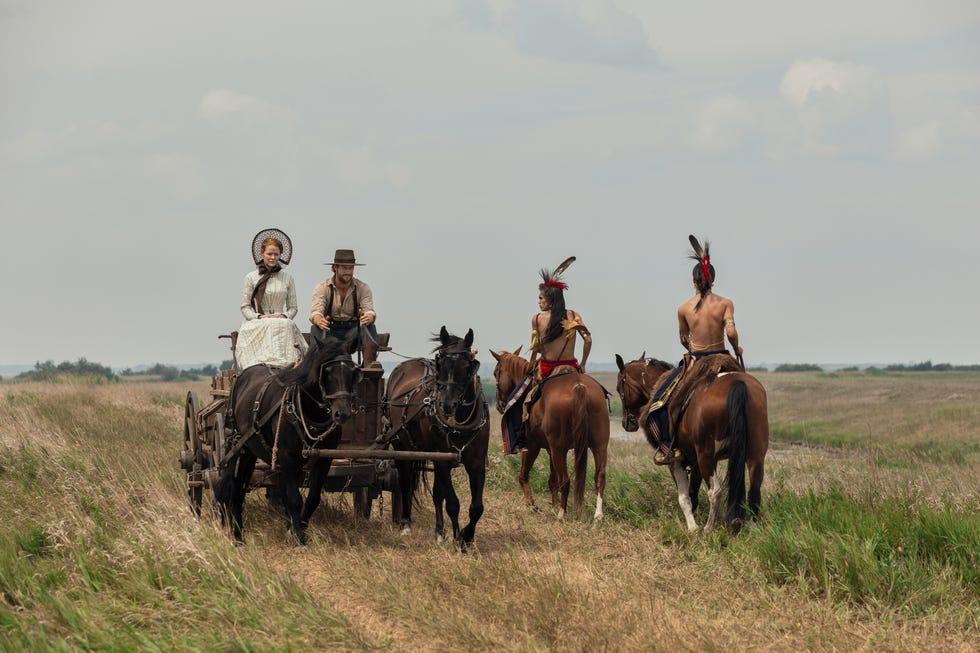
Netflix began streaming all eight episodes of its “Little House on the Prairie” reboot on July 9, 2026. Before the first episode aired, the right had already declared war on it. Podcaster Megyn Kelly warned Netflix that if it tried to “wokeify” the beloved franchise, she would make it her “singular mission to absolutely ruin” the project. Reviewers answered that Netflix had gone ahead and done it. The fight was on, and it filled the entertainment press for weeks.
Underneath the noise sits a story neither side wants to tell. “Little House on the Prairie” has always been the origin story of U.S. capitalism told as a children’s bedtime tale. The reboot changes the casting and the conscience. It does not change the property line.
The 2026 version, run by Rebecca Sonnenshine, follows Charles and Caroline Ingalls and their daughters as they leave Wisconsin and settle outside Independence, Kansas, in the 1870s. Sonnenshine builds out a neighboring Osage family living in the same territory, casts the real Black frontier doctor George Tann as the Ingalls’ close neighbor, and lets the show admit out loud that the settlers came to seize land that belonged to the Osage. Osage cultural consultants worked on the production, and roughly 100 members of Osage and other Indigenous communities took part in varying capacities. The book that once told readers there were “no people, only Indians” — a line Laura Ingalls Wilder herself later softened to “no settlers” — now shares the screen with the people it had erased.
That is a real change from Wilder’s page and from the 1970s NBC series, where the Osage appeared and vanished in the pilot. It is also why the conservative machine came after it. But the reboot turns dispossession into a moral failure that sympathetic settlers can recognize, rather than a system of state violence that created property rights still enforced today. It invites the audience to be sad about the theft without questioning the ownership that the theft produced.
The politics behind the books
Begin with what the books were built to do. The “Little House” novels began appearing in 1932, in the depths of the Depression, and continued through the New Deal years. Wilder’s daughter, Rose Wilder Lane, edited and reshaped the manuscripts, and Lane was no neutral hand. Along with Ayn Rand and Isabel Paterson, she was a founder of the U.S. libertarian movement. She despised Franklin Roosevelt, called his Washington a nest of communists and refused on principle to use government services. Scholars from William Holtz to Christine Woodside to Caroline Fraser have documented how Lane turned her mother’s rough memories into heroic tales aimed straight at the New Deal — against relief, against unions, against the idea that working people should meet their needs together instead of one household at a time.
The moral of the books is self-reliance. The history is the opposite. The Ingalls family’s movement west depended at every stage on federal power. In Kansas, they squatted on Osage land that federal policy and military force were preparing to seize and open to settlers. Later came Homestead Act claims and railroads built with public money and public land grants. “Independence, Kansas” is a fitting address for a myth about rugged independence that ran entirely on the government.
And the land was not empty. When the Ingalls put up their cabin outside Independence, they were squatting illegally on the Osage reservation. The Osage Nation has condemned Wilder’s books for generations, because the books turn their eviction into a wholesome family adventure. This is how the frontier myth works. It takes the seizure of land, the killing and removal of the people who lived on it, and the conversion of that land into private property, and it retells the whole thing as thrift, grit and good character.
Marx called this process original expropriation: the violent separation of people from the land and other means of production, creating capitalist property on one side and a class with nothing to sell but its labor on the other. On this continent it wore a specific face. The U.S. government, settlers, railroads, speculators and banks worked together to take Indigenous land, cut it into deeds and open it for profit. The frontier was the front line of that work. The myth exists to make the front line look like a family picnic.
Kansas makes the point sharper than most places could. A generation before the Ingalls arrived, the territory ran red over a single question: whether the western land being seized would be worked by enslaved people or folded into free-labor capitalism. Both answers took the theft of the land as settled. The white settler’s “freedom” on the prairie was always bound up with someone else’s unfreedom — the Native nations driven off, and the millions held in bondage whose stolen labor built the wealth of the expanding country. The frontier sold white household independence as the national ideal while resting on the denial of freedom to everyone else.
This is why the diversified reboot cannot rescue the story. Putting an Osage family and a Black doctor on screen, and having the characters feel bad about the taking, leaves the taking in place. The land is still seized. The property built on it — the deeds, the railroads, the banks, the agribusiness that farms that same Kansas ground today — still stands, unmentioned. Representation is not restitution. A more inclusive frontier myth is still a frontier myth.
The culture war around the show is theater. Netflix, one of the largest media monopolies on earth, profits whether the audience comes to cheer the reboot or to rage at it. The company renewed the series for a second season before a single episode aired. The shouting between liberal praise and conservative fury keeps the argument fixed on casting and tone, pushing aside the question of who owns the land and who works it now. That suits the owners fine.
The history the frontier myth leaves out
There is a different way to tell this history, and it already exists, told from the side of the people the frontier ran over. Louise Erdrich, a member of the Turtle Mountain Band of Chippewa and a National Book Award winner, wrote her “Birchbark House” series as a direct answer to “Little House.” It follows an Ojibwe family through the same century, through epidemic and forced removal, from the side of those who endured settlement rather than those who profited from it. It makes visible what the frontier myth hides: the theft, the death and the destruction of whole ways of life that “westward expansion” required.
A better reboot from Netflix is not what is needed. What matters is which side of this history working people stand on: the settler on the wagon, or the Indigenous peoples driven from the land and the workers whose exploited labor built the wealth of this system.
The frontier myth teaches workers to identify with the property owner. The real history teaches them to stand with the dispossessed.
Join the Struggle-La Lucha Telegram channel