
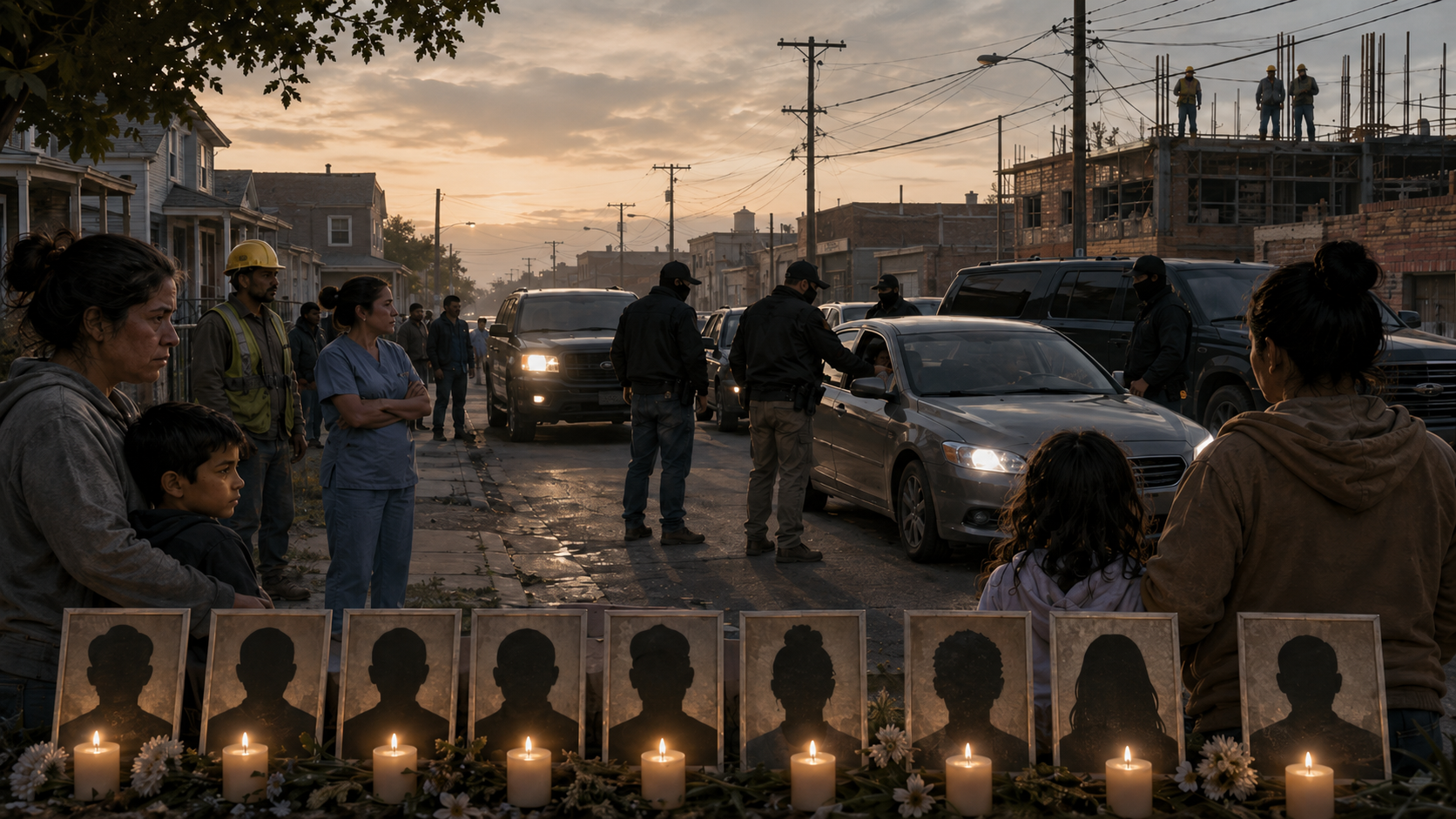
U.S. Immigration and Customs Enforcement officers rammed Joan Sebastián Durán Guerrero’s car and fired through the windshield as he drove to work in Biddeford, Maine, on July 13.
Durán Guerrero was 25, a food delivery driver from Bucaramanga, Colombia, who worked two jobs and was authorized to work in the United States. His wife and three-year-old daughter reached the intersection minutes after he was shot.
The Department of Homeland Security waited nearly 12 hours before issuing a statement. It said an officer fired “fearing for public safety” as Durán Guerrero “attempted to flee the scene.”
Durán Guerrero was not the person agents had come to arrest. The agents wore no body cameras. Doorbell cameras, business surveillance and bystanders supplied the record of the killing.
He was the eighth person killed by gunfire from U.S. immigration agents since Trump launched the mass deportation campaign on taking office Jan. 20, 2025.
Seven of the dead are publicly known by name: Ruben Ray Martinez, Silverio Villegas González, Keith Porter Jr., Renée Good, Alex Pretti, Lorenzo Salgado Araujo and Joan Sebastián Durán Guerrero. A Border Patrol agent shot a 31-year-old Mexican man near Rio Grande City, Texas, on Dec. 11, 2025. The government has never publicly identified him.
Four of the eight were U.S. citizens. Seven were killed during immigration operations, and none was shown to be the person agents had come to arrest. Porter was killed by an off-duty ICE officer, and Homeland Security immediately defended the killing. The eight included workers on their way to their jobs, bystanders and people resisting ICE violence. No federal agent has been charged.
In five of the killings, the government claimed that the victim used a vehicle to threaten an agent or the public. In every case where video, witness accounts or medical findings were available, the record contradicted that claim. The government lied.
A campaign of terror
All eight killings expose the armed force and impunity of the deportation machinery. ICE sends armed agents into working-class neighborhoods with the power to stop, seize and kill. The campaign targets immigrants first, then turns on anyone who warns, records or comes to their defense.
After each killing, the government casts the victim as the aggressor.
Agents use unmarked cars and road stops to catch workers one at a time as they drive to work, take their children to school or carry out other daily tasks. Then the car becomes the excuse. A worker driving away is called “weaponizing” a vehicle. The government writes the justification after the bullets are fired.
The eight shooting deaths occurred outside detention. The same campaign kills more people behind detention walls.
Government casts the dead as aggressors
Ruben Ray Martinez was the first of the eight.
Martinez was 23, a U.S. citizen from San Antonio celebrating his birthday before starting trade school to become a mechanic. A Homeland Security Investigations agent shot him through the open side window of his car on South Padre Island, Texas, on March 15, 2025.
ICE claimed Martinez accelerated and struck an agent. Body camera video obtained by CBS News shows the car stationary or barely moving, with its brake lights on. Agents dragged the wounded Martinez from the car, threw him face down and handcuffed him before providing medical care.
ICE concealed the killing for nearly 11 months. A grand jury later declined to charge the agent.
On Sept. 12, 2025, ICE agents killed Silverio Villegas González in Franklin Park, Illinois, during Operation Midway Blitz.
Villegas González was 38, a restaurant cook from Michoacán and the primary caretaker of his two children. He had dropped them at school and daycare minutes earlier.
Homeland Security claimed he dragged an officer “a significant distance” with his car. No video shows the alleged dragging or the shooting. Footage recorded afterward captured the supposedly injured agent describing his injuries as “nothing major.”
The medical examiner found that Villegas González was shot at close range. One bullet entered the back of his neck and traveled into his chest.
Villegas González’s killing drew little national attention. He was an immigrant restaurant worker killed away from the cameras, and the government’s account largely stood unchallenged outside Illinois. The later killings of Renée Good and Alex Pretti exposed the same violence to a much wider public because witnesses recorded them and a mass movement forced them into national view.
Three months later, a Border Patrol agent killed the still-unidentified Mexican man near Rio Grande City. The agency claimed there had been a struggle, released no video and withheld his name.
Keith Porter Jr., a 43-year-old Black U.S. citizen and father of two, was killed outside his Los Angeles apartment complex on Dec. 31, 2025.
Friends and relatives say Porter had fired a rifle into the air during a New Year’s celebration and was returning home when Brian Palacios, an off-duty ICE officer, confronted and killed him. Homeland Security described Palacios as having “bravely responded to an active shooter situation.” Porter’s family says Palacios never saw him fire.
One week later, federal agents again claimed that a vehicle had been used as a weapon — this time in Minneapolis.
Minnesota fought back
Operation Metro Surge placed roughly 4,000 federal agents in the Twin Cities. Residents warned one another, recorded arrests and organized to protect their neighbors.
That defense had taken organized form first in Los Angeles nearly a year earlier.
Unión del Barrio, rooted in the Mexican and Central American communities of Southern California, put community patrols on the streets to spot ICE vehicles before agents reached workers, hand out know-your-rights literature and tell residents that no agent can enter a home or workplace without a signed warrant. In February 2025, the organization initiated the Community Self-Defense Coalition, which grew to more than 80 member organizations.
The patrols stopped raids. On Feb. 23, 2025, 12 ICE vehicles left Alhambra, California, empty-handed after defense patrols arrived. In Oxnard, California, a factory worker in contact with the coalition refused agents entry and turned them away.
Workers in other cities took up the method. What began as neighborhood patrols in Los Angeles became the practice that met the deportation force in Chicago, in the Twin Cities and in hundreds of cities after that.
Renée Nicole Macklin Good was part of that resistance.
Good was a 37-year-old U.S. citizen, writer and poet. On Jan. 7, 2026, she was driving with her wife in south Minneapolis and warning neighbors that ICE agents were nearby.
Agents surrounded her SUV. Good reversed briefly and then drove forward, turning away. ICE agent Jonathan Ross fired into the vehicle and killed her.
Within hours, Homeland Security called Good a domestic terrorist. Trump called Good “very violent” and “very radical” and claimed Ross had been run over. Bystander video showed the SUV turning away as Ross fired.
Seventeen days later, federal agents killed Alex Jeffrey Pretti.
Pretti was a 37-year-old U.S. citizen and intensive care nurse for the Department of Veterans Affairs. He was filming federal officers when an agent shoved a woman to the ground. Pretti stepped between them.
Agents pepper-sprayed him and wrestled him down. With about six officers surrounding him on the ground, two Customs and Border Protection officers shot him multiple times.
Good and Pretti were killed while defending other people. Their citizenship did not protect them. The deportation machinery turns against anyone who interferes with its power to seize workers. When a neighborhood warns, records and defends its people, the government brings raids, surveillance, detention and armed force against the whole community.
Solidarity also became the force that stopped the operation.
Good’s killing led to a general strike in Minnesota on Jan. 23, the largest labor action yet taken against the deportation campaign. The strike call went national: solidarity actions answered it in some 300 cities the same day, backed by more than 90 unions and community organizations. Tens of thousands filled the streets of the Twin Cities. Pretti was killed the day after the strike. His death drove the movement forward.
On Feb. 12, the administration announced the end of Operation Metro Surge.
No federal investigation had led to charges against the agents who killed them. Organized workers and communities made the operation impossible to continue.
Workers attacked on the way to work
Five months after Operation Metro Surge ended in Minnesota, the White House imposed a new nationwide quota requiring ICE to make 2,000 arrests a day. Two more shooting deaths came six days apart in July.
Eighty percent of officers were reassigned to arrest operations, many on mandatory seven-day weeks. Arrests at jails and courthouses could not supply enough people to meet the quota. To reach it, ICE sent agents into working-class neighborhoods before dawn in unmarked SUVs, stopping workers on their way to their jobs. Salgado Araujo and Durán Guerrero were killed during those stops.
On July 7, an unmarked vehicle approached a white van in Houston’s East End. Unidentified men in plain clothes got out and attacked the van. The driver, Lorenzo Salgado Araujo, was a 52-year-old Mexican construction worker who had lived in the United States for about 35 years. He was taking his crew to a job site.
The attackers were ICE officers looking for two other people believed to be traveling in a white van. Salgado Araujo was not wanted on any warrant or accused of any crime.
Homeland Security said he “weaponized” his vehicle. Two passengers said no agent was ever directly in front of the van and that the shots came from the sides.
Bystander video shows Salgado Araujo handcuffed on the ground and bleeding.
“Help me! They shot me!” he cried.
He died at Ben Taub Hospital.
An FBI search warrant later cited “white crystal-like substances” inside the van. The substance was homemade electrolyte drink mix.
Six days later, on July 13, agents in Maine rammed Joan Sebastián Durán Guerrero’s car and shot him as he drove to work.
On July 14, one day after Durán Guerrero was killed, ICE ordered a nationwide pause on most vehicle stops. The pause lasted one day. On July 15, Trump overruled the directive and ordered the stops to resume.
Videos, autopsies, passengers and doorbell cameras had exposed the vehicle story as a script written after the shooting. The Wall Street Journal identified more than a dozen incidents between July 2025 and January 2026 in which immigration officers fired at people inside vehicles.
Killed behind the walls
The deportation machine also kills where there are no cameras — in the holding rooms and detention centers where it locks up the people its agents seize.
Human Rights Watch counted 52 deaths in ICE custody between Jan. 20, 2025, and June 4, 2026. The detention death rate is the highest in more than a decade, more than double the rate at the start of Trump’s second term. At least 22 people have died in custody in 2026 as of July 15, on pace to pass the record 33 deaths of 2025.
They die from neglect. ICE packs detainees into rooms built to hold people for hours and keeps them there for days and weeks. At 26 Federal Plaza in New York, each detainee had about 10 square feet — the floor of a phone booth — and people with tuberculosis, kidney failure and other serious illnesses went without care. In a Dallas holding room in March 2026, an Afghan man who had fought alongside U.S. troops died after staff ignored his calls for help with chest pain.
Now ICE has stopped reporting the deaths of detainees who die soon after release, erasing them from the record.
ICE investigates itself
Federal agencies protect the agents who kill.
They enter neighborhoods in plain clothes and unmarked vehicles without displaying credentials. They are sent into mass arrest operations without the training such operations require. Even when they wear body cameras, the cameras are not turned on. To the workers they surround, seize and shoot, they operate as an armed terror force.
Evidence is withheld. Investigations are delayed, narrowed or buried.
On July 16, FBI managers were told that the bureau would stop investigating confrontations involving Homeland Security agents. The cases would be handed to Homeland Security Investigations, an arm of ICE itself.
Even before that change, the FBI did not begin by asking whether an immigration agent had committed a crime. It asked whether the agent had been assaulted.
That turns every killing upside down.
Killers walk free, protesters go to prison
The government uses assault charges to turn protesters and witnesses into aggressors. More than 550 people have been charged with assaulting federal officers. Of more than 400 resolved cases, nearly half ended in dismissal, withdrawal or acquittal.
On June 23, federal judges in Fort Worth, Texas, sentenced eight anti-ICE protesters to a combined 450 years for a July 4, 2025, noise demonstration outside the Prairieland immigrant detention center in Alvarado, Texas.
The government called the Roman candles they fired into the air “explosives” and treated their anti-ICE politics and associations as support for terrorism. Marine Corps veteran Benjamin Song prevented another police killing when he fired on a police lieutenant who had aimed his weapon at a fleeing protester. Song received 100 years. Daniel Sanchez-Estrada, who was not at the protest, got 30 years for moving a box of leftist pamphlets. Sentencings on July 1 and July 6 brought the total across the 16 defendants to more than 560 years.
From the bench, a judge said the sentences were a message to “anyone who shares a similar ideology.”
The prosecutors called the defendants a “North Texas antifa cell.” No such organization exists. “Antifa” means anti-fascist; it is not the name of an organization. The label let the government turn a protest into a terror conspiracy and turn friends and neighbors into members of an invented cell.
In Minneapolis — the city where agents killed Good and Pretti and walked free — federal prosecutors indicted 15 immigrant-rights organizers on June 16. Prosecutors charged them with blocking ICE vehicles, tracking agents and warning neighbors of raids — the same work that drove the deportation force out of the Twin Cities. The prosecutors branded them “antifa” too, and could not name a single agent the organizers had injured.
The agents who kill are shielded. The people who resist the killing face lifetimes in prison.
The government needs this impunity. It sends agents into neighborhoods without visible identification and without cameras recording their actions, then protects them from consequences when they seize, beat and kill.
Families and communities have forced the truth into public view.
Relatives demanded names and records. Neighbors filmed the agents. State and county officials were pushed to investigate. Mexico filed complaints over the deaths of its nationals.
In Minnesota, workers and communities went further. They turned neighborhood defense into mass action and forced an end to ICE’s Operation Metro Surge. The community defense that began with patrols in Los Angeles spread to Minneapolis, where it grew into a general strike.
The government isolates each killing and blames each victim. The movement joins the names together, exposes the lies and builds the power to stop the killings.
Join the Struggle-La Lucha Telegram channel