
The U.S. Supreme Court and Louisiana Republicans are orchestrating a “coup by law” to suppress Black voting rights, using Louisiana as a test case for a broader national strategy.
On April 29, the Supreme Court struck down Louisiana’s congressional map, which included a second majority-Black district, making it harder to enforce the Voting Rights Act. Then on April 30, Gov. Jeff Landry used the ruling to declare an electoral emergency, suspending U.S. House primaries – even though absentee voting was already underway and over 42,000 ballots had been cast.
On May 4, the Supreme Court took the unusual step of rushing its judgment (bypassing the standard 32-day waiting period) to help legitimize the governor’s actions.
The latest attack on voting rights came on June 22, 2026, when the Supreme Court declined to hear an appeal challenging an 8th U.S. Circuit Court of Appeals ruling on Section 208 of the Voting Rights Act. By refusing to review the case, the Court left in place the Eighth Circuit’s ruling that private individuals and groups could not sue to enforce Section 208, a nationwide provision allowing voters with disabilities or an inability to read or write to receive assistance in casting a ballot. The Eighth Circuit’s jurisdiction covers Arkansas, Iowa, Minnesota, Missouri, Nebraska, North Dakota and South Dakota.
After conservative Justice Neil Gorsuch issued a single-paragraph opinion in 2021 calling into question the private right of action under Section 2 of the Voting Rights Act, multiple states used the same legal argument for the first time against Section 208, saying that only the U.S. attorney general has the right to bring lawsuits under that section.
The case that the justices decided not to take up was brought by the immigrant advocacy group Arkansas United, which has provided Spanish-language interpreters at polling sites to assist voters with limited English proficiency. After Arkansas United won in the trial court, GOP state officials appealed, and the 8th Circuit reversed the decision in July 2025, ruling that private groups like Arkansas United do not have the right to bring this kind of lawsuit.
The net effect: a dramatic decline in voting rights lawsuits protecting the right to vote.
For decades, enforcement of these sections of the Voting Rights Act has mainly been driven by lawsuits by private individuals and groups.
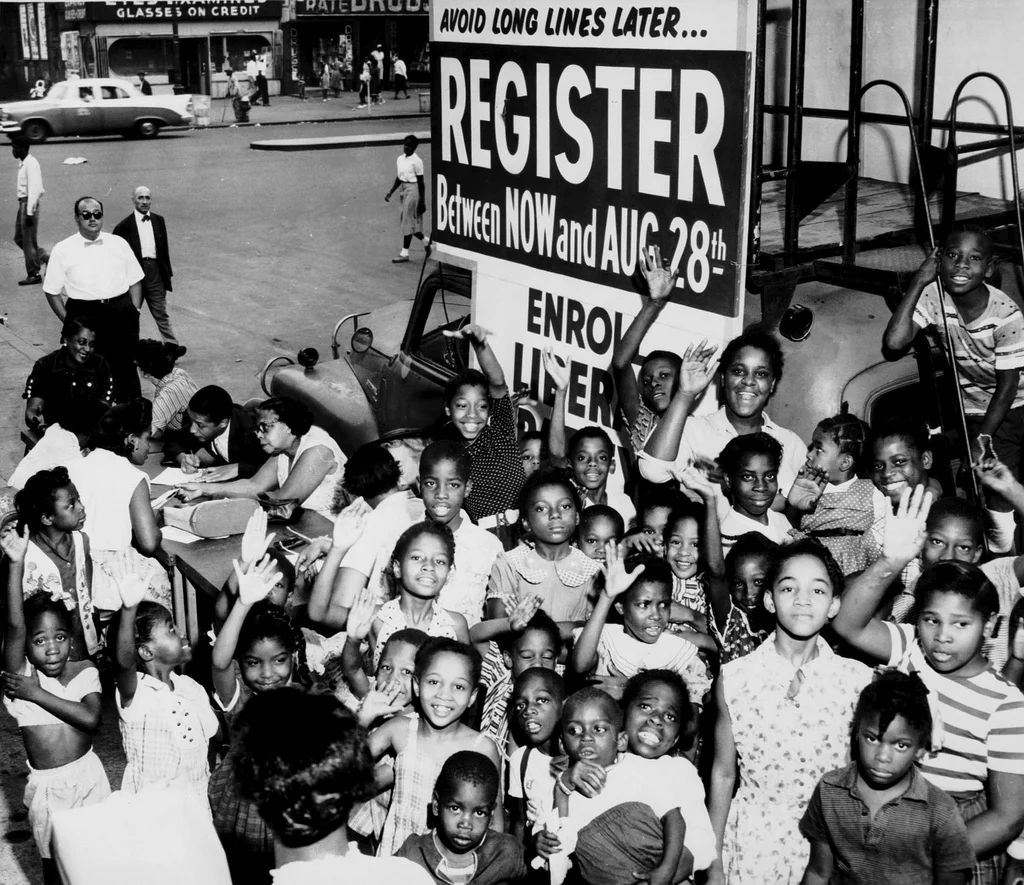
The Voting Rights Act of 1965 outlawed discriminatory voting practices that discouraged and disenfranchised Black and Brown peoples. It also mandated federal oversight and preclearance for election law changes in jurisdictions with a history of discrimination.
As the ACLU of Louisiana said, a court has allowed Landry “to suspend part of an election already in progress and disenfranchise voters who have already cast their ballots.”
Violence has followed decisions like this from the Court.
After the Civil War ended and slavery was abolished in 1865, Reconstruction governments for the first time allowed Black former slaves in the South a taste of self-determination. But decreasing exploitation threatened the interests of former slave owners and financial and industrial monopolies in the North – so the unelected highest court was used to deny the democratic rights of African people.
White supremacist organizations like the Ku Klux Klan used extreme violence and the Supreme Court enabled this anti-Black violence to thrive by systematically stripping away the federal legal protections that had previously been put in place. This is how the disenfranchisement of Black voters created a self-reinforcing cycle: violence suppressed the Black vote, and the Court’s rulings ensured that violence could go unpunished, which in turn fueled more violence and further disenfranchisement.
The Equal Justice Initiative (EJI) has documented nearly 6,500 lynchings of Black people from 1865 to 1950. The Supreme Court – complicit with reactionary state officials – has a history of establishing historic and very dangerous trends.
The EJI highlights a Louisiana case that set the precedent for the country:
In the Slaughter-House Cases of 1873, the Court used a false interpretation of the 14th Amendment, forcing Black residents’ claims of injustice – even those resulting in death – to remain in state courts dominated by white power structures, stripping away federal protection for Black people. In other words, they could only look for justice from the very state systems run by the people complicit in, or sympathetic to, the violence.
Then United States v. Cruikshank (1876) effectively decriminalized white supremacist murder through the Court’s interpretation of the Enforcement Act – gutting the act’s intent to defend and ensure democratic access to the ballot and public office. The case arose from federal charges against the perpetrators of the Colfax Massacre of April 13, 1873, in which as many as 150 Black men were murdered. This violence was explicitly about overturning an election and removing Black officials from local office, making it a direct attack on the political power of Black voters. (Eric Foner, “Reconstruction: America’s Unfinished Revolution,” 1988)
The Supreme Court overturned the convictions, ruling that the 14th Amendment only prohibited actions by the state, not private individuals. The Enforcement Act, which Congress had passed specifically to allow the federal government to prosecute civil rights violations as crimes, was rendered useless.
Black residents were now at the mercy of white terrorists, so long as the terrorists were private actors, not representing the state. The Justice Department immediately dropped 179 prosecutions in Mississippi. The signal to the South was unmistakable: racial violence to suppress Black rights would not be federally punished.
Today’s attack on the Voting Rights Act in Louisiana is again a test run to see whether it can be exported across the South. That has already happened in Tennessee, where the Legislature passed — and Gov. Bill Lee signed into law in May — a new congressional map that breaks Memphis, the largest majority-Black city in the South, into three districts, erasing the state’s only majority-Black district.
Justice Elena Kagan, dissenting from the April 29 Callais ruling, joined by Justices Sonia Sotomayor and Ketanji Brown Jackson, clarified the repercussions:
“The Voting Rights Act is — or, now more accurately, was — ‘one of the most consequential, efficacious, and amply justified exercises of federal legislative power in our Nation’s history.’ It was born of the literal blood of Union soldiers and civil rights marchers. It ushered in awe-inspiring change, bringing this Nation closer to fulfilling the ideals of democracy and racial equality. And it has been repeatedly, and overwhelmingly, reauthorized by the people’s representatives in Congress. Only they have the right to say it is no longer needed — not the Members of this Court. I dissent, then, from this latest chapter in the majority’s now-completed demolition of the Voting Rights Act.”
Black struggle was at the heart of winning the Voting Rights Act in Selma and Montgomery, and Black representation is the special target now because it’s a central part of every struggle of the working class in the U.S. The Supreme Court’s robes may give it an air of neutrality, but its record from Dred Scott in 1857 to Plessy v. Ferguson in 1896 to today’s rulings shows a different reality – with evidence of consistent actions to build white supremacy, slavery and disenfranchisement of oppressed peoples.
But the struggle did not stop there. The victory of establishing the Voting Rights Act of 1965, a product of the Civil Rights Movement, significantly contributed to the decline of lynchings of Black people and the elimination of Jim Crow laws. The movement’s forcing of the Department of Justice and FBI to investigate and prosecute racial violence with new federal laws challenging violent institutions of hate changed the paradigm. The impunity given to the Ku Klux Klan and other racist vigilante groups and white supremacists temporarily ceased. But the violence is again more enthusiastically encouraged by President Trump and the increased push towards fascism – which could not happen without the complicity and collaboration with the Democratic Party.
The solidarity of Black and Brown peoples with other victims of terror, colonialism and imperialism comes from a shared history of apartheid-like repression and occupation – like the denial of voting assistance to Spanish speakers and other non-English speakers.
Black activists, revolutionaries and intellectuals have long connected these struggles. Renowned author James Baldwin, born in Harlem – who faced systemic racism in the North – was a strong supporter of the Palestinian struggle against Israel’s occupation.
In “Open Letter to the Born Again,” published in The Nation on Sept. 29, 1979, Baldwin wrote:
“But the state of Israel was not created for the salvation of the Jews; it was created for the salvation of the Western interests. This is what is becoming clear (I must say that it was always clear to me). The Palestinians have been paying for the British colonial policy of ‘divide and rule’ and for Europe’s guilty Christian conscience for more than thirty years.”
When the living costs rise, while wages sink, and the military seems to soak up every last dime, the fight against fascism, the fight against genocide, becomes even more relevant to the daily lives of all working people.
The U.S. war on Iran had an immediate effect on inflation, driving up the cost of personal and commercial transportation. The wars on Cuba and Venezuela, along with military aid to Israel, add to the inflated ask of Trump’s $1.5 trillion military budget. The U.S. share of the world’s GDP was 50% after World War II and is now down to 26%, and U.S. manufacturing produces only 16% of the world total, while China’s share is double that.
The fastest-growing investment on Wall Street is in AI – used as a tool to cut jobs rather than expand production.
As unproductive military spending increases, the economy weakens. Health care, Medicare, food stamps, housing and education are sacrificed along with the living standards and lives of workers. Much of the value created by workers is going right into the pockets of the military-industrial complex. Elon Musk, a favorite of the U.S. military, is becoming the first trillionaire through his AI company and SpaceX.
The real cost of war is the lives of the school children in Iran hit by U.S. bombs and Israel’s acts of extermination against the children in Gaza; the cost of those dying from lack of health care – from the U.S. to the Global South due to the economic war of sanctions and IMF debt.
This is not sustainable, and our international solidarity – pushing against the immorality of the trillionaires and billionaires and their war against humanity – is the cure.
Join the Struggle-La Lucha Telegram channel