
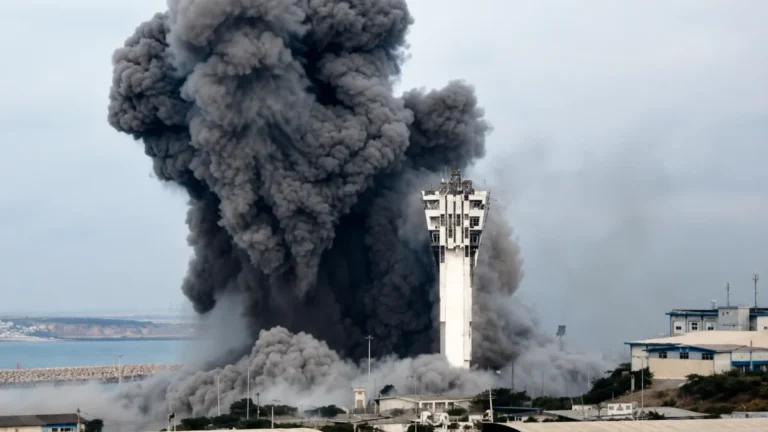
In the early hours of July 17, the Pentagon bombed bridges, water pumping stations, and a railway station, while also striking the civilian airport at Iranshahr and the control tower of Iran’s only deep-water ocean port. U.S. warplanes and missiles have hit Iran every night since July 11, when the bombing resumed after President Donald Trump tore up the June 17 ceasefire agreement.
‘We’re going to knock out all their power plants’
These strikes follow a deliberate blueprint laid out by the administration over several months. In a Fox News interview aired July 14, Trump vowed to hit Iran’s energy grid and bridges, saying, “We’re going to knock out all their power plants,” and threatening to destroy all of Iran’s bridges unless Tehran capitulated at the negotiating table.
This echoes earlier, more extreme rhetoric: War Secretary Pete Hegseth pledged in March to give Iranian troops “no quarter” — declaring that no quarter will be given, meaning surrendering troops will be killed, is itself a war crime under the Rome Statute. In April, Trump posted a threat of outright extermination: “A whole civilization will die tonight.”
The bombing has followed the script. Authorities in Iran’s southern Hormozgan Province said U.S. missiles struck electricity facilities and water pumping stations near the port of Jask. The seawater pumping station and power transformer at the Bunji desalination plant were “completely destroyed,” Hamzeh Pour, chief executive of the Hormozgan Water and Wastewater Company, told the Tasnim news agency, leaving 20 villages — some 10,000 people — without water.
U.S. missiles hit at least six bridges in the province, including the Gariveh Bridge on the route linking Bandar Abbas, Bandar Khamir and Lar — strikes aimed at severing the roads that connect Bandar Abbas, Iran’s main port, to the rest of the country. At least seven people were killed in the bridge strikes, Iranian state television reported; the Hormozgan Governor’s Office put the province’s dead at eight.
A railway station in Hormozgan Province was hit. And U.S. missiles struck the civilian airport at Iranshahr. Iran’s Energy Ministry asked residents of the south to conserve electricity as strikes strained the grid in extreme summer heat.
A U.S. strike near Shahid Baqaei Hospital, a children’s cancer center in Ahvaz, forced the evacuation of some 200 patients, including children in the middle of chemotherapy, Al Jazeera reported. Iranian Foreign Ministry spokesperson Esmaeil Baghaei called the attack “a cowardly war crime against the most innocent of human beings.”
At the port of Chabahar, U.S. missiles brought down the 60-meter Vessel Traffic Service tower that coordinated merchant shipping and rescue operations for fishing crews in the Gulf of Oman. Hegseth posted a photograph of the tower collapsing in smoke, gloating that “Iran does not control the SoH” — the Strait of Hormuz, 350 miles away.
Iran’s Health Ministry said the renewed strikes had killed at least 50 people and wounded more than 500 as of July 18. That is on top of roughly 3,500 Iranians killed in the first 39 days of the war launched Feb. 28 — a campaign of some 23,800 airstrikes that opened with a U.S. attack on an elementary school in Minab that killed 168 people, most of them schoolchildren.
These are deliberate attacks on civilian life. Washington is bombing the water, power, transportation and medical systems that millions of people need to survive. The aim is to make daily life impossible and force Iran to surrender. This is a campaign of open war crimes.
Blockade, tankers, invasion plans
Washington broke the June 17 agreement — a memorandum of understanding mediated by Pakistan — on July 2, when a U.S. naval convoy moved to seize control of the Omani side of the Strait of Hormuz. Iran reclosed the strait in response, and strikes on shipping began July 6. Trump declared the memorandum dead on July 8, notified Congress on July 10 that military action would resume, and the bombing restarted July 11. Iran’s negotiators say the memorandum is “suspended” by U.S. violations — Tehran has pointedly not declared it dead.
Trump reimposed the naval blockade of Iran on July 14. Within 17 hours of the blockade taking effect, the U.S. military said it had “redirected” two commercial ships. On July 15, a U.S. aircraft fired Hellfire missiles into the smokestack of the Belma, a Curaçao-flagged tanker sailing for Kharg Island, disabling the civilian vessel at sea.
The Wall Street Journal reported July 15 that Trump is leaning toward expanding the war after a White House Situation Room meeting the previous evening. The plans include sending U.S. ground forces to seize Kharg Island — Iran’s main oil export terminal — and other territory along the Strait of Hormuz. Reuters reported that U.S. officials describe the current bombing as “shaping operations” preparing the ground for more complex assaults. Retired Gen. Frank McKenzie, former head of Central Command, went on CBS to advocate seizing Iranian soil as a bargaining chip.
Iran has answered. On July 17 and 18, Iranian forces carried out their largest strikes of the war against U.S. military installations across the region. The Revolutionary Guard said it struck U.S. fighter jets and refueling aircraft at the Al-Azraq Air Base in Jordan. The Iranian military said its forces also struck an ammunition depot at the Al-Adire camp and ammunition storage, buildings and communications links at Ali Al Salem Air Base in Kuwait, as well as a warehouse of U.S. naval drones and an artificial-intelligence targeting center in Bahrain. A U.S. official cited by Axios said Iran also launched a ballistic missile at a U.S. base in Saudi Arabia.
Two U.S. service members were killed in Jordan and a third is missing in action, Central Command said, after Iranian ballistic missiles and drones struck U.S. forces there on July 17 — the attack Iran said targeted the Al-Azraq base. The Pentagon’s acknowledged death toll now stands at 16, with the Jordan deaths the first U.S. combat deaths since March. The real toll is higher. The Intercept has documented for months that the Pentagon’s casualty count is a gross undercount — what one U.S. government official called a “casualty cover-up” — with the official database missing hundreds of known casualties, at least one acknowledged death excluded from the rolls, and 15 wounded quietly deleted from the count in April without explanation.
Iranian strikes damaged a combined power-and-desalination plant in Kuwait, forcing the country to ration electricity. In the early hours of July 18, Kuwait closed its airspace and said two power and water desalination plants had been hit. Several Kuwaiti firefighters were wounded battling a fire started by the strikes. Kuwait draws about 90% of its drinking water from desalination.
The Revolutionary Guard declared on July 17 that the Strait of Hormuz remains completely closed. Reuters reported that Tehran has asked Yemen’s Ansarallah to stand ready to close the Bab el-Mandeb Strait if U.S. attacks on Iranian power infrastructure continue.
The war is failing — and the Pentagon hides the cost
The war is failing on its own terms. The Iranian government stands. Washington has failed to take command of the strait. The Pentagon is hiding the cost from the public. OMB Director Russell Vought told Congress on June 30, citing Pentagon figures, that the war had cost about $30 billion. Internal Defense Department estimates reported by NBC News put the real cost at $80 billion to $100 billion. The official figure counts only expended munitions. It leaves out more than $30 billion needed to rebuild U.S. bases damaged by Iranian retaliation, including $1 billion in Bahrain alone.
The Congressional Research Service reported in May that 42 U.S. aircraft had been damaged or destroyed, including F-15E Strike Eagles, an F-35, KC-135 refueling tankers and MQ-9 Reaper drones. By July, the Reaper toll alone had reached about 30, according to a U.S. official — at roughly $30 million each, approaching $1 billion in drones.
The U.S. war is also poisoning Iran for years to come. The Climate and Community Institute calculated that the first 14 days of bombing released 5 million metric tons of greenhouse gases. The March attack on Tehran’s oil depots sent black rain laced with hydrocarbons, sulfur dioxide and heavy metals over the capital. The bombing campaign also destroyed a desalination plant on Qeshm Island, cutting off water to 30 villages. Iran’s Energy Ministry says water distribution infrastructure — pumping stations and service reservoirs — was damaged at 388 locations across the country.
Trump threatens that next week “gets really bad” for Iran, again naming power plants and bridges as targets. The threat is an admission that the war has failed to force Iran to surrender. Iran continues to resist. Washington is answering that resistance by bombing the water, power, transportation and medical systems that civilians need to survive and by preparing a wider invasion. Every new attack adds to Washington’s war crimes and brings the region closer to a larger war.
Join the Struggle-La Lucha Telegram channel