
The parasite driving this summer’s massive foodborne illness outbreak has a unique quirk: it cannot spread directly from person to person.
Cyclospora cayetanensis requires a week or two in warm soil or water to become infectious. That biological delay acts as a smoking gun. It means the thousands of illnesses sweeping the country didn’t start in a restaurant kitchen or a grocery store aisle. Instead, the outbreak has to be traced backward to a common source — back to the fields, the packing houses, and the unsanitary conditions forced upon the workers who harvest the crop.
This summer’s cyclosporiasis surge grows from fields and packing operations. Michigan alone has recorded more than 3,700 cases since June, against the 40 or 50 it sees in a normal year. The CDC has confirmed cases in 34 states and is reviewing thousands more.
It enters the food chain wherever sanitation fails. It can enter through contaminated irrigation water. It can enter in the fields, where workers are denied a clean place to relieve themselves and wash their hands. It can enter later through the water used to wash or pack the crop.
Investigators have not yet established which route fed the current outbreaks. But every route runs through sanitation. Every route comes down to whether agribusiness spends the money needed to keep human waste out of the food chain.
And workers denied the power to demand those sanitary conditions are the same workers the government is driving out of the fields.
There is a federal sanitation standard, and it is a narrow one. A covered farm must provide one toilet and one handwashing station for every 20 workers, within a quarter-mile of the field.
But farms with 10 or fewer hand laborers are excluded. So are crews whose field work, including travel time, lasts three hours or less.
Farmworkers were written out of the basic labor law of the last century. The 1935 National Labor Relations Act gave industrial workers the legal right to organize and bargain and left farmworkers out by design — a Jim Crow-era carve-out that kept agriculture a low-wage preserve worked by those with the least power to fight back.
They fought back anyway. The toilets and clean water the law now nominally requires, farmworkers won from the growers themselves. Mostly Filipino and Mexican workers struck the Delano grape fields in 1965 and carried the fight to the whole country through the grape boycott.
In July 1970, they forced growers to sign the first union contracts of their kind in California agriculture. The union contracts put drinking water, toilets and handwashing stations in the fields. They barred growers from spraying pesticides while workers labored and required protective clothing against the poisons. A sanitary, non-toxic field was a union demand, won by strike and boycott, years before Washington put any of it into federal law.
Even where the rule applies, enforcement is another matter.
The U.S. Department of Labor states plainly that farmworkers who cannot wash their hands risk exposure to parasites and can carry contamination onto the crop. Government survey data show that undocumented workers and workers paid by the piece are among those least likely to have reliable access to toilets and clean water.
When a crew has no toilet and no clean place to wash, it is the grower who has put human waste within reach of the crop. The outbreak begins in the gap between what the law promises and what agribusiness provides.
Roughly 70% of hired crop workers are immigrants, most from Mexico and Central America. About 40% lack legal work authorization, according to federal figures.
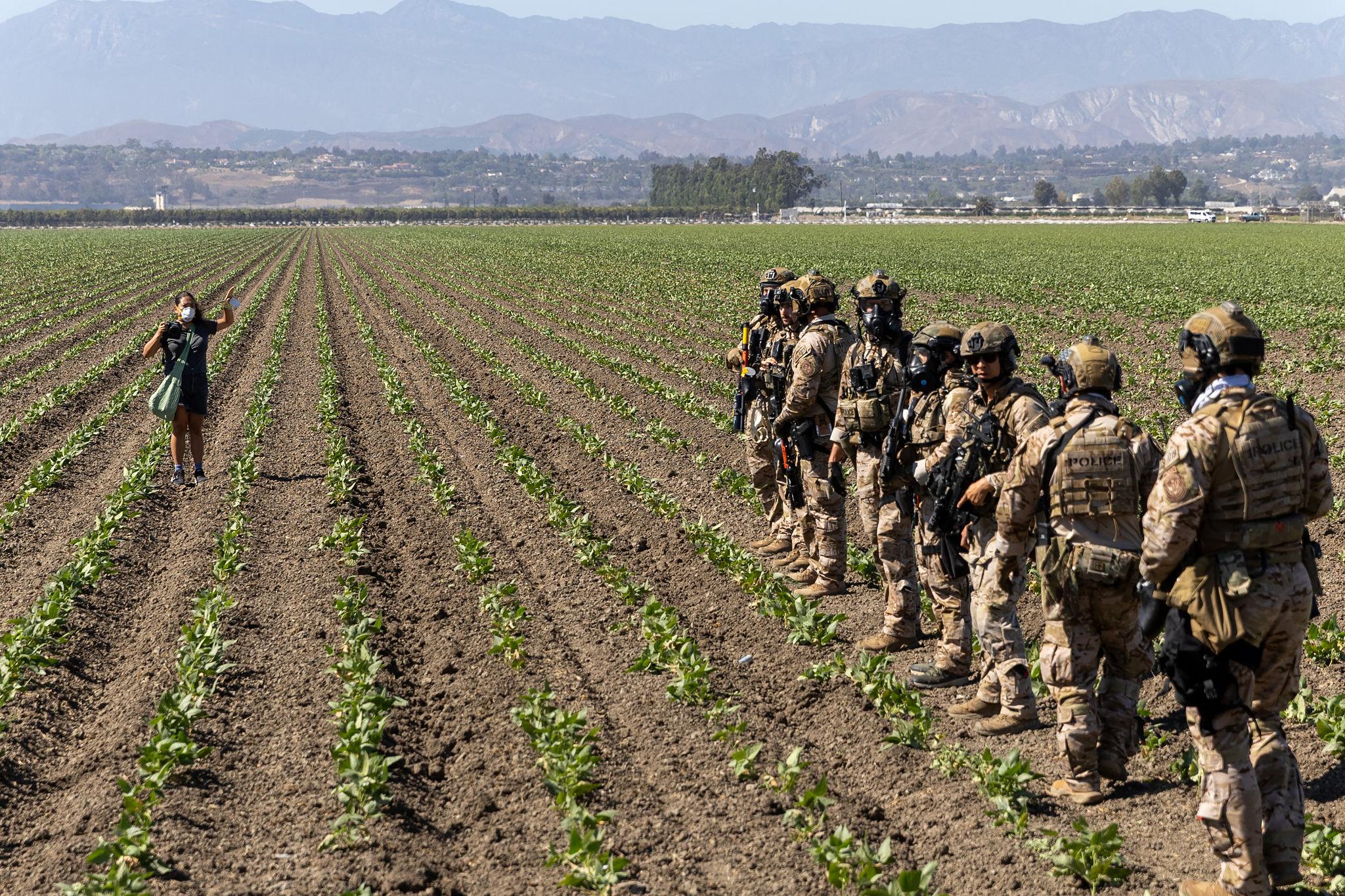
These are the workers the Trump administration has spent 2026 raiding and deporting.
Stephen Miller set a quota of 3,000 immigration arrests a day — a floor, he said, not a ceiling. ICE agents have raided farms and packing houses across California, the Midwest and the South. In parts of California, growers reported that as much as 70% of their workforce vanished after the raids.
ICE does not have to arrest every farmworker to control the whole workforce. Every raid warns the workers who remain what can happen if they demand higher wages, clean water or a toilet.
Workers describe agents chasing them through the rows. At least one worker has died trying to escape a raid.
Jaime Alanís García fell 30 feet from a greenhouse roof while trying to escape agents during a raid on a Ventura County farm in July 2025.
ICE terror makes the fields more dangerous.
A worker who knows that reporting an unsanitary field may bring ICE to the crew does not report it. A worker whose crew has been cut in half by raids is forced to harvest faster, with less time to reach a toilet, wash their hands or demand a break. A worker marked for deportation cannot safely challenge a grower who refuses to provide clean water.
The arrest quota drives down wages and sanitation standards by keeping the workforce frightened, divided and disposable. The same terror that keeps the workforce invisible in the fields ultimately obscures the true scale of the outbreak. Once the parasite reaches the lettuce, and then the consumer, the cycle of undercounting continues in our clinics.
The parasite then reaches people who eat the contaminated produce. But many who become sick never appear in the official count. Federal and state officials agree that the true toll is far higher than the reported numbers. The reasons are not mysterious. Testing for Cyclospora is expensive. Many laboratories do not routinely perform it. The parasite is shed intermittently, so one negative result proves nothing.
Many people are sick for days or weeks and make repeated visits before a doctor orders the test.
Everyone who rides out days of watery diarrhea — unwilling to lose a shift’s pay or face an emergency-room bill — never enters the count.
Michigan has reported more than 3,700 cases after maintaining Cyclospora surveillance and interviewing more than 1,000 patients. Other states are finding fewer cases in part because they are doing less testing and tracing. The official count shows where people are being tested, not everywhere the parasite is spreading.
Meanwhile, the federal government has weakened the system used to find where contaminated food came from.
Mass firings that began April 1, 2025, eliminated thousands of jobs at the FDA and CDC. Among the offices hit was the CDC’s Division of Parasitic Diseases and Malaria, whose work included cyclosporiasis. In July 2025, FoodNet made active surveillance for Cyclospora optional at its 10 participating sites, ending required tracking that had been in place since 1997. That makes outbreaks harder to detect and compare across states.
The government also delayed the rule designed to speed up those investigations. The FDA’s produce-traceability rule was meant to reduce the search for a contaminated grower from weeks to hours. It was supposed to take effect Jan. 20, 2026. After pressure from the food industry, the government postponed enforcement until July 20, 2028.
Investigators must once again trace contaminated produce by hand, one record and one phone call at a time — exactly the system the rule was written to replace.
Agribusiness is allowed to obscure the source of contamination just as it is allowed to obscure the conditions under which the crop was harvested.
Weeks into the outbreak, no grower, supplier or product has been named. Investigators are focusing on lettuce and other salad greens. Taco Bell has pulled some ingredients as a precaution, with no confirmed link.
Better government tracking only tells us who got sick; it does nothing to change the system. The outbreaks recur because agribusiness will not pay for sanitation, and the government will not make them. Instead, the state deploys armed agents to silence the workers who would demand a clean place to wash. That is the modern agricultural model: a terrorized, disposable workforce forced to keep harvesting.
A frightened worker cannot demand a clean field. History shows us what works. The toilets and clean water of the 1970s were won through strike and boycott. Only that organized power can make the fields safe for the workers — and the food safe for the rest of us.
Join the Struggle-La Lucha Telegram channel