
On May 5, Secretary of State Marco Rubio stood at the White House podium and announced what victory in the U.S. war on Iran now meant. “As President Trump has said,” Rubio told reporters, “the United States of America holds all the cards.” The goal, he said, was for the Strait of Hormuz to be opened “back to the way it was, anyone can use it, no mines in the water, nobody paying tolls.”
Read it again.
On Feb. 28, 2026, the U.S. opened Operation Epic Fury by assassinating Iran’s head of state, Ayatollah Ali Khamenei — an act of war meant to break Iran’s sovereignty. By May, the stated goal of the war had become reversing the consequences of the U.S. war.
That was more than two months ago. The strait remains under Iranian command. And the U.S. bombing has escalated beyond anything since the June ceasefire.
The one-day ‘rescue’
Rubio’s May 5 remarks introduced Project Freedom, which Washington called a rescue mission for nearly 23,000 civilian mariners aboard commercial ships in the Gulf. But the ships were not trapped for lack of a route — Iran and Oman had already designated a passage through the strait.
The problem was that the route was not under U.S. command. Project Freedom was an attempt to escort commercial vessels through Hormuz under Pentagon control instead. It lasted one day. Trump suspended it the same day, announcing “great progress” toward an agreement with Iran. The progress was fiction — Tehran was merely considering a proposal for talks.
Shipowners and insurers with billions at risk did not trust the U.S. Navy. They took Iranian missiles more seriously than Pentagon promises.
What the demand actually is
The clause Rubio tucked at the end — “nobody paying tolls” — gives the game away. The issue is command. The Islamabad Memorandum of Understanding (MOU) reopened the strait to commercial traffic along the route designated by Iran and Oman. Washington’s own negotiators signed that agreement. But the passage remained under Iranian command, and Iran, having declared the strait closed to the imperialist blockade fleet, has reportedly allowed passage to vessels that pay.
Washington is trying to replace that arrangement with a U.S.-backed corridor and collect its own charge for “security.” On July 2, a U.S. naval convoy moved to take control of the Omani side of the strait. That operation was no part of the memorandum. Iran stopped it and closed the strait again. On July 13, Trump announced that the U.S. would reinstate the naval blockade and seek “reimbursement” at a rate of 20% on all cargo because the U.S. military is “securing passage” through Hormuz.
Iran, an oppressed nation under attack, has dared to control passage through its territorial waters that the U.S. has treated as its own free road for generations. The empire’s answer is to seize the route, impose its own toll and call it freedom of navigation.
And in exchange for what? For nothing. Washington has already shown it cannot deliver a concession even when it signs one. General License X, the U.S. Treasury waiver that briefly permitted Iranian oil sales, was revoked less than three weeks after it was issued. Every future waiver now expires whenever the Treasury chooses.
Washington uses agreements as weapons, signing when that serves the U.S. war and discarding them when breaking them serves the war. China has drawn the lesson: Beijing invoked its anti-sanctions law and ordered its companies not to comply with U.S. sanctions on five refiners accused of buying Iranian oil.
This is the oldest pattern in Washington’s book. Between 1778 and 1871, the U.S. government signed some 370 treaties with Indigenous nations and broke them to seize the land. It has gone on breaking agreements ever since, tearing up arms-control treaties and walking out of the 2015 nuclear deal with Iran. In 1972, Indigenous activists marched on Washington to protest that record and named their caravan the Trail of Broken Treaties. The Islamabad memorandum joins the trail.
Rubio was demanding that Iran hand the strait to the U.S. military in exchange for promises Washington had already shown it would break. That was no basis for agreement — a demand for surrender under threat of a new attack.
The answer from the streets
That demand to surrender has been rejected — and the power behind the rejection rose from the streets after the assassination that opened the war.
The U.S.-directed strike on Feb. 28, 2026, assassinated Iran’s Supreme Leader, Ali Khamenei, along with four members of his family, including his 14-month-old granddaughter. The war planners believed they had decapitated the resistance on day one. Khamenei’s funeral proved them wrong.
The U.S. terror was not confined to the assassination. In the same opening wave, a U.S. missile strike massacred more than 175 people, most of them children, at Shajareh Tayyebeh Elementary School in Minab. Three missiles struck the school compound in rapid succession while classes were underway. The dead were mainly girls between the ages of 7 and 12.
In the opening weeks, U.S. strikes hit schools, hospitals, vaccine-production facilities, bridges, universities and residential neighborhoods with no credible military target, destroying civilian buildings by the thousands. It was a reign of terror meant to force Iran into submission. Iran answered with resistance.
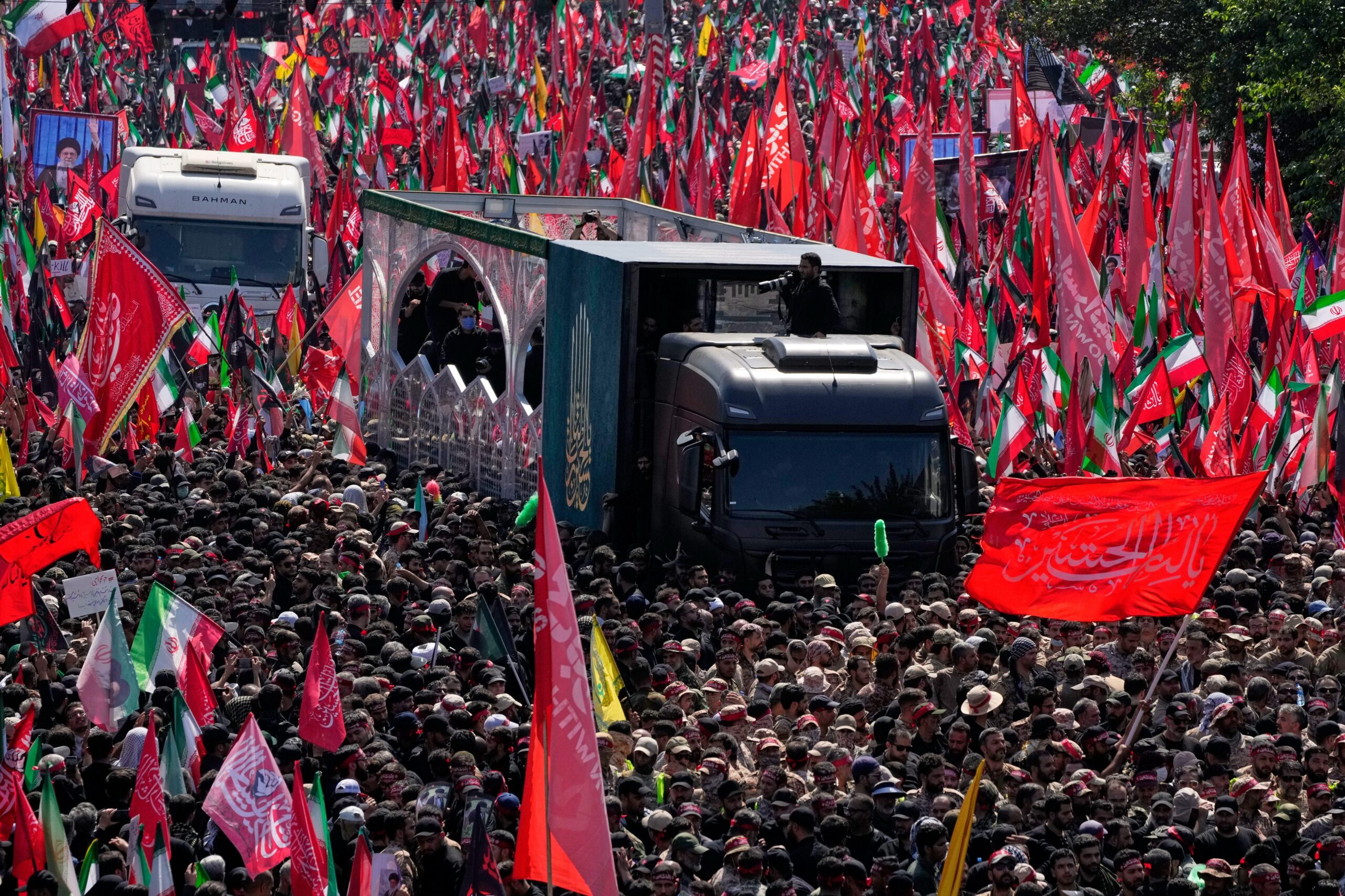
The U.S. war delayed Khamenei’s burial for more than four months. The mourning became a national mobilization. On July 4, Khamenei’s body lay in state at Tehran’s Grand Mosalla. While Trump spoke at Washington’s 250th-anniversary spectacle, mourners unfurled a red flag reading “O avengers of Hussein” — the Prophet’s grandson, killed at Karbala in 680 for refusing to submit to an unjust ruler and mourned by Shia Muslims ever since as a symbol of resistance to oppression.
On July 6, millions packed the procession route through Tehran to Azadi Square. The body traveled to Qom, Najaf and Karbala before burial on July 9 in Mashhad, his birthplace. “We will take revenge for the blood of our leader,” a 30-year-old mourner, Zahra Valaei, told Reuters. “We will not let it be trampled underfoot.”
This is what Washington’s war planners did not foresee. Even before the funerals, the June memorandum of understanding (MOU) had drawn protests in several Iranian cities accusing the negotiators of conceding too much. The marches settled it: a government that surrendered the strait would now face its own people.
The war managers set out to separate the Iranian state from the Iranian people. Instead the U.S. war brought millions into unified resistance. A nation fighting an imperialist war for its surrender cannot give up its strongest weapon, and the people of Iran have said so in the tens of millions.
Two months of ‘restoration’
Two months after Rubio promised to restore the strait “back to the way it was,” Washington was bombing Iran again and tearing up its own ceasefire. The renewed attempt to seize the strait widened the war beyond it, hitting the outer works of the Bushehr nuclear facility — a deliberate threat against a civilian power plant.
On July 12, Iranian forces struck the UAE-owned container ship GFS Galaxy after it abandoned the designated route and ignored orders to change course. The ship caught fire, and the crew abandoned it.
The U.S. answered with a third wave of strikes in a week. Iranian missiles reportedly struck U.S.-linked military targets in Oman, Qatar, Bahrain, Kuwait, Jordan and the UAE. Gulf energy infrastructure was hit for the first time since the June ceasefire.
War risk insurance premiums have surged again, maritime authorities are warning of a severe threat to shipping, and the strait remains under Iranian command.
The bombing showed what “back to the way it was” was worth. The objective announced on Feb. 28 — breaking Iran as an independent state — had not changed, but the war had cost the empire its free road through the Gulf.
That objective has not changed because the stakes have not changed. Wall Street has piled up debts and financial claims against the world’s labor, oil, currencies and budgets, and those claims can be paid only while the dollar rules world trade. Oil is central to that rule, and so is the Pentagon. When profit from production cannot cover Wall Street’s swollen claims, finance capital leans harder on debt, sanctions, oil and war.
The Strait of Hormuz is one place the dollar system is in crisis. Monopoly capitalism in decline cannot concede the Gulf, because conceding the Gulf means weakening the petrodollar, and weakening the petrodollar means weakening the empire.
The war machine runs short
The U.S. retreat also reflected limits inside its own war machine. In the 39 days before the April 7 ceasefire, the Pentagon used large shares of several critical missile stockpiles. U.S. arms factories cannot replace them at the speed the Pentagon fires them. The Pentagon can expend in weeks what U.S. factories need years to replace.
Trump’s June order invoking the Defense Production Act was an admission of the shortage, even though the Pentagon attempted to deny it. Decades of offshoring and profit-taking have hollowed out U.S. productive capacity. Wall Street can create mountains of debt and paper claims. It cannot manufacture missiles.
That shortage helped force the June retreat.
Washington lost the initiative
An army that retreats to rearm has not left the field, and no one should mistake a shrunken war aim for peace. It is the political packaging of the next assault, now in preparation.
By breaking its own ceasefire, Washington admitted the failure. The initiative passed instead to the millions who filled Iran’s funeral routes and to the resistance across West Asia that forced the June retreat.
Washington reloads. So does the resistance — it is stronger, and angrier, and more united than it was on Feb. 28.
Join the Struggle-La Lucha Telegram channel