
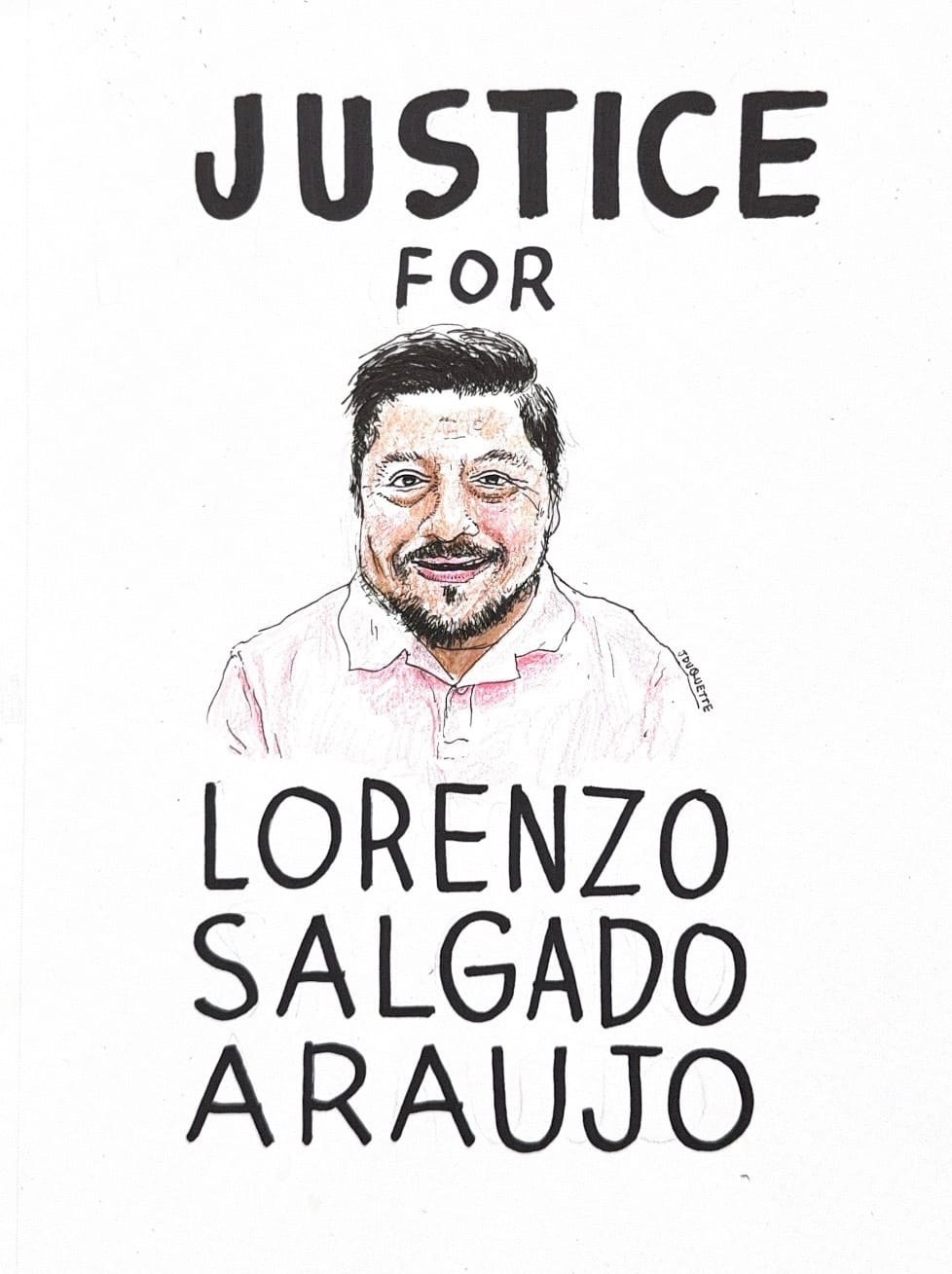
Before sunrise on July 7, Lorenzo Salgado Araujo stepped out of his Houston home, patted his dog goodbye, got into his work van and drove off to pick up his crew. He had made some version of that trip for 35 years, building houses across Houston, including the one his family lives in.
By 7 a.m., he lay handcuffed on Canal Street, shot through the abdomen by an ICE agent, crying out for help.
His oldest son, Ronaldo, a Houston schoolteacher, learned of the shooting from a Facebook video. “I recognized him immediately,” he said, “not from his appearance but from his voice, crying for help as he lay on the street bleeding out.”
Salgado Araujo was 52. He came to Houston from Mexico at 17. He and his wife raised three sons, all sent to college. He had no criminal record and was applying for legal residency, with Ronaldo, a U.S. citizen, as his sponsor.
ICE was not looking for him.
ICE did not shoot Lorenzo Salgado Araujo because he was a danger. ICE shot him because Washington had ordered a quota — 2,000 arrests a day — and that quota sent armed agents into Mexican working-class neighborhoods before dawn, hunting for bodies to fill the number.
Agents were staking out the block for two other men. Instead, they fixed on Salgado Araujo’s work van in Magnolia Park, one of the oldest Mexican working-class barrios in Houston. What brought him to their attention was where he was, who he was and what he looked like to them: a Mexican worker before dawn, driving to a construction job.
The Texas Civil Rights Project has demanded an investigation into racial profiling. But the community did not need an investigation to know what happened.
“I’m Latina, I’m Chicana, but that could easily be me, going down the street on the next block over,” Janie Torres, who lives in the neighborhood, told Houston Public Media after rushing to the scene.
Her citizenship offered no exemption. The terror is aimed at a people — the Mexican and Chicano people of the Southwest, an oppressed nation inside U.S. borders since the U.S. seized half of Mexico in 1848.
Construction is the most dangerous industry in Texas. A construction worker dies on the job in the state every three days — falls, heat, trench collapses, the ordinary deaths of an industry that runs on speed and cut corners.
Salgado Araujo survived 35 years of that. What killed him was a police quota set in Washington.
A quota with guns
Internal ICE documents obtained by the New York Times describe the surge ordered by the White House in late June. Strip away the agency language and they read like a bosses’ speedup order.
Management set a quota of 2,000 arrests a day. Eighty percent of ICE officers were assigned to making arrests. As many agents as possible were put on mandatory seven-day weeks. The deportation chief sent around a congratulatory email praising “remarkable operational results.”
ICE is a police agency of the capitalist state. But Washington drove it like a boss drives a speedup line.
Every worker knows what a speedup produces. In the packinghouse it is severed fingers. In the Amazon warehouse it is workers collapsing from heat because the rate will not allow a water break. When the speedup is imposed on armed agents hunting human beings, it is a construction worker shot through the passenger window of his van by an agent trying to make a number.
A Texas Tribune analysis of federal data obtained by the Deportation Data Project found that ICE arrests in Houston’s streets, homes and workplaces have more than quadrupled, rising to nearly a third of all arrests in the city.
Jails and courthouses could not produce the 2,000 arrests Washington demanded each day. To reach that number, ICE had to expand its street operations, sending agents out before dawn in unmarked SUVs to search neighborhoods like Magnolia Park on Houston’s Mexican and Chicano east side.
That is where Salgado Araujo was mortally wounded.
Caging the witnesses
What the state did after the shooting shows what it is protecting.
Three other men were in the van: Jose Trinidad Rojas, 51; Daniel Tirado Pantoja, 43; and Victor Salgado, 44, Lorenzo’s brother. The bullet was fired past Victor Salgado’s face. All three men were locked in the ICE jail in Conroe, Texas, and pressured to sign their own deportations.
From inside the jail, all three gave the Washington Post accounts published July 10. Their accounts agree: no agent was in front of or behind the van. The agents fired from the sides.
In a handwritten statement, Rojas wrote that the government’s claim that the van was used as a weapon “is a lie.”
As Lorenzo Salgado Araujo bled on the pavement, handcuffed, an agent taunted the men, Victor Salgado recalled through the family’s attorney: “Se querían escapar, ¿verdad?” You wanted to escape, right?
The shooter has not been named. The agents involved were moved out of Houston. They wore no body cameras. The FBI’s investigation is of the dead man, for “assault on a federal officer.”
ICE held the body, logged at the hospital as a John Doe after agents took his identification, and demanded biometric data from the family before releasing it.
The official story was ready-made: Salgado Araujo had “weaponized his vehicle.” The same story was issued after the killing of Renee Good in Minneapolis and the shooting of Marimar Martinez in Chicago. Both stories were destroyed by video.
Immigration agents have opened fire again and again during the current deportation surge, often around vehicles. At least 10 people have been fatally shot by ICE or CBP officers in Trump’s second term. Four have been killed in their vehicles; others, like Alex Pretti in Minneapolis, were shot down on foot. No agent has been charged.
The cover-up is larger than the protection of a few killers. The state is protecting its instrument.
A force expected to seize 2,000 people a day wants to hide from public scrutiny. Its agents need anonymity, impunity and witnesses too frightened — or too locked up — to speak. Free witnesses are dangerous to ICE because they can tell the neighborhood what really happened.
The prewritten lie, the caged witnesses, the shooter moved out of Houston, and the withheld body are how the state keeps its police agency running at quota.
The courts do their part. Fifteen anti-ICE protesters in the Prairieland case were just sentenced on June 23 and July 1 to a combined 556 years in prison, while every killer in federal uniform walks free.
Terror works on wages
The quota feeds the privatized detention industry that profits from it. It also does something more basic for the capitalist class: it holds down wages.
A University of Texas and Workers Defense Project study found that half of surveyed Texas construction workers were undocumented. More recent estimates still put the number in the hundreds of thousands. When Hurricane Harvey flooded 200,000 Houston homes in 2017, undocumented crews gutted the houses and put the city back together. The Workers Defense Project called them the second responders.
The construction industry cannot function without this labor. Neither can meatpacking, agriculture, food service and the other industries that employ millions more undocumented workers across the U.S.
The ruling class confronts a contradiction of its own making. It depends on these workers. It also threatens them every day with arrest and deportation.
Removing all 13 million undocumented people from the country would tear apart industries that profit from their labor. The bosses know it. Their industry associations say so openly.
But the threat of deportation is itself profitable.
ICE’s raids are one of the ways the capitalist state enforces the system of labor exploitation.
Undocumented construction workers in Texas earn an average of $3.12 an hour less than U.S.-born workers. One in four suffers wage theft, compared with fewer than one in 10 U.S.-born workers. Fewer than a third are covered by workers’ compensation in an industry that kills a worker every three days.
Raids, threats and the fear of deportation enforce that wage gap. Every contractor profits from undocumented labor.
Attorney Ysabel Lonazco in Utah described the mechanism after the June surge: her clients are now afraid to drive to the grocery store.
That terror is then used against every construction worker. A contractor who can threaten one section of the workforce into accepting unpaid hours, shorted checks, no workers’ compensation and dangerous conditions can use that same pressure against everyone on the job.
That is what national oppression does for the capitalist class. It divides workers by nationality and turns the oppression of one people into a weapon against every worker.
The bosses collect at both ends. The millions who stay work under the threat of raids and deportation. The tens of thousands the police seize are turned into revenue for private prison corporations, at an average of $187 a day. Inside the jails, the detained do the cooking, cleaning and laundry that keep the cages running — for $1 a day.
The strikers at Delaney Hall in Newark walked off those jobs in May and exposed the arrangement.
Texas has done this before
This national oppression has a birth certificate. The killing happened in Magnolia Park, and the ground itself holds the history — because the ground itself was stolen.
Before Texas was Texas, the land belonged to Indigenous nations: the Karankawa, Atakapa and Akokisa peoples of the Houston and Gulf Coast region, along with the Coahuiltecan and Caddo, the Comanche and Lipan Apache across the lands that became Texas. The Texas Rangers were organized in the 1820s and 1830s to clear them from it.
Mirabeau Lamar, the second president of the Republic of Texas, declared war on Indigenous nations. It would end, he said, only in their “total extinction or total expulsion.” Texas waged extermination campaigns against the Karankawa until they were driven from the coast.
Anglo settlers came into Texas as invited guests of Mexico and brought enslaved people with them in defiance of Mexican law, which abolished slavery in 1829. The 1836 secession that created the Republic of Texas secured, above all, the right to hold slaves. Texas remained slavery’s far western stronghold. For enslaved people there, freedom came late: Juneteenth marks June 19, 1865, when Union troops landed at Galveston and finally enforced emancipation — two and a half years after the proclamation, in the last corner of the Confederacy it reached.
Nine years after secession, the U.S. annexed Texas. President James Polk sent troops into disputed territory to provoke the war he wanted. Ulysses S. Grant, who fought in that war as a young officer, later called it one of the most unjust wars ever waged by a stronger nation against a weaker one.
The Treaty of Guadalupe Hidalgo was signed on Feb. 2, 1848, while U.S. troops occupied Mexico City. Mexico was stripped of more than half its territory. The lands stolen under the treaty became not only California, Nevada, Utah, New Mexico, but most of Arizona and Colorado, parts of Wyoming — and slices of the border areas of Oklahoma and Kansas.
Some 100,000 Mexicans and uncounted Indigenous people lived on the stolen land. No Indigenous nation was consulted.
The treaty promised citizenship and property rights to Mexicans who remained on the conquered land. But before the treaty was ratified, the U.S. Senate removed Article X, which would have specifically protected Mexican land grants. The promise was broken before the ink was dry.
Over the following decades, courts, taxes, fraud and the Rangers’ guns transferred the land to Anglo owners.
From 1915 to 1919, during the period Mexicans in South Texas named La Matanza — the massacre — Texas Rangers and Anglo vigilantes killed hundreds, by some scholarly estimates thousands, of Mexicans and Mexican Americans. The killings terrorized the living and sped the transfer of Tejano land to Anglo ranchers.
In the 1930s, during the Depression, the ruling class turned on people of Mexican descent as scapegoats. Roughly a million were expelled. About 60% were U.S. citizens. They were seized in raids on parks and hospitals and put on trains.
In 1954, the government launched an operation it named with a racist slur as its official title: Operation Wetback. Officials claimed a million removals, while the raids and terror drove many more out under threat.
That is the pattern. First the land is taken by war and extermination. Then the labor of the dispossessed is put to work. Employers recruit it when profits require it, deny it equal rights and turn to raids and expulsions whenever the ruling class needs a scapegoat.
The tools have changed. ICE now uses corporate surveillance databases, facial-recognition systems and drones where the Texas Rangers used rifles and posses. The function is the same: terrorize Mexican workers in Texas so that an entire workforce remains exploitable.
The street answered
The surge was designed to be invisible.
Homeland Security Secretary Markwayne Mullin promised a “less public-facing” campaign because the open raids of 2025 and early 2026 — Los Angeles, Chicago, Minneapolis — brought workers into the streets and made the operation politically expensive.
On July 8, the day after the killing, the people ICE meant to frighten were not afraid to protest at the spot where Salgado Araujo was murdered. They stood there by the hundreds. Candles burned on the pavement where agents had left him shackled.
They came from Magnolia Park and the east side. They knew the government’s lie before it was finished being told.
The League of United Latin American Citizens said what the neighborhood already knew: ICE has told this lie before — the driver as an attacker, the agent firing in self-defense — and video has knocked it down every time.
Join the Struggle-La Lucha Telegram channel