
On July 8, at the NATO summit in Ankara, Donald Trump declared the ceasefire with Iran “over.” Over the next two days, U.S. warplanes struck some 170 targets across Iran, including railway bridges carrying mourners to the burial of Ayatollah Ali Khamenei. Iran reported 14 people killed and answered with missile strikes on U.S. bases across West Asia.
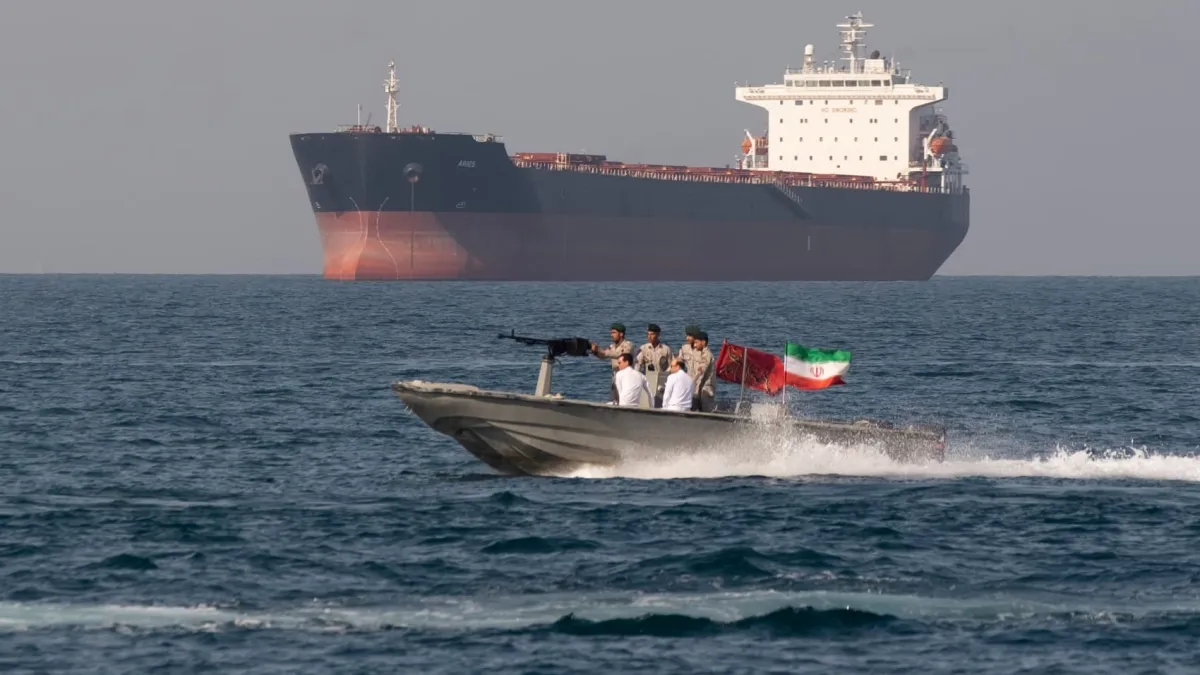
Washington launched Operation Epic Fury on Feb. 28, 2026, to overthrow Iran’s government and seize back control of the oil that the 1979 revolution took out of imperialist hands. Iran answered by closing the Strait of Hormuz, bottling up the Gulf’s oil, driving up shipping and insurance costs, and beginning to disrupt the movement of goods, money and profits through the world capitalist economy.
Washington had also seized billions of dollars belonging to Iran that were held in U.S.-controlled banks and financial accounts. Every government could see the warning: money held in the dollar system is money Washington can take.
Faced with a war that was damaging both the oil trade and the dollar system it was meant to defend, Trump retreated in June.
But a retreat is not a defeat, and no one should mistake one for the other. An army that retreats to rearm has not left the field. Secretary of War Pete Hegseth said as much, describing the pause as time for “reloading.”
Washington has not given up the war on Iran or any of its aims. It has shifted the war into a new phase — economic strangulation punctuated by periodic bombing — while it rebuilds its munitions stockpiles, refills its oil reserves and waits for better conditions.
Washington has run this play before. It ran it against Iraq for 12 years.
One war, two invasions
The U.S. war against Iraq is usually remembered as two wars: the Gulf War of 1991 and the invasion of 2003. It was one war.
The first phase opened on Jan. 17, 1991, when the U.S. began 42 days of bombing that destroyed Iraq’s electrical grid, water treatment plants and industrial base. The ground war drove Iraqi forces out of Kuwait and restored the al-Sabah oil monarchy, which British imperialism had carved out of Iraq and placed under its protection. But Kuwait was only the immediate battlefield. Washington’s larger objective was to break Iraq, reverse the 1958 revolution and the 1972 oil nationalization, and restore imperialist control over the region’s oil.
George H.W. Bush did not march on Baghdad in 1991. Washington had restored the Kuwaiti monarchy, devastated Iraq and created the conditions for a prolonged siege. It postponed the overthrow of the Iraqi government; it did not abandon it.
Washington evidently expected that the Iraqi government would fall under the weight of the economic war that followed. It did not fall. So the siege went on.
The sanctions imposed on Aug. 6, 1990, were kept in place for more than a decade, cutting Iraq off from food, medicine, water-treatment chemicals and spare parts. U.N. researchers attributed hundreds of thousands of deaths of Iraqi children to the sanctions regime. On CBS’s “60 Minutes” on May 12, 1996, Lesley Stahl asked U.S. Ambassador to the U.N. Madeleine Albright: “We have heard that a half million children have died. I mean, that’s more children than died in Hiroshima. And, you know, is the price worth it?” Albright answered: “I think this is a very hard choice, but the price — we think the price is worth it.”
Alongside the starvation came the bombs. U.S. and British warplanes patrolled “no-fly zones” over most of Iraq and struck throughout the 1990s. The bombs were meant to disable and destroy the infrastructure that the sanctions prevented Iraq from rebuilding — power stations, communications systems, transportation networks and water facilities. The pretext was always the same: Saddam Hussein was supposedly obstructing U.N. weapons inspections.
Washington bombed when it suited Washington’s timetable. In August 1998, Albright, by then the secretary of state, promised force “on our timetable” and at a time and place of Washington’s choosing. Bill Clinton chose Dec. 16-19, 1998, launching Operation Desert Fox — four days of bombing Iraq just as the House of Representatives was preparing to vote on his impeachment.
Then, on March 20, 2003, under George W. Bush, the U.S. invaded and marched into Baghdad. Twelve years of siege had done their work. Iraq’s army, economy and society had been hollowed out. The invasion shattered what remained, and the occupation set off a civil war that broke up Iraq as an independent state.
Two presidents from one family, three administrations of both capitalist parties, 12 years of “peace” that killed more Iraqis than the bombing did.
One war.
The retreat of 1991 was the preparation for the invasion of 2003.
Iran, 2026: the retreat and the reloading
The first phase of the U.S. war on Iran killed between 3,500 and 6,000 Iranians and wounded more than 26,000, according to estimates reported in Western media. The Pentagon admits to 13 U.S. troops killed and 425 wounded, figures almost certainly understated. The direct cost to the U.S. treasury passed $103 billion in the first 120 days.
The war failed to break the Iranian government or seize control of Iran’s oil. Iran answered by closing the Strait of Hormuz, creating the economic pressure that helped force Washington’s retreats in April and June.
Now the reloading phase is underway. Its methods resemble the war on Iraq in the 1990s: blockade, sanctions, negotiations under threat and periodic bombing. But Iran enters this phase with military, economic and geographic advantages Iraq did not possess.
Since the June ceasefire, the U.S. has carried out repeated air and missile strikes while threatening a ground invasion to seize Kharg Island, Iran’s oil-export hub, and pressing forward with the naval blockade of Iranian commerce and the sanctions that lock up Iran’s money.
The July strikes on Iran’s railways tell the story of the phase now opening. U.S. bombs hit a rail bridge 34 miles from Mashhad on the route carrying mourners to Khamenei’s funeral, and another bridge in Golestan Province on the rail line linking Iran to Turkmenistan.
The targets indicate that Washington intends to bomb the infrastructure that allows Iran’s economy to function under blockade conditions. That is the Iraq sanctions logic, updated for a country that, unlike Iraq in the 1990s, has land routes to China, Russia and Central Asia that no naval blockade can close.
As in Iraq, the periodic bombing runs alongside “negotiations” that Washington treats as another weapon. The Memorandum of Understanding deferred every major question — the strait, sanctions and Iran’s frozen funds — and Washington now bombs and talks at once, offering technical discussions with one hand while striking railway bridges with the other.
Iraq’s repeated confrontations with U.N. weapons inspectors were used by Washington throughout the 1990s as the pretext for keeping sanctions in place and launching new bombing raids. In December 1998, the U.N. inspection commission withdrew its teams from Iraq. The United States and Britain then launched Operation Desert Fox, four days of bombing.
Iran holds far stronger cards.
Commercial traffic continues to use the route controlled by Iran while largely avoiding the U.S.-protected corridor on the Omani side. Qatar — host of Al Udeid Air Base, the forward headquarters of U.S. Central Command and the largest U.S. military base in West Asia — has slowed expansion of Ras Laffan, the giant gas complex that makes it one of the world’s biggest exporters of liquefied natural gas. Every tanker leaving Ras Laffan must pass through the Strait of Hormuz. Washington cannot guarantee safe passage even for the state that houses its regional war command, and Asian gas prices remain far above prewar levels.
Iran therefore still holds the weapon that helped force the June retreat: the ability to interrupt the oil and gas traffic on which imperialist profits and allied economies depend. Those pressures have not gone away.
Not one man’s war
The imperialist industry explains all this through Trump. He is flailing, they say. Nobody fears him. He lacks the stomach for a long war. Anonymous officials tell reporters they are betting their savings against an invasion.
The Iraq record answers this.
George H.W. Bush “lacked the stomach” for Baghdad in 1991, by the same logic. The war continued for 12 years anyway and finished under a different president.
The retreat-and-reload pattern is not the temperament of one man in the White House. It is an operating method of the imperialist state in the global class war. Whatever flag a war flies, its real content is class content. Iraq nationalized its oil on June 1, 1972. Iran’s oil was nationalized in 1951, seized back by the CIA coup of 1953, and taken out of imperialist hands for good by the revolution of 1979.
Washington’s answer to the revolution was economic war. The first U.S. sanctions on Iran were imposed on Nov. 14, 1979, when Jimmy Carter froze $12 billion in Iranian assets. In the 46 years since, the sanctions have never been lifted — only layered, extended and tightened, under every administration of both capitalist parties, strangling Iran’s economy and imposing hardship on a whole people. The blockade and sanctions of 2026 escalate a siege already 46 years old.
Both wars are wars of the U.S. ruling class to recapture control over oil and territory taken out of imperialist hands, and to break every state and people that stand outside its command. The course of these wars is set by the needs of monopoly capital, not by the whim of any president.
The same imperialist offensive extends far beyond Iran. The Jan. 3 operation that kidnapped Venezuelan President Nicolás Maduro and Cilia Flores placed Washington in direct command of Venezuela’s oil revenues and freed its hands for the assault on Iran. The siege against Cuba and the demand to annex Greenland are other fronts in the same drive for energy, territory and control.
Neither the ceasefires nor the Memorandum of Understanding ever ruled out a far bigger U.S. attack on Iran in the future — perhaps under a Democratic president, in a more favorable economic and financial position.
That is exactly what the retreat of 1991 turned out to mean for Iraq: the siege, then the march to Baghdad.
Iraq shows that a ceasefire does not end an imperialist war. Sanctions, blockades, sabotage and periodic bombing are the war continuing by other means. They weaken the targeted country and prepare the next assault. The anti-war opposition in the United States must oppose the siege now, the bombs now and the rearmament already underway.
Join the Struggle-La Lucha Telegram channel