
In the first week of July 2026, a heat dome settled over the central and eastern United States. Heat indexes reached 115 degrees. More than 185 million people were under heat alerts, and more than 30 people died before the heat broke. The real count will rise, because heat often kills through the heart, kidneys and lungs and is recorded as something else.
Millions of people were told to stay indoors. Delivery workers were sent into the streets.
That is the app economy’s business model in physical form. When the weather becomes dangerous, those who can afford to stay inside order food, groceries and medicine. The app companies protect their profits by making dangerous weather part of the workers’ jobs: they send workers into the heat, pay them by the delivery and then deny that those workers are their employees.
In New York City, an estimated 65,000 app delivery workers ride e-bikes and mopeds for DoorDash, Uber Eats, Grubhub and the grocery apps. They worked as heat indexes were forecast to reach 105 to 110 degrees, during what city officials warned could be one of New York’s hottest days in more than a decade.
During an earlier heat emergency, one Brooklyn courier told Grist that delivery demand rises exactly when everyone else stays home: “that’s when the demand for our jobs is the highest.” A DoorDash worker in Phoenix told Inside Climate News that the job felt like “standing in an air fryer or a microwave.”
The app companies sell convenience by making workers absorb the danger.
The apps call this flexibility. In reality, the algorithm sets the pace. It assigns the order, sets the delivery window and times every leg. A courier overheating in a triple-digit heat index cannot simply stop in the shade for 20 minutes. The app registers delay. Delay can mean lower pay, fewer orders or deactivation.
The app is the foreman. DoorDash, Uber Eats, Grubhub, Instacart and the other delivery giants are not neutral technology companies. They are for-profit corporations using code to control labor while denying responsibility for the workers who make their money. Their code does not recognize heat.
That is why bargaining over the algorithm is not a technical demand. It is a survival demand. The same app that sets the pay also sets the pace that drives the worker into danger.
The workers sent into that heat are not random. In New York City, the delivery workforce is heavily immigrant, Black and Latine. Many are pushed onto the apps because stable jobs with contracts, benefits and workplace protections are closed to them.
The algorithm reads that need. It uses opaque formulas to set pay, routes and timing, and it drives down pay for the workers with the fewest options. First, the labor market shuts workers out of protected jobs. Then the app sends them into deadly weather for the lowest possible wage and the highest possible profit.
The app companies call these workers independent contractors, not employees. That classification is the legal trick at the center of the business model. The companies control the job through the app — the pay, the order, the route, the delivery window and the threat of deactivation — while denying that they are employers.
That is what misclassification means. It is usually discussed as a wage question. In deadly heat, it becomes a question of who has the power to stop work, take shelter and live.
Outside the law by design
The federal government has never issued a workplace heat standard. It failed to act when federal health officials recommended one in 1972. It still has not acted after more than half a century of rising temperatures, longer heat seasons, hundreds of recorded heat deaths on the job and tens of thousands of heat injuries. The official numbers are undercounts.
OSHA proposed a heat rule in 2024, more than half a century after federal health officials first recommended one. Hearings ended in 2025. The Trump administration has not finalized it. Business groups are trying to weaken it or kill it.
In April 2026, the administration let OSHA’s heat inspection program expire, then reissued it two days later without the numerical inspection goals. The agency that never wrote the standard now runs a heat program with no commitment to a number of inspections.
But even if the rule were signed tomorrow, it would still leave out the workers the app companies classify as independent contractors. The Occupational Safety and Health Act protects employees. The app companies classify couriers and drivers as independent contractors. That is the category the platform bosses spent more than $200 million to enforce in California through Proposition 22.
The employer has not disappeared. DoorDash, Uber Eats, Grubhub, Instacart and the giant grocery-delivery corporations still control the job. They set the pay, assign the order, impose the delivery time and cut access to work when the app’s schedule is not met. But the independent-contractor label lets them deny being the employer responsible for wages, breaks, workers’ compensation or protection from deadly heat.
The companies built that escape hatch on purpose.
Several states have gone further. They have not merely failed to protect workers. They have outlawed protection. Texas passed the preemption law opponents call the “Death Star,” wiping out Austin and Dallas ordinances that required 10-minute water breaks every four hours for construction workers. Florida barred every city and county from adopting its own heat protections, killing a Miami-Dade measure that would have required water, shade and rest for hundreds of thousands of outdoor workers.
The bosses oppose heat standards because standards limit profit and control. They want the power to keep people working through deadly heat.
The ceiling of the emergency plan
A social-democratic mayor heads the capitalist New York City government. Electing him to City Hall shows what workers and oppressed people want. It does not change the class character of the government.
During the July heat wave, Mayor Zohran Mamdani’s administration activated an emergency heat plan, opened cooling centers, dispatched cooling vans and set up pop-up cooling stations with water, misting fans and towels for outdoor workers — street vendors, day laborers and deliveristas. It expanded the program from two stations to seven.
Seven stations, for a delivery workforce of 65,000, in a city with hundreds of thousands of outdoor workers.
Mamdani’s administration contacted 75,000 businesses to “encourage” heat illness plans and remind workers they can use Protected Time Off for heat-related illness. The June 22 executive order recognized the danger facing outdoor and indoor workers, including gig workers and day laborers. But recognition is not protection. Guidance is not an enforceable heat standard.
Some of these measures will save lives. But encouragement, guidance and seven misting stations show the limit of capitalist government itself. City Hall, the state legislature and the federal regime are all built to protect the employer’s control over the workplace.
Mamdani himself named the problem at a June 30, 2026, briefing: “Workers cannot cool down when they have quotas to meet.”
City Hall can hand out water. It cannot make DoorDash stop the clock. That is the limit of capitalist government — and why the workers need organization of their own.
The federal government showed which side it stands on. On July 4, with heat indexes above 110 degrees, the Trump administration went ahead with its Salute to America 250 celebration on the National Mall. Its own Weather Service was warning that the heat was dangerous. The administration held the celebration anyway.
D.C. Fire and EMS later reported 96 patient contacts and 40 transports from the National Mall. More than 700 people received medical attention there over the holiday events. People were carried away on stretchers while the patriotic show went on.
The same limit appears in the companies’ own heat response. The platforms offered weather advisories and asked customers to tip more. Grubhub said during a June 2025 New York heat emergency that it encourages couriers to “exercise caution and take breaks when needed.”
But an unpaid break on piece rates is not protection. A tip suggestion is not hazard pay. A weather alert from the same app enforcing the delivery window is not safety. When the weather becomes dangerous, the companies are not required to slow the pace, guarantee paid breaks or pay a higher wage. They leave the worker to choose between stopping in the heat and losing income, or continuing to ride so the order gets delivered.
The only standard that holds
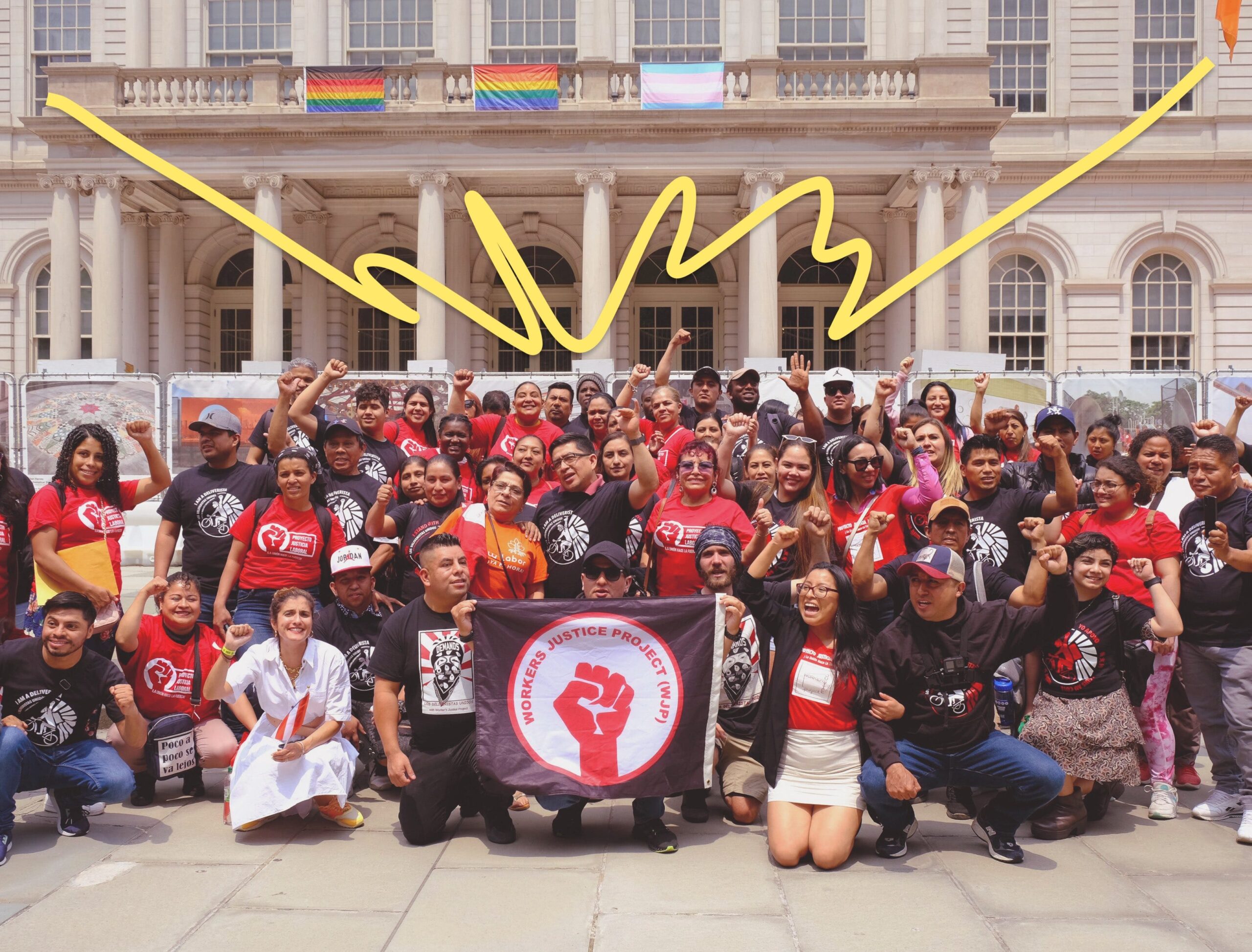
The real answer has already begun in the same workforce the companies said could not be organized. Los Deliveristas Unidos, built by largely immigrant couriers themselves, forced New York City to open the platforms’ confidential records and won the country’s first minimum pay rate for app delivery workers. That rate covers working time, including waiting time.
The organizing created the law, and the law gave the city something to enforce. On Jan. 30, 2026, the Mamdani administration announced a $5.2 million settlement with Uber Eats, Fantuan and HungryPanda for violating the minimum pay rate, with Uber agreeing to reinstate workers deactivated by the algorithm between December 2023 and September 2024 — as many as 10,000 people. City Hall signed the settlement. The workers made it possible. Before the couriers organized, there was no pay rate to violate, no deactivation protections to invoke and no confidential records opened to inspection.
The New York City couriers are not alone. On May 22, 2026, Massachusetts certified the App Drivers Union as the exclusive bargaining agent for nearly 70,000 Uber and Lyft drivers — the first recognized rideshare union in the country, and what labor leaders called the largest private-sector organizing victory since Ford autoworkers unionized in 1941. The drivers won it while still classified as independent contractors, the same category the heat rule would leave uncovered.
Scattered couriers in Los Deliveristas Unidos cracked open the pay formula in New York. Scattered drivers organized industry-wide in Massachusetts. The bosses’ claim that app workers cannot act together as a class is already broken in practice.
The heat is not finished. July and August still lie ahead. The couriers who worked through the first deadly heat wave will be back on the street for the next one, and the one after that.
The danger is not the same as it was in 1972, when federal health officials first recommended a workplace heat standard. The heat problem has grown worse. U.S. cities now face heat waves more often, for longer seasons, and with more dangerous humid heat days than they did half a century ago. The bosses and the government knew the danger then. They have had more than 50 years to act. They still have not produced a federal standard.
This is not an accident. It is how capitalism meets climate disaster: fossil fuel profits protected, app profits protected, and the workers’ bodies treated as a cost of doing business. Climate change has made the heat more dangerous. The app economy has made more workers carry it order by order.
A federal heat standard was recommended in 1972. It still does not exist. The temperature is not pending. Workers whom the law refuses to recognize as workers have already begun acting as a class. That is the only standard that has ever held.
Join the Struggle-La Lucha Telegram channel