
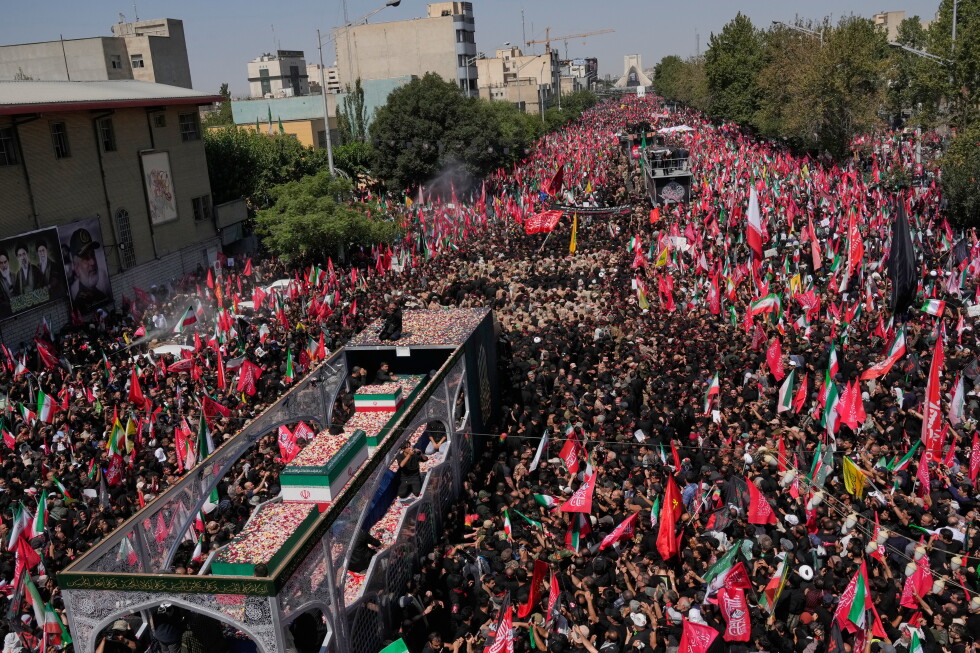
The coffin moved slowly. It had to. The funeral procession for Ayatollah Ali Khamenei, set to cross central Tehran on July 6, was rerouted and shortened because the crowds were too dense for it to pass. Mourners arrived by car, motorcycle, bus and on foot from every province. Along the route, workers hung an effigy of Donald Trump from a crane.
Khamenei was assassinated on Feb. 28, 2026, in the opening minutes of the U.S. war on Iran, when Washington and its forward base in Tel Aviv launched what the Pentagon calls Operation Epic Fury. The strike also killed members of his family — among them his 14-month-old granddaughter, Zahra Mohammadi Golpaygani.
Iran’s Health Ministry estimates some 15 million people will take part in the funeral ceremonies, the Tasnim News Agency reported. The ceremonies began July 4 with the body lying in state at the Imam Khomeini Grand Mosalla and will conclude July 9 with burial at the Imam Reza shrine in Mashhad, after processions through Qom and Iraq’s Shiite holy cities.
Several million joined the July 6 procession alone, according to the IRNA news agency, along a route stretching some 12 miles through the capital. The 1989 funeral of Ayatollah Ruhollah Khomeini drew an estimated 10 million people, IRNA has reported — a figure this week’s mourning stands to surpass, making it one of the largest funeral gatherings in recorded history.
The capitalist press has strained to explain the crowds away as state stagecraft. The workers and farmers filling Tehran’s avenues in July heat, misted with water hoses to keep from collapsing, tell a different story. They are mourning their dead. The United States gave them a great many dead to mourn.
The children of Minab
Among the martyrs honored this week are the children of the Shajareh Tayyebeh girls’ elementary school in Minab, in Hormozgan province near the Strait of Hormuz. On the morning of Feb. 28 — a school day, during Ramadan — U.S. missiles struck the school roughly an hour into the first wave of attacks. Witnesses and Red Crescent medics describe a “double tap”: after the first strike, the principal moved surviving students into a prayer room and called parents to collect their children. Then that shelter was hit.
Iranian judicial and education authorities counted 168 dead — most of them schoolchildren, along with teachers and parents who had rushed to the school. Authorities published portraits of 119 murdered children.
The evidence of U.S. responsibility is overwhelming, and much of it comes from Washington itself. Footage from the scene, geolocated by Bellingcat and BBC Verify, shows a U.S. Navy Tomahawk cruise missile — a weapon Iran does not possess. Gen. Dan Caine, chair of the Joint Chiefs of Staff, briefed reporters in the war’s first week that U.S. forces held responsibility for strikes across southern Iran, where Minab sits. The Pentagon’s own investigators concluded in their preliminary inquiry that the United States carried out the strike.
Human Rights Watch’s analysis of satellite imagery found at least seven impact sites in the compound. The strikes were centered on buildings — including the school and a medical clinic, places no army can honestly call military targets.
A United Nations investigation opened March 17 continues, and UN High Commissioner for Human Rights Volker Türk told the Human Rights Council on March 27 that there must be justice for the harm done. More than four months after the massacre, the Pentagon has released no findings, accepted no responsibility and published no list of the dead.
Trump’s account of the massacre has moved from denial to contempt. In early March, he told reporters that in his opinion Iran itself had fired the missile — a Tomahawk, a U.S. Navy weapon Iran does not possess. By June 17, asked at the G7 summit in France whether anyone would be held accountable, he had retreated to a shrug: “Mistakes are made; war is nasty.” He said nobody had done it on purpose and referred the question to War Secretary Pete Hegseth.
On March 3, thousands filled a public square in Minab for the mass funeral of the schoolchildren, as excavators cut more than a hundred graves at Hermud cemetery. One mother called the attack “a document of American crimes.”
That is the war the imperialist media asks Iranians to forget while Washington demands terms at the negotiating table.
Trump sneers at Iran’s dead
Trump’s response to the largest funeral in modern history has been open contempt. Speaking at Mount Rushmore on July 3, he sneered that Iran was desperate to settle and that Washington had granted “a week off for a funeral, because we’re nice.” On July 6, as millions marched past the hanged effigy of him in Tehran, he declared in the Oval Office that the U.S. had militarily destroyed Iran.
The boast collides with reality in the Strait of Hormuz. In the early hours of July 7, Iranian anti-ship missiles struck tankers using the U.S.-backed transit route on the Omani side of the Strait of Hormuz, penetrating round-the-clock U.S. air cover that costs an estimated $1 million an hour to maintain. Iran can still close the Strait of Hormuz. Washington has not destroyed its military.
Meanwhile Israel’s war minister, Israel Katz, publicly threatened the new Supreme Leader, Mojtaba Khamenei, with assassination. The younger Khamenei, severely wounded in the Feb. 28 strike that killed his father, has not appeared in public. Tehran closed its airspace during the funeral against the threat of a U.S. attack on the mourners themselves.
The masses answer Washington
The demand for justice and vengeance has filled the week, from the streets up. Mourners along the procession route carried red banners addressed to the “avengers of Khamenei,” a phrase reaching back to the seventh-century martyrdom of Imam Hussein at Karbala. “The killers of Khamenei must face punishment,” a 38-year-old mourner told AFP at the July 5 prayers. Iran’s army chief, Maj. Gen. Amir Hatami, pledged at the ceremonies that the nation “will never cease” in its pursuit of justice for the crime, Press TV reported. Parliament Speaker Mohammad Bagher Ghalibaf, Iran’s chief negotiator with Washington, saluted the millions in the streets as proof of an invincible nation.
The meaning is clear. Any Iranian leader who might have feared the domestic cost of prolonged confrontation with the United States has now stood before the largest mass mobilization in the country’s history — a public that has absorbed assassination, massacre and economic siege and answered by filling the streets to demand justice. That is a mandate to concede nothing. It is not a mandate from parliament alone, but from the streets. Every U.S. calculation that bombing would bring Iran to the table on its knees has been buried this week alongside the martyrs.
Indirect talks in Doha were paused for the funeral. The memorandum of understanding governing the partial reopening of the Strait of Hormuz expires Aug. 15. Washington entered this war promising a quick decapitation. It assassinated a head of state, bombed a girls’ school and killed thousands. Washington produced the opposite of what it wanted. Iran’s people buried their dead together and came out of the graveyards angrier than they went in.
This is the oldest lesson of the global class war. The Pentagon can murder a leader. It cannot murder a people. Every empire that has bombed a nation into mourning has discovered that mourning is where resistance is organized. Vietnam taught Washington this. Korea taught it before that. The peoples of West Asia have been teaching it again for two decades.
The millions in Tehran’s streets were not summoned by any decree. They were summoned by Tomahawk missiles, and they will be heard from.
Join the Struggle-La Lucha Telegram channel