
The Supreme Court closed its term by showing how the capitalist state works.
On June 30, the court struck down Donald Trump’s executive order denying birthright citizenship to children born in the U.S. to undocumented and temporary-visa parents. Five justices held that the 14th Amendment protects those children as citizens at birth.
The ruling brought relief to millions of immigrant families. That should not be minimized. A child born in the U.S. remains a citizen.
A right written in blood
This right was written in blood. Before the Civil War, the Supreme Court itself ruled that Black people could never be citizens. In the 1857 Dred Scott decision, Chief Justice Roger Taney declared that Black people, enslaved or free, “had no rights which the white man was bound to respect.” That was the law of the land, handed down by the same court that sits today.
The Civil War smashed that ruling. Four million enslaved Black people fought for their own freedom — fleeing the plantations, striking against the slave system from within, and joining the Union Army by the hundreds of thousands. Their struggle, together with the war that crushed the slaveholders’ rebellion, forced emancipation into the Constitution.
During Reconstruction, Black people and their allies pushed further. The 14th Amendment, ratified in 1868, overturned Dred Scott in plain words: all persons born in the United States are citizens of the United States. No president, no state, no court could take that away. Congress wrote the amendment broadly and deliberately. Its authors knew it covered the children of immigrants, and they said so on the floor of Congress.
The Supreme Court confirmed this in 1898, at the height of anti-Chinese racism. Wong Kim Ark was born in San Francisco to Chinese immigrant parents who were barred by law from ever becoming citizens themselves. When he returned from a trip abroad, the government refused to let him back in, claiming he was no citizen. The court ruled that the 14th Amendment meant what it said: born here means citizen, whatever the status of the parents.
That is the right Trump’s executive order tried to cancel with a signature. It survived this open assault from the White House — for now.
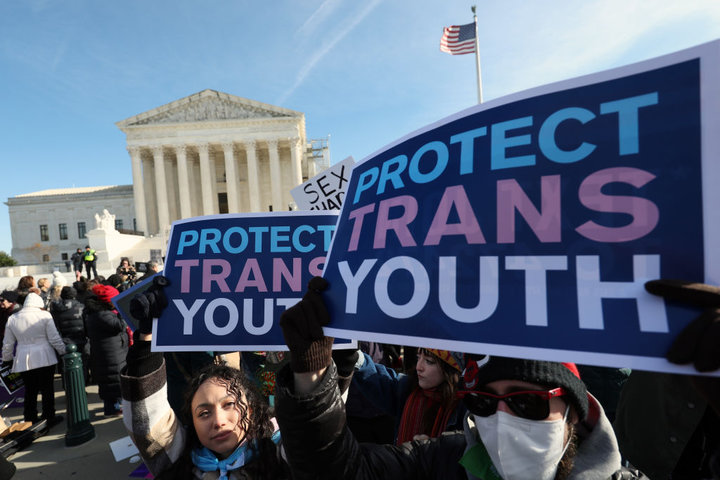
But the same day the court preserved that right, it upheld state bans that bar transgender girls and women from girls’ and women’s school sports. Justice Brett Kavanaugh wrote the decision. Justice Clarence Thomas went further in a concurrence, declaring that trans girls and women are not girls or women at all.
Two rulings, one method
The two rulings, handed down the same day, show how the court works.
The court preserved birthright citizenship because tearing it up would shake the legal order capitalism depends on. Citizenship at birth is the foundation for everything that follows in a person’s life — birth certificates, school enrollment, Social Security numbers, jobs, passports, voting rolls, property deeds. Millions of documents and records rest on it. If a president could cancel it with a signature, every citizenship paper in the country would be open to challenge. The banks, the employers, the government agencies — the whole machinery the capitalist class uses to run this country — depend on that stability. The court protected it for them.
Trans girls got no such protection. There is no crisis for the legal order in barring a teenager from her school’s soccer team. The states demanded the power to exclude trans girls and women from sports, to declare who counts as a girl and who doesn’t, and the court handed them that power. Kavanaugh’s ruling and Thomas’ concurrence gave legal cover to a campaign of exclusion aimed at some of the most vulnerable young people in the country.
Put the two rulings side by side and the court’s method comes into view. The justices ask one question: what does preserving or destroying this right mean for the system they serve? Where a right props up the legal order that capitalism needs to function, the court defends it. Where an oppressed group can be attacked without disturbing that order — where the attack even serves to divide working people and expand state power — the court clears the way.
The court protects the rights the ruling class needs to run the system: secure property, enforceable contracts, citizenship records the banks and the bosses can rely on. It contains rights won through struggle when those rights have been forced into the legal order. But it strikes at rights that get in the way of profit and state power: a poisoned worker’s right to sue, a Black voter’s right to representation, a prisoner’s right to challenge an unjust sentence, an asylum seeker’s right to ask for protection.
Demolition of the Voting Rights Act
The term’s most far-reaching attack came earlier, on April 29, and it was aimed at Black political power.
In Louisiana v. Callais, the court struck down Louisiana’s second majority-Black congressional district. Black people are about one-third of Louisiana’s population. For decades they were packed into a single district — since 2013, one out of six, diluting Black voting power across the state. Years of litigation under the Voting Rights Act finally forced the state to draw a second majority-Black district. The court threw it out — and in doing so gutted what remained of Section 2 of the Voting Rights Act, the provision won by the Civil Rights movement in 1965 to stop states from drawing district lines that erase Black political representation.
The Voting Rights Act was won in blood — in Selma, in Birmingham, in the murders of Civil Rights workers across the South. It stood for 60 years as one of the movement’s greatest victories. This court has now dismantled it piece by piece, and Callais finished the job. The ruling is a green light for racist gerrymandering across the South and beyond. State legislatures are already moving to redraw maps and eliminate Black districts. Justice Elena Kagan, in dissent, called it “the majority’s now-completed demolition of the Voting Rights Act.”
The same court that preserved the 14th Amendment’s citizenship guarantee in June had spent April tearing down the other great constitutional victory of Black struggle. The two rulings follow the same logic. The court is not inconsistent. It is class-consistent.
Birthright citizenship holds up the legal order the ruling class needs. Black voting power threatens the political order the ruling class wants in the South and beyond.
Deportation as labor control
On June 25, the court turned against immigrant workers and asylum seekers.
In Mullin v. Doe, the court ruled that the Trump administration could move ahead with ending Temporary Protected Status, or TPS, for Haitian and Syrian workers. Hundreds of thousands of people who have lived, worked and raised families here were pushed toward loss of work authorization and deportation. The court also said the decision could not be reviewed in the way lower courts had tried to review it.
That same day, in Mullin v. Al Otro Lado, the court allowed the government to turn asylum seekers away before they could set foot in a U.S. port of entry and apply for asylum. Justice Sonia Sotomayor wrote in dissent that this was no delay at all but a complete denial of processing. A Customs and Border Protection whistleblower testified that officers were instructed to lie to asylum seekers — to tell them the port was full and turn them back when it had room to process them. People turned away were beaten, kidnapped and raped in the border camps, exposed to the very persecution they were fleeing. “More people will die,” Sotomayor warned.
Bayer shielded, victims shut out
The court also ruled for Bayer’s Monsanto, blocking state failure-to-warn lawsuits by cancer victims who charge that Roundup caused their illness. The decision threatened tens of thousands of pending claims. Bayer stock jumped after the ruling.
The court and prisons
The court also strengthened the hand of prison officials against the people they hold.
In Rutherford v. United States, decided May 28, the court ruled against federal prisoners serving sentences that even Congress has since recognized as excessive. Congress passed the First Step Act in 2018, ending the practice of “stacking” mandatory gun charges that had produced sentences of 50, 70, even 100 years for first-time offenders. But Congress did not make the change retroactive, so thousands of prisoners remained locked up under sentences that could no longer be imposed today. Some sought relief through compassionate release, asking judges to weigh the injustice of a sentence no current defendant would receive. The court shut that door. Prisoners serving those sentences will stay in prison under them.
In Landor v. Louisiana, decided June 23, the court protected prison guards who assaulted a prisoner for his religion. Damon Landor is a Rastafari man who had grown his dreadlocks for nearly two decades as an act of faith. When he arrived at a Louisiana prison with weeks left on his sentence, he carried a federal court ruling holding that Louisiana’s policy of shaving Rastafari prisoners violated religious freedom law. A guard threw the ruling in the trash. Guards then handcuffed Landor to a chair and shaved his head to the scalp. The Supreme Court ruled that Landor cannot sue the officials for damages. The guards who did it face no personal consequence, and the law that was supposed to protect him provides no remedy.
Two arms, one class
The pattern is clear. For Black voters, the court gutted what remained of the Voting Rights Act’s power to stop states from weakening Black representation. For immigrant workers, it narrowed the path to court review. For asylum seekers, it upheld the power to keep them from applying for asylum. For poisoned workers and rural families, it shielded a chemical giant. For prisoners, it upheld prison authority and left excessive sentences in place. For trans youth, it gave states the power to exclude them from school sports.
Much of the corporate media presented the term as a struggle between Trump and “the rule of law.” But ruling after ruling gave legal cover to Trump’s political program: deportations, border turnbacks, the ending of TPS, the attacks on trans youth. And where Trump’s program wasn’t at issue, the court served the same interests by other means — granting impunity to prison guards, locking prisoners into sentences Congress had repudiated, shielding Bayer from cancer victims.
The court did not check Trump. It cleared the road for him, and for the class he serves.
The court and the White House are two parts of the same capitalist state. They may differ over timing, methods or legal forms, but they serve the same class.
The Trump administration uses executive orders, raids, firings, deportations and threats to terrorize immigrant workers, break up families and tighten control over the whole workforce. The court gives those attacks legal force.
The birthright citizenship ruling fits this pattern. The majority did not suddenly become friends of immigrant workers. It preserved the citizenship guarantee because capitalist rule depends on law. The ruling class cannot always afford to let Trump smash the machinery it uses to rule.
The Supreme Court saved birthright citizenship while helping Trump deport the parents of citizen children.
That is why the TPS ruling matters so much. Haitian and Syrian workers did not arrive in a vacuum.
Haiti has been bled for more than a century: by the French indemnity, U.S. banking control, the U.S. Marine occupation of 1915 to 1934, and repeated U.S.-backed coups, including the 2004 overthrow of President Jean-Bertrand Aristide.
Syria has been torn apart by imperialist war, U.S. sanctions that strangle reconstruction, and years of destabilization. Workers from oppressed nations are driven from countries the imperialist system helped make unlivable, then used inside the U.S. as a vulnerable labor force.
TPS gave some of those workers a narrow legal foothold. The court helped kick it away.
Deportation is a weapon of labor control. A worker who can be deported is easier for the boss to threaten. A worker who loses papers can be pushed deeper into low wages, dangerous work and silence. The whole workforce is pressured when one section is made more vulnerable. Every attack on immigrant workers is an attack on all workers.
The same is true of the attack on trans people. The campaign against trans girls in school sports is a political weapon. Reactionary organizations chose a small number of children as a target because the attack lets them divide workers, whip up fear and expand state control over bodies, schools and families.
Once the state claims the power to decide which girls count as girls, it does not stop with trans students. It opens the door to policing any girl who does not fit the reactionary image of femininity. It invites school officials, politicians and courts into the most private parts of young people’s lives.
The whole working class must answer this attack.
Won through struggle
The court’s defenders point to the birthright ruling and say the system still works. Workers should draw the opposite lesson. The system works for the class it was built to serve.
The 14th Amendment was forced into law by the Civil War, Black struggle and the destruction of slavery. Mass struggle against racist terror won the Voting Rights Act. Workers won union rights by striking, marching, occupying, organizing and fighting the bosses.
Every right workers and oppressed people hold was won through struggle. No worker can depend on the courts to defend rights that only struggle can protect.
The answer is solidarity. The strength that can beat these attacks is the united power of workers and oppressed people — in the unions, in the schools, in the streets, in the workplaces and in every community under attack.
Join the Struggle-La Lucha Telegram channel