
On June 24, a senior U.S. State Department official stood at a Victor Pinchuk Foundation dinner in Gdansk, Poland, and announced that Ukraine was winning the war. “We do have a moment right now where Ukraine is winning the war, for the moment,” said Jeremy Lewin, acting under secretary of state for foreign assistance. For the first time since early 2023, he said, the momentum had passed to Kiev.
The line came from the top. President Donald Trump called Ukraine “winning now,” pointing to its drone strikes on Moscow, and a senior Ukrainian official told the Kyiv Independent that Trump had privately urged President Volodymyr Zelensky to act “more boldly” against Russia.
Western outlets that had gone quiet on Ukraine filled with matching coverage: Russia on its back foot, Crimea near collapse, drone strikes on Russian refineries turning the war. The strikes are real. The fires are real. But the battlefield told another story. Russian forces broke into Konstantinovka, the southern gateway to the Donbass “fortress belt,” and overran block after block of the city. That is the opposite of a Ukrainian victory. Even the Kyiv Independent, no friend of Moscow, reported Russian troops “making real headway” into the heart of Ukrainian-held Donbass.
Adm. Sir Tony Radakin, who ran Britain’s armed forces from 2021 to 2025, used a Sunday Times article on June 28, 2026, to press for a sharp rise in military spending. He told the likely next prime minister, Andy Burnham, that he was already in a “quasi-wartime role,” and should govern accordingly rather than let his “wartime” cabinet leave Britain’s defenses weak, and must commit to spending 3.5% of output on the military by 2035.
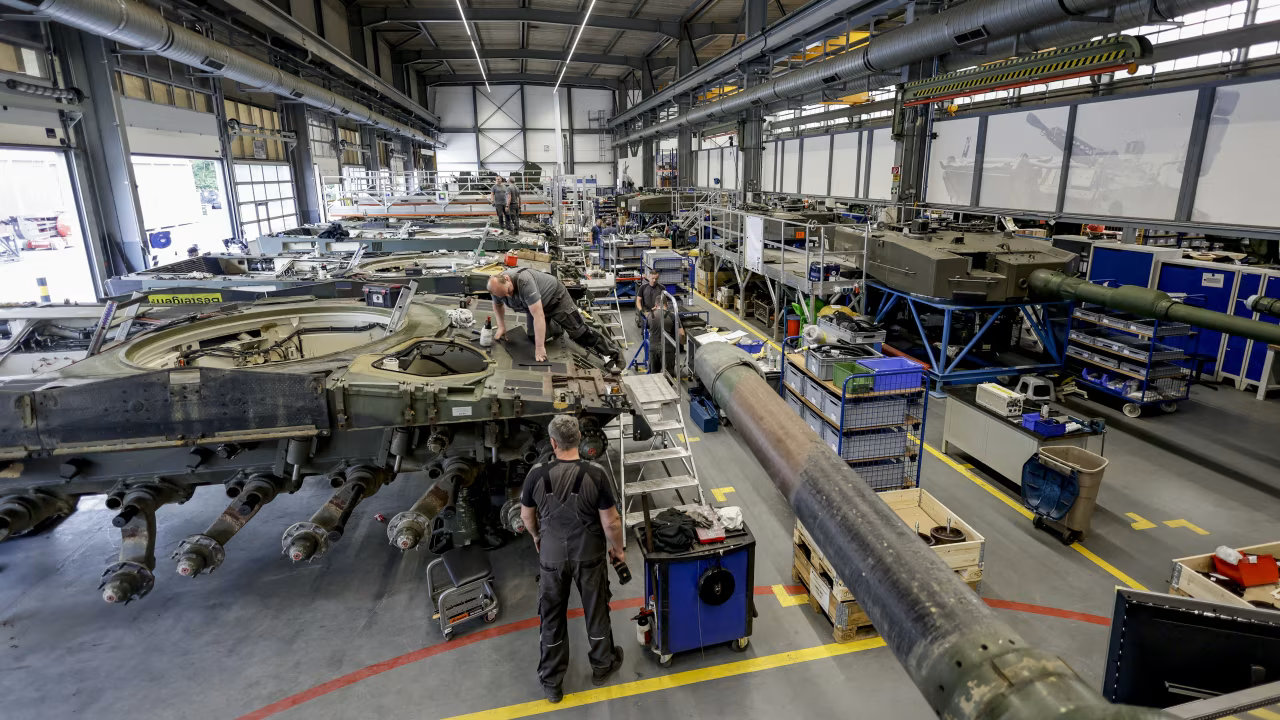
The “Ukraine is winning” campaign serves German capital. German industry has been shrinking since 2022. Nearly a quarter of industrial capacity is unused. Workers are being laid off. The Wall Street Journal put it plainly in March 2025: “Europe’s Idling Factories Eye New Start in the Military.” It reported that Rheinmetall was open to taking over car factories as Europe ramps up military spending. The monopolies cannot get enough profit from ordinary production, so they turn to the state. NATO contracts and military orders give them guaranteed markets.
NATO, sanctions, loans and military contracts become tools for moving government money through the entire chain of monopolies tied to the war economy. The capitalist state opens its treasury to the arms, aerospace and military-electronics monopolies — Germany’s Rheinmetall, Britain’s BAE Systems, France’s Thales and Italy’s Leonardo — and cuts pensions, health care and public education, and drives down wages for the working class. Arming the monopolies and stripping the working class are one and the same offensive. This is the framework within which Europe’s rulers now operate.
The war on Iran has sharpened the same crisis. Washington’s war in West Asia has driven up oil, shipping, insurance, energy and industrial costs across Europe. For German capital, already hit by four years of stagnation and layoffs in auto and chemicals, the shock added pressure toward military buildup and cuts at home.
Germany is the engine. Its 2026 budget sets military spending at 82.7 billion euros, 20 billion more than the year before; counting the Bundeswehr “special fund,” total military outlay reaches about 117 billion euros, on a path to roughly 153 billion — NATO’s 3.5% target — by 2029. In March 2025, the Bundestag rewrote the constitution to exempt military spending above 1% of GDP from the debt brake.
Defense Minister Boris Pistorius has set out to build the strongest conventional army in Europe by 2039. In an interview published June 15, 2026, the chief of the German air force, Lt. Gen. Holger Neumann, said the Luftwaffe was ready to “fight tonight.” He then named Kaliningrad, St. Petersburg, the Kola Peninsula and the Black Sea among the Russian targets Germany says it is prepared to strike in a war with Russia.
The same government is at war with its own working class. Chancellor Friedrich Merz, a former BlackRock manager, declares that Germany “can no longer afford the welfare state” and that “the Bonn Republic has ended forever.”
His coalition has abolished Bürgergeld, the basic welfare payment, and is replacing it with harsher rules. A single recipient now receives 563 euros a month. Under the new system, a second missed appointment can result in a 30% cut, and repeated missed appointments can reduce benefits to zero.
Merz is going after pensions and health care. The commission he backs wants workers to retire later, end early retirement at 63 and push part of the pension system into the stock market. It also targets free health coverage for spouses without paid jobs. At the same time, corporate taxes are being cut from 15% to 10% by 2032.
The drive runs across the continent. In Britain, Radakin demands 3.5% of output for the military. In France, Macron has launched a “voluntary” military service for 18- and 19-year-olds, set to reach 50,000 per year by 2035 — a step back toward the conscription that France ended in 1996. Poland talks of doubling its army. The European Union has opened a 90-billion-euro loan to Kiev, with the first 3.2 billion euros already paid out, while Czechia, Slovakia and Hungary were allowed to stay out of the guarantee scheme.
Yet the armies are not ready. That exposes the fraud. Poland’s buildup is pegged to 2039. Behind the war talk, European forces remain in poor shape, and moving even a single brigade east is no easy task.
But the war drive is already doing its work. The manufactured Russian threat justifies rearmament, pension cuts, conscription plans, attacks on social benefits and the reordering of the imperialist alliance under Washington and Berlin.
None of this requires a war to be fought. Rheinmetall makes money from the threat of war itself. The threat creates the market. The NATO summit in Ankara on July 7-8 is called to expand arms production and sign new contracts.
Military orders are state demand, backed by taxes and borrowing. They guarantee profits before a shot is fired — for the arms makers and for the whole chain of steel, chemical, electronics, shipbuilding, energy, logistics, banking and insurance monopolies tied into the war economy.
But military spending does not overcome the crisis. Arms are unproductive — they build nothing, feed no one — and behind them the debts and deficits pile up.
What is the war for? The aim is stated openly. As Estonian prime minister in 2024, Kaja Kallas, now the European Union’s foreign policy chief, said Russia’s defeat could break it into “small nations,” and called that no bad thing. Roderich Kiesewetter, a former Bundeswehr staff officer, writes that the goal must be Russia’s “unconditional capitulation.” Der Spiegel marked the 85th anniversary of the Nazi invasion with a cover reading “Our War Against Russia.”
The war has material aims: energy, grain, minerals, markets, labor and industrial position. In 1941, German capital followed the Wehrmacht with offices and plans to seize Soviet food, oil, coal, factories and land. In the 1990s, Western capital got a preview of what it wanted when Russia’s state property was broken open, privatized and sold off. The aim today is to push Russia back into that position: a subordinate supplier of raw materials, a field for investment, and a territory to be broken up if necessary.
The same hand reaches from West Asia to the Donbass, hunting oil, gas, minerals, grain, markets and control over the channels of finance. In an April 2026 speech in Washington, NATO Secretary General Mark Rutte called Europe “a power projection platform for the United States.” The bases that launched Washington’s war on Iran and the rearmament aimed at Russia are one machine. European workers are being lined up behind a war against Russia, while Ukrainian workers are used as cannon fodder for a NATO project that enriches the monopolies.
The war drive is meeting resistance below; the working class is moving. Tens of thousands of German schoolchildren have walked out against conscription in waves since December 2025, the latest on May 8, 2026, under the slogan “The rich want war — the youth, a future.”
Belgian workers shut the country down in a three-day general strike on Nov. 24-26, 2025, and again on May 12, 2026, against the De Wever government’s austerity and its 34-billion-euro military program.
In Italy, general strikes against the Meloni government’s war budget and its complicity in the genocide in Gaza have joined the fight against rearmament. Dockers in Genoa, Livorno and Ancona refused to load arms bound for Israel during the 2025 strike wave, and in June 2026 dockers in Genoa and Salerno blocked weapons again, touching off a general strike on June 20 under the slogan “Disarm them.”
The school walkouts, dock strikes and general strikes show the force that can stop this war drive: the workers and youth of Europe, fighting the war budgets, conscription plans and attacks on their living standards.
Join the Struggle-La Lucha Telegram channel