
U.S. warplanes struck Iran again June 28, the second round of bombing in two days near the Strait of Hormuz.
Iran answered with missile and drone attacks on U.S. military sites in Kuwait and Bahrain. Tehran said Washington had broken the ceasefire. Washington blamed Iran.
Washington cannot hide the basic fact. The U.S. opened this war on Feb. 28, with Israel acting as its military outpost in West Asia. By June 17, Washington had been forced into a pause. On June 19, it signed an agreement with Tehran to stop the fighting and reopen the Strait of Hormuz.
Then it bombed Iran again.
These were the strikes of an empire that cannot impose its will but cannot stop trying.
The more Washington fails to win, the more it widens the war. The U.S. military could not break Iran in four months of war. It could not keep the Strait of Hormuz open by command. It could not make Iran surrender. It could not protect its own bases from retaliation across West Asia.
Now it is bombing again, even as its own war machine is under strain. U.S. missile stocks have been drawn down. The White House is pressing weapons makers to speed production and move onto a war footing. The war that was supposed to show U.S. strength has exposed U.S. limits.
The fuel crisis exposes the same thing. The U.S. economy runs on diesel. Trucks, trains, tractors and ships depend on it. Military aircraft depend on the same refining system for jet fuel. When distillate stocks are thin, war demand cuts into the fuel needed to move commodities, food and raw materials. The war runs through the heart of the capitalist economy. It disrupts the circulation on which profit depends. The ruling class then tries to force every disruption onto workers through layoffs, wage pressure, speedup and repression.
The war command knows this. It bombed anyway.
That is what the imperialist state is built to do. It is the state of finance capital, the oil monopolies and the dollar system. It protects their command over trade routes, credit, energy and world markets. It will risk fuel shortages, disrupted transport, higher commodity prices and wider war to defend that command.
Nowhere is this clearer than the Strait of Hormuz.
Iran sits on one side of the strait. Oman sits on the other. The U.S. sits on neither. Yet the U.S. Navy claims the right to escort tankers through a waterway thousands of miles from any U.S. shore.
Washington calls this “freedom of navigation.” What it means is U.S. military control of the oil routes. It means the Pentagon claims the right to police every chokepoint on earth.
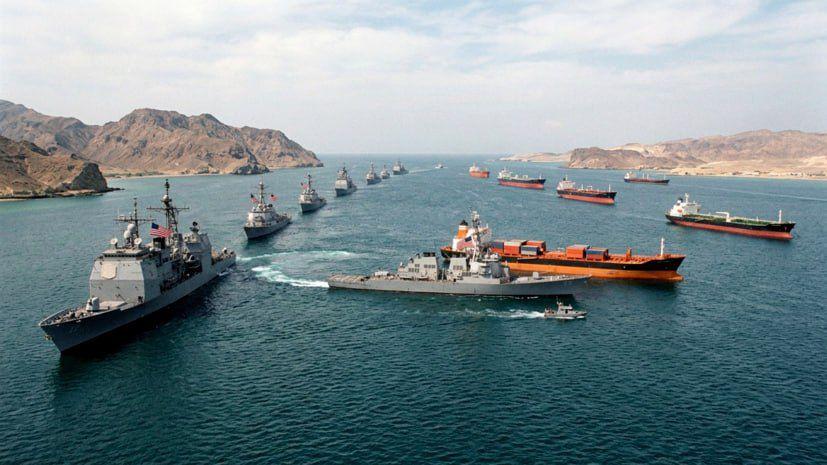
The tankers are not just ships carrying oil. The U.S. naval escort around them is a show of force. The Pentagon is trying to prove that oil can still move under its guns and that Iran has no right to defend the waters at its own door.
But the display cuts both ways. If the U.S. needs a major military operation to move a limited number of ships, then its control is not solid. It is thin. It is contested. It has to be enforced shot by shot.
Oil that moves under U.S. naval command is oil Washington is trying to keep inside the dollar system.
Lebanon shows the same command structure.
Israel has continued to bomb southern Lebanon and keep troops on Lebanese land despite ceasefire agreements. Washington has not restrained it. Instead, the U.S. used the ceasefire talks to accept Israel’s continued occupation of Lebanese land and to describe that occupation as a security arrangement.
This settles a question the U.S. ruling class works hard to confuse. Israel does not drag the U.S. into wars Washington does not want. Israel is a U.S.-armed client state in West Asia, supplied and protected to do Washington’s work.
When Israel bombs Lebanon, Washington writes the framework around the bombing. When Israel holds Lebanese land, Washington calls the occupation a security arrangement. The “tail wags the dog” story gets the order of command backward.
Washington commands. Israel carries out.
No worker has an interest in this war. It is a war for oil, chokepoints and the dollar. It is waged against the people of Iran and Lebanon under the bombs. It is also waged inside the U.S., where the same ruling class drives down living standards and militarizes the government.
The U.S. can still destroy. That makes it dangerous. But destruction is not victory. Washington keeps bombing Iran because the war has already shown what it cannot do.
It cannot dictate terms in the Strait of Hormuz. It cannot make Iran submit. It cannot make Lebanon disappear from the battlefield. It cannot hide the strain inside its own economy and military machine.
This is what declining imperialism looks like up close: armed to the teeth, still murderous, still dangerous — and driven to wider war because it is losing its grip.
Join the Struggle-La Lucha Telegram channel