
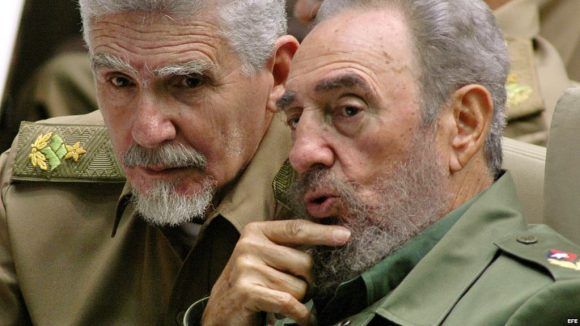
Ramiro Valdés Menéndez, one of the last surviving commanders of the Cuban Revolution and a principal builder of the institutions that defended it against six decades of U.S. war, blockade and subversion, died the morning of June 21, 2026, in Havana. He was 94. The Communist Party of Cuba and the Cuban government announced his death. President Miguel Díaz-Canel wrote that the loss of the Comandante de la Revolución “hurts deeply, like that of a father.”
His death removes one of the last living links to the generation that took power in 1959. Of the men who passed through Moncada, the Granma expedition and the Sierra Maestra, only a few remain. Among the surviving figures of the historic generation are Raúl Castro, 95, and Guillermo García Frías, 98, the first campesino incorporated into the Rebel Army after the Granma landing.
Valdés was born April 28, 1932, in Artemisa, west of Havana, into a poor family. At 21, he joined the July 26, 1953, assault on the Moncada barracks, the action that opened the armed struggle against the U.S.-backed Batista dictatorship. Three years later, he landed with Fidel Castro, Raúl Castro, Che Guevara and the Granma expeditionaries, then fought in the Sierra Maestra as the Rebel Army took shape. He became a comandante, served as Che’s second-in-command and fought beside him in the decisive Battle of Santa Clara in December 1958. From the war he emerged as one of the few leaders to hold the title Comandante de la Revolución. Cuba later named him Hero of the Republic and Hero of Labor. After the Communist Party of Cuba was founded in 1965, he served on its Central Committee and Political Bureau.
The institutions Valdés helped build gave the Cuban people the means to defend their revolution against an adversary 90 miles away that was determined to destroy it. He founded and led the Ministry of the Interior and helped organize Cuba’s state security and intelligence services. They were built in the years of the Bay of Pigs invasion, Operation Mongoose, sabotage, assassination plots against Fidel Castro, bombings and paramilitary raids launched from U.S. soil. These institutions were the Cuban people’s answer to that war — and a decisive reason Washington failed to strangle the revolution in its first decade.
In later years he held a series of state posts, including minister of informatics and communications and, under the 2019 constitution, vice prime minister. In 2010 he went to Venezuela to advise the government of Hugo Chávez during an electricity crisis, part of the deep cooperation between Havana and Caracas that Washington has spent the years since working to dismantle.
Valdés died in the middle of the gravest energy crisis Cuba has faced. On the day of his death, the state electric utility, Unión Eléctrica, reported that the largest simultaneous outage left roughly 64% of the country without power. Blackouts in parts of Havana have run more than 30 hours at a stretch. The crisis, which began in mid-2024, has sharpened dramatically since January 2026, when the Trump administration declared an energy emergency and moved to choke off the island’s oil supply — threatening tariffs against any country that ships petroleum to Cuba and interdicting tankers bound for its ports. United Nations human rights experts have condemned the fuel blockade as unlawful and warned that it has subjected Cuba to “energy starvation.” The target is not only the Cuban state. It is the fuel that keeps hospitals open, water systems running and basic services alive. This is a criminal siege — an attempt to starve a people into submission.
The damage has been devastating. Cuba has been driven into its deepest economic crisis in decades. That is the purpose of the blockade: to empty shelves, darken homes, break public services and wear down the people who have defended the revolution. Cuban Foreign Minister Bruno Rodríguez Parrilla has called the U.S. measures collective punishment of a genocidal character.
On June 4, 2026, Washington added Díaz-Canel, Lis Cuesta and Alejandro Castro Espín to its sanctions list — the first time a sitting Cuban president has been personally targeted. Trump and Secretary of State Marco Rubio have gone further, openly and repeatedly threatening Cuba with direct U.S. attack. In an Axios interview published June 19, Trump pointed to the January 2026 U.S. kidnapping of Venezuelan President Nicolás Maduro as the model, saying a Cuba operation was “possible.” He placed Cuba and Venezuela within easy reach of U.S. forces — “Venezuela is relatively close and Cuba is a hopscotch” — and reduced the difference to plunder: “Venezuela has oil. Cuba doesn’t.” Rubio, the administration’s chief operator on Cuba and Venezuela, has driven the same campaign of blockade, pressure and regime change.
This is the Cuba Valdés leaves behind: an island under siege, strangled through hunger and darkness, and threatened again with direct U.S. assault. The defense of the revolution — the work to which he gave his life — is once more the question on which Cuba’s survival turns. His death closes a chapter of the generation that made the revolution. The war against that revolution has not ended.
Join the Struggle-La Lucha Telegram channel