
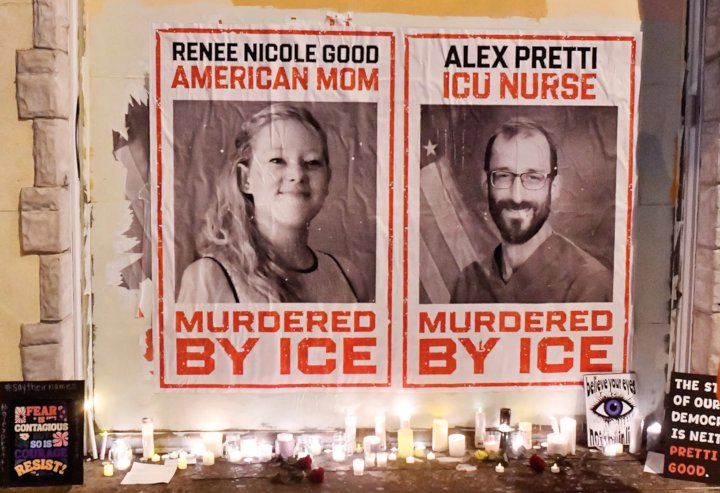
Federal agents killed Renee Good and Alex Pretti during Trump’s ICE invasion of Minnesota. Five months later, no agent has been charged.
But on June 16, federal agents raided homes across the Twin Cities and arrested 12 immigrant-rights organizers. A grand jury charged 15 people with conspiracy to impede or injure federal officers. Several face additional counts. One defendant was already jailed; two remained at large.
The 94-page indictment names two Minneapolis groups — Direct Action Minnesota and the Black Cat Worker’s Collective — and brands them “antifa.”
That label is the point. The government could not make its earlier cases stick, so it reached for conspiracy.
The earlier cases fell apart
Since Operation Metro Surge — the Trump administration’s mass ICE operation launched in Minnesota in December 2025 — U.S. Attorney Daniel Rosen’s office charged 36 people with assaulting or impeding federal agents. Those cases have fallen apart. Eighteen were dropped outright, three of them permanently. Prosecutors signed non-prosecution agreements in at least 11 more. A federal magistrate called one sworn statement behind the charges a “false affidavit” and asked why prosecutors were still pursuing the case.
Unable to convict protesters one by one, the government changed targets.
The conspiracy count does not require prosecutors to show that each of the 15 struck an agent. It ties them together through meetings, encrypted group chats, rapid-response networks, homemade shields, tracking ICE vehicles, warning neighbors of raids and blockades at the Bishop Henry Whipple Federal Building, the federal immigration hub at Fort Snelling.
That is what the indictment really targets: the structure of community defense that Minnesota workers built against ICE.
At his June 16 news conference, Rosen spoke again and again of “violence.” Asked to name one federal agent injured by the people he had indicted, he named none. Pressed for evidence, he told reporters to read the indictment, handed out minutes earlier.
Erik Davis, a religious studies professor at Macalester College and one of the 15, said plainly what the case looked like from inside the courtroom: “I looked through the indictment at all the things that include my name, and I seem to be indicted for holding meetings.”
The class character of the case comes into focus beside what the same prosecutors refuse to do.
Killers walk free
In January, federal agents shot and killed Good and Pretti during Metro Surge. No agent has been charged. Asked by KARE 11 why, Rosen said only that the investigations were “ongoing.”
Bruce Nestor, an attorney for one of the 15 and a past president of the National Lawyers Guild, says that instead of prosecuting those killings, Rosen’s office called for investigating the victims’ families and friends — the same impeding-ICE theory now aimed at the defendants. Several prosecutors quit after the office was pushed to turn the investigation away from the agents who killed Good and Pretti and toward people close to the victims.
So the line is drawn. The agents who killed Good and Pretti walk free. The people who organized to stop the kidnapping of their immigrant neighbors face years in federal prison.
The killers walk free. The organizers face prison.
The defendants are not a hardened cell. Natasha Rakotz, charged with assault on a federal officer, is a home health aide. She turned herself in on June 17. “I am not a violent person,” she said. “The only thing I did was care about my community and my neighbors.”
Cameron Kennedy, a 36-year-old sales representative, was one of the 12 arrested June 16. That morning his neighbors blew whistles and pounded on his door to warn him — the same kind of alarm neighbors raised across the Twin Cities to call out masked agents, and the same conduct the indictment now treats as a crime. A dozen federal agents in tactical gear were already on the stairs, guns drawn, with a warrant and a battering ram. A sign in Kennedy’s window read “ICE out of Minneapolis.” His doormat read “Come back with a warrant.” He raised his arms and opened the door. Agents seized his phone and his computer. He said he feared for his life.
Even the court refused to give prosecutors what they wanted. A judge rejected the demand for cash bail. The defendants were released under restrictions, including no contact with one another and no protest on federal property.
Outside the St. Paul courthouse, U.S. marshals answered community support with chemical irritants and flash-bang grenades. Dozens had packed the courtroom. When it filled, officials refused an overflow room and gassed the crowd trying to enter.
Nestor called Rosen’s news conference a propaganda show. He said the indictment was designed to punish and intimidate.
That is its purpose.
A scare label, not a terrorism charge
The case rests on a label. In September 2025, Trump declared “antifa” a domestic terrorist organization by decree. But no such domestic terrorist designation exists in U.S. law. The Brennan Center for Justice has pointed out that the designation carries no legal effect, that no mechanism exists to brand a domestic group as terrorist, and that “antifa” describes a decentralized movement, not an organization in any ordinary legal sense.
The government is not charging the 15 with terrorism at all. It borrows the language of terrorism to prosecute people accused of blocking roads, holding meetings and warning neighbors about ICE.
That is the machinery behind National Security Presidential Memorandum 7 and Joint Task Force Vanguard. Counterterrorism language is being turned against immigrant-rights organizers, workers, students and neighbors who refused to let ICE operate in silence.
Minnesota workers and youth faced down Operation Metro Surge in the streets. They kept their neighbors housed and fed. They watched ICE vehicles, sounded alarms and stood in the way.
They did not back down then. The threat of conspiracy charges will not make them back down now.
Join the Struggle-La Lucha Telegram channel