

The people locked inside Delaney Hall stopped eating, and they stopped working. ICE answered with tear gas, beatings and night transfers — a fleet of vans moving in the dark so no one outside could see.
It did not work. As the strike entered its fourth week, nearly 40 women held in Unit 1 of the Newark immigration jail announced on June 11 that they were joining — issuing their own demands and reopening a fight the government had spent the previous week trying to disperse across the country.
The strike began May 22, when more than 300 people detained at Delaney Hall signed an open letter and launched a combined hunger and labor strike. They refused meals. They also walked off the jobs that keep the facility running — kitchen work, cleaning, the unpaid and barely-paid labor that detained people perform for $1 a day. That second refusal is what GEO most wants buried, because it exposes Delaney Hall as a business that cages people, then makes them run the cage for pennies.
Delaney Hall is run by GEO Group, the for-profit prison company, under a contract with ICE worth roughly $1 billion. It is a 1,000-bed jail on Doremus Avenue and was the first new immigration detention center opened under the second Trump administration, beginning operations in May 2025. Its short history is already a record of crisis: an uprising in June 2025 in which detained men tore through a wall, and the December 2025 death of 41-year-old Jean Wilson Brutus less than a day after he was booked in.
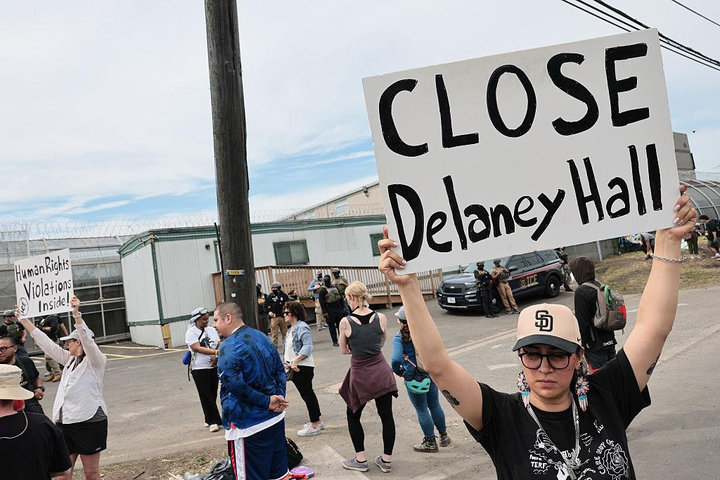
The strikers’ demands are not complicated, and they are not about menus. They have called for the release of the medically vulnerable, the elderly, pregnant women, and the young; for immigration judges to actually review their cases; for federal courts to hear their habeas petitions; and for an end to the pressure ICE puts on detained people to sign their own deportations. The conditions they are protesting have been described, in letters smuggled out of the facility and in testimony from physicians who have spoken with them, as medical neglect, expired food, water unfit to drink, and bathrooms that cannot be used. Dr. Chanelle Diaz, a professor of medicine at Columbia University Medical Center, relayed that detainees report roughly 95% of bond hearings denied — people with no criminal record held for months, some more than a year, with no due process. By refusing food, Diaz said, they are putting their bodies on the line to force a system that treats them as disappeared to see them as people.
Then the women answered. On June 11, nearly 40 women held in Unit 1 joined the strike with demands rooted in the abuse they face as women inside the jail. They want female detainees released, beginning with those under 21, mothers, and women with medical conditions. They want GEO’s medical staff replaced with qualified nurses and its security personnel replaced outright. And they are demanding the firing of one guard — a GEO staff member against whom detained women say they have filed 10 separate complaints of sexual assault. The guard, by their account, remains on the payroll. “We are mothers, daughters, sisters,” the women said in a video recorded inside the jail.
The state’s response has been to try to break the strike by scattering the strikers. Beginning the weekend before the women’s announcement, ICE transferred more than 200 detained hunger strikers out of Delaney Hall — by some counts as many as 400, the majority of those on strike — moving them at night to evade the protesters who had gathered for weeks to physically block the vans. Local authorities installed fencing across the jail’s driveways to keep demonstrators away. That is strikebreaking. Dispersing organizers to distant facilities is a tactic for defeating a strike and severing it from the solidarity built up outside the walls.

That solidarity did not break either. New Jersey Gov. Mikie Sherrill, a Democrat, responded to the protests by swapping ICE for state police and then local police outside the jail — a rotation of who held the line against demonstrators. None of it touched a single thing the strikers demanded. The nightly protests continued anyway, and so did the detained workers’ refusal to labor. Paulo Almiron of the New Jersey group Resistencia en Acción said relatives report their loved ones are still abstaining from work, and that the transfers ended nothing: “this doesn’t mean that the strike is over.” The women’s action, he said, is one decentralized strike spread across the jail’s separated wings. The women’s action carried it forward.
Washington’s official position is denial. Homeland Security Secretary Markwayne Mullin, who replaced Kristi Noem in March, has claimed there is no hunger strike at Delaney Hall at all, dismissing it as a political stunt and suggesting the handful he acknowledges simply want different food. DHS called New Jersey’s lawsuit over the facility “frivolous” and insists detainees receive proper meals, water, and medical care. The facts tear that denial apart. ICE’s own policy classifies anyone who has not eaten for 72 hours as on hunger strike; the strike has run for weeks. Detained people have named the conditions; their families have repeated them; visiting members of Congress reported small portions of spoiled food and ignored medical needs; and physicians have warned about detainees being tear-gassed on May 28 and then denied the clean water and eye-flushing that exposure requires.
The denial is easier to maintain when no independent inspector can get inside — which is the point. When New Jersey’s Department of Health sent inspectors on May 28, GEO let them into part of the building but barred them from the medical unit, the sleeping areas, and the bathing and toilet areas — precisely the places where the worst conditions are alleged. On June 2, state Attorney General Jennifer Davenport sued GEO Group in Essex County Superior Court to compel full access. The City of Newark, which had already sued GEO in April 2025 over unpermitted modifications to the building, is moving to expand that case to demand the jail be closed. When Sherrill herself toured on June 8, federal officials kept the visit closely controlled.
Measure that official response against what the strikers actually demanded. They called for the release of the sick, the elderly, the pregnant and the young; for real review of their cases; for the courts to hear their habeas petitions; and for an end to the coercion pushing people to sign their own deportations.
New Jersey’s Democratic officials have offered something much smaller: a fight over whether health inspectors may walk through the building. Newark’s bid to shut Delaney Hall turns on permits and unapproved modifications to the structure. The lawsuits contest the conditions of confinement. The strikers are contesting the confinement itself.
That gap explains why inspections and lawsuits have not ended the strike. The officials at the gate are asking for oversight. The people behind the walls are demanding freedom.
Delaney Hall is a sharp expression of something national. The ACLU counts active hunger and labor strikes in immigration jails across at least six states — Washington, Texas, Pennsylvania, Michigan, California and New Jersey — as the detained population has climbed from roughly 40,000 when this administration took office to a record 73,000 by mid-January.
The crisis inside Delaney Hall grows from the detention system itself: ICE cages people, GEO profits from them, and both depend on isolation, fear and forced obedience to keep the jail running.
The people locked inside have answered together. They are refusing food at great cost to their own bodies. They are withholding the labor that keeps the jail running. They are refusing the daily cooperation ICE and GEO need to make captivity look orderly.
ICE tried to break the strike with force. GEO tried to hide it behind locked doors. Officials tried to reduce it to a question of inspection. But the strikers have made something else visible: people whom the government tried to disappear are organizing, sacrificing and fighting for one another.
They are refusing food. They are refusing work. They are refusing to be buried alive inside the detention system.
Join the Struggle-La Lucha Telegram channel