
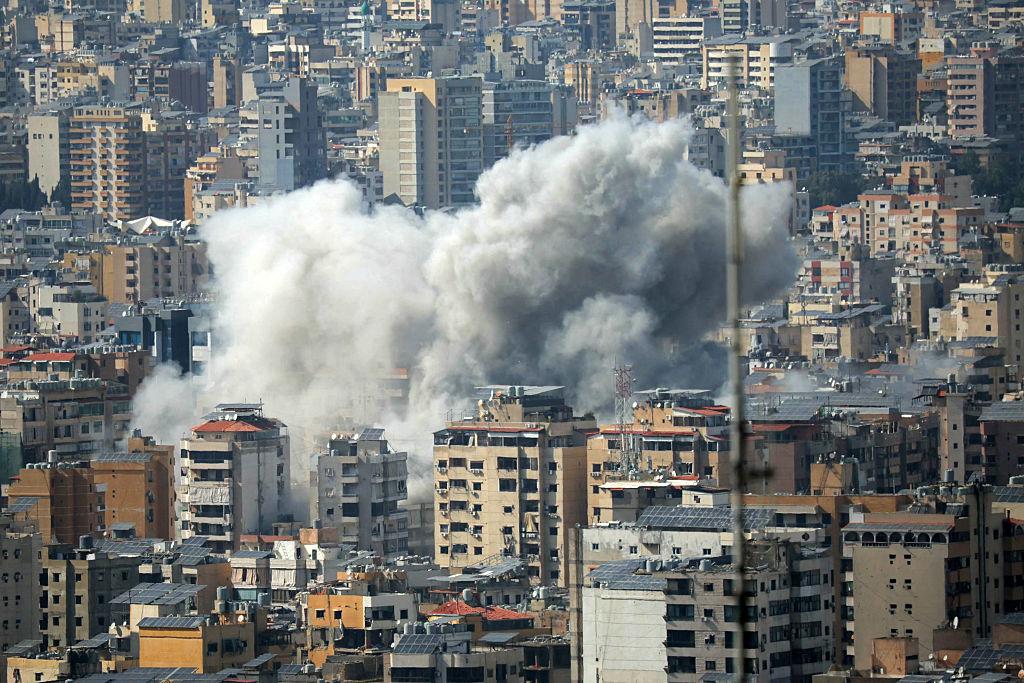
Trump announced on June 14 that the United States and Iran had reached a deal to suspend the war Washington launched on Feb. 28. Hours before the announcement, U.S. bombs fell on the southern suburbs of Beirut, killing three.
That sequence is the truth about the deal. “The Deal with the Islamic Republic of Iran is now complete,” Trump wrote on Truth Social, ordering the U.S. naval blockade lifted and the Strait of Hormuz reopened. “Ships of the World, start your engines. Let the oil flow!” While he wrote it, the bombing went on. No ceasefire was in effect, whatever the headlines said.
The press will tell you Israel struck Beirut. The planes, the bombs and the missiles are U.S. The jet fuel that flies them is shipped in for free on tankers out of Texas. Israel is the U.S. forward base in West Asia. It strikes where Washington arms it to strike, when Washington fuels it to strike, under cover Washington provides. One Iranian official put it plainly: the good-cop, bad-cop routine is played out.
That routine has a purpose. It lets Washington keep the war running while Trump puts distance between himself and the bombing, in Congress and among his own base. The price at the pump he cannot hide. In the war’s opening weeks, as gas crossed $3.50 a gallon, he brushed the spike off as a passing detour and called it “a very small price to pay,” and Representative Mike Lawler of New York said the higher prices were “absolutely worth it.” What they will not name is who gains. Every dollar added at the pump is a windfall for the U.S. oil and gas industry, a pillar of Trump’s donor base, and it comes out of workers’ pockets.
A war for the revenue stream
The aim of the war was never hidden from anyone who looked at the money. U.S. imperialism went into West Asia, and has fought its endless wars there, to keep the profits from Arabian Gulf oil and gas flowing into U.S. banks and corporations. The sums run to the trillions. When Trump traveled to Saudi Arabia, Qatar and the United Arab Emirates in 2025, he brought 30 corporate executives with him and came home with $3 trillion to $4 trillion in contracts — roughly half the annual U.S. federal budget.
The war on Iran belongs to a campaign that opened when the Soviet Union was destroyed in 1991: a drive to retake the monopoly control over the world’s energy that U.S. capital held in the 1950s and 1960s. Washington invaded Iraq. It destroyed Libya. It turned its guns on Iran.
In Iran, it has been thrown back. The Trump administration set out to overthrow the government, destroy the nuclear program, break the military and seize the Strait of Hormuz. It achieved none of it. Early on, it funded and armed protesters inside the country — “We sent guns to the protesters, a lot of them,” Trump boasted in April.
The opening strikes of Feb. 28 were meant to break the state at the top. They killed Supreme Leader Ali Khamenei and much of the military command. Washington expected panic, division and collapse. It got none of that. Mojtaba Khamenei succeeded his father. The armed forces held together. The government that Washington tried to shatter was still standing when it approved the June 14 deal.
When the decapitation strike failed, Washington widened the war against the whole country. Its bombing campaign has killed at least 3,468 people and wounded more than 26,500 by the Iranian health ministry’s count. Nearly 30,000 people have been killed or wounded.
On April 13, it imposed a naval blockade. U.S. warplanes destroyed water reservoirs at Sirik that supplied more than 20,000 people. U.S. forces also fired on tankers trying to run the blockade. Three Indian sailors were killed aboard the Settebello. Indian reports put the number of Indian seafarers killed since the war began at at least seven. Still, Iran did not surrender. After two months, the Strait of Hormuz remained shut by Tehran’s order.
Washington killed leaders, bombed cities, blockaded shipping and still failed to force surrender. That setback to U.S. imperialism is real. For workers and the oppressed around the world, it is a victory.
‘Permanently toll free’ and other lies
Trump’s account of the settlement is as hollow as his account of the war. Trump claimed he had made Hormuz “permanently toll free.” Iran answered with a lawyer’s distinction of its own. It would not charge “tolls.” It would charge fees for “services.” Before the war, ships paid neither. Trump sold free passage. Iran kept leverage.
In the same breath, Trump threatened to resume the war. He told the New York Times he would “restart military attacks on Tehran” if Iran does not reach a final accord, or else make the United States “the guardian” of West Asia in exchange for 20% of the region’s revenues. There is the mask off: a protection racket, with the U.S. military hired out to the oil monarchies.
This is what Trump called “complete”: an unsigned 60-day ceasefire, with the future of sanctions, the nuclear program and any final accord pushed into negotiations that had not begun. Iran’s officials say the war and the blockade will end the night of June 15; the memorandum is to be signed June 19 in Geneva by Vice President JD Vance.
The Democrats answered all of this by complaining that Trump had failed U.S. imperialism. Representative Seth Moulton called the terms “basically a surrender document.” House Minority Leader Hakeem Jeffries told NBC that “Iran is stronger right now.” Their objection is that Washington did not win.
The war is paused, not over
In the streets of Iran, masses of people are demonstrating against any capitulation, refusing to trust the foreign ministry, some calling for it to resign. They know the lesson of 2018: no agreement with U.S. imperialism is worth the paper it is signed on. Washington kept to the 2015 nuclear accord only until May 2018, when Trump tore it up though Iran had met every term.
And the wider war goes on. The siege of Gaza is as tight as ever. The U.S. is building a military base on Gaza’s border. On the West Bank, the terror runs daily: homes burned, farm animals killed, olive trees torn out, Christian villages attacked. It is plantation-style terror.
What restraint Washington shows comes from the account books, not from mercy. Oil executives warned Trump in person of the supply cliff ahead as producer and consumer prices ran hot. Elon Musk’s holdings across the Arabian Peninsula — Starlink, SpaceX — sit exposed if the war reignites, and with them the SpaceX stock offering launched this month and Musk’s standing as the world’s first trillionaire. That arithmetic, and not any concern for the people under the bombs, is what is forcing a pause.
Workers should take the measure of both facts at once. Iran has dealt U.S. imperialism a serious defeat, and that is a good thing. And U.S. imperialism, beaten back in one theater, will only redouble its drive to dominate West Asia and the world by force of arms. The task is solidarity — with Iran, with Lebanon, with Palestine — against that drive.
Join the Struggle-La Lucha Telegram channel