
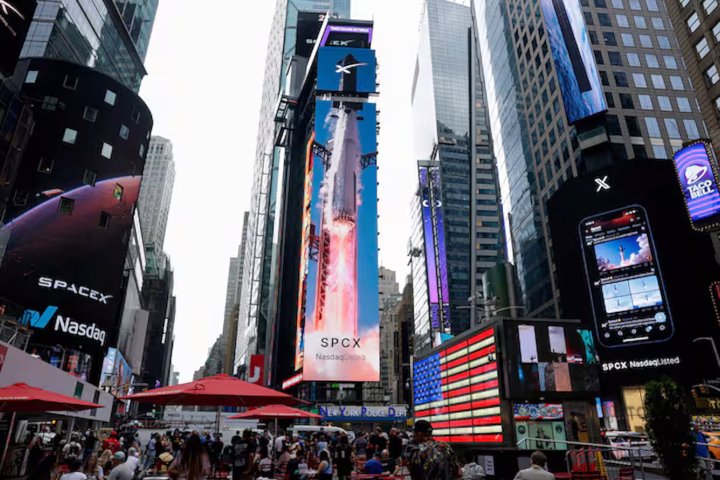
When SpaceX shares began trading on the Nasdaq on June 12, the trap was already set.
Millions of workers have 401(k)s and IRAs in retirement funds that copy Wall Street’s stock lists. Wall Street calls those lists indexes — the Nasdaq 100, the Russell 1000, the S&P 500. If Nasdaq or Russell adds a company to one of those lists, the fund buys the stock. It does not ask whether the price makes sense. Workers get no vote. Nobody asks them.
This is deferred wages — money workers already earned — used to buy Musk’s stock without their consent.
SpaceX was losing money. Wall Street still priced it like a sure thing. To hold up that price, Musk needed buyers who would come in automatically. Workers’ retirement funds supplied those buyers.
The sales pitch was rockets, Starlink, artificial intelligence and the fantasy of putting data centers in orbit. SpaceX also folded in Musk’s xAI gamble, tying workers’ retirement money to another speculative market that has yet to produce the profits Wall Street has already priced in.
Wall Street calls this passive investing. For workers, it meant forced buying with their own deferred wages.
The rules were rewritten for Musk
Wall Street’s stock lists are controlled by private companies. Nasdaq, FTSE Russell and S&P Dow Jones decide which companies get added. Their decisions move trillions of dollars.
For decades, new companies usually had to wait before entering the major lists. That delay gave the market time to test the price before retirement money was pushed in.
Those protections were stripped away for Musk.
Reuters reported in March 2026 that SpaceX demanded fast-track entry into the indexes as a condition of listing. Nasdaq rewrote its rules to admit SpaceX to the Nasdaq 100 after just 15 trading days. FTSE Russell cut its wait to five days.
SpaceX sold only a small piece of itself to the public — about 4% of the company. That left very few shares for sale. The new rules still forced retirement funds to buy. So much forced buying, aimed at so few shares, drove the price up.
Only the S&P 500 refused. On June 4, S&P Dow Jones Indices kept its rules requiring profits, time on the market and enough shares in public hands. It said the decision preserved “core index principles.”
S&P was defending its own rules and credibility, not workers’ pensions.
Nasdaq and Russell chose a different principle: serve the richest capitalist in the world.
A proven Wall Street racket
Wall Street has used this trick before.
Here is how it works. Wall Street announces that a stock will be added to one of its lists. Big traders buy the stock first. They know retirement funds will be forced to buy it soon. That forced buying drives demand up. Then the early buyers sell the stock to the retirement funds at a higher price.
The retirement money pays the inflated price. The profit goes to those who got in first. If the stock falls later, the loss stays with the fund.
That is the racket.
A 2025 Harvard Business School study by Marco Sammon and Chris Murray showed how much money this drains. In earlier cases, funds forced to buy right away paid about 15% too much. From 2017 to 2023, more than $5.8 billion was taken from funds that copy Wall Street’s lists — including funds holding workers’ 401(k)s and IRAs — and handed to speculators.
SpaceX takes the same racket to a new level.
Sammon estimated that funds tied to Russell, MSCI and Nasdaq could all be pushed into SpaceX stock within the first 15 trading days.
“I can’t think of a precedent with this many indexes adding so much of a stock so quickly,” he told The American Prospect.
Wall Street also aimed SpaceX shares at individual buyers. SpaceX set aside a record share of its first public stock sale for people buying on their own, far above the usual amount. Musk’s promoters sold them stories about rockets, Starlink and colonies on Mars. Wall Street counted on them to buy at the inflated price.
How workers lost their pensions
Workers did not always have to gamble on the stock market to retire.
The labor movement fought for and won real pensions. They were called defined-benefit pensions because the benefit was set in advance: a monthly check for life. The amount was tied to years of work, not to the daily rise and fall of Wall Street.
Those pensions were deferred wages. They were part of the pay package workers won on the job.
They also had federal protection. Under the Employee Retirement Income Security Act of 1974, private pension plans were backed by federal pension insurance. If a company stopped paying into the plan or went bankrupt, workers still had a guarantee, up to legal limits.
The bosses wanted out of that promise.
The 401(k) gave them the way out. Written into the tax code in 1978 and opened up by IRS rules in 1981, the 401(k) shifted retirement from a guaranteed pension to an individual account. The boss no longer had to promise a monthly payment for life. Workers were pushed into accounts tied to the stock market.
A 401(k) is not a pension. It is an account. It is not guaranteed. If the market falls, the worker takes the hit.
That is how the automatic stock fund became the least bad option for many workers. It had low fees, broad holdings and no need to pick individual stocks. By 2026, half of U.S. households held pooled investment funds of one kind or another, and the automatic kind dominated.
This huge pool of retirement money — deferred wages taken from workers’ paychecks — is now managed by a few Wall Street giants: BlackRock, Vanguard and State Street. When Musk demanded rules that steered that money into SpaceX stock at his price, they carried it out.
The bill comes due later
SpaceX is tied to the same AI bubble now driving Wall Street. The promise is that artificial intelligence, Starlink and future space projects will produce profits big enough to justify the price. Wall Street has already collected on that promise. Workers’ retirement money is being pushed in before those profits exist.
SpaceX is the test case. OpenAI and Anthropic are waiting behind it. Each new stock sale can use the same machinery: hype the company, change the rules, force retirement funds to buy, and leave workers holding the stock if the price falls.
If the bubble keeps rising, Musk, the banks and the early investors profit first. If it breaks, the damage shows up later in the 401(k)s of bus drivers, nurses, teachers and warehouse workers.
They never chose to bet their retirement on Elon Musk.
The capitalist class broke the guaranteed pension and pushed workers into Wall Street accounts. On June 12, 2026, Wall Street showed what that means: the bosses write the rules, the funds obey, and workers’ retirement money is turned into a payday for Musk and the speculators.
Join the Struggle-La Lucha Telegram channel