
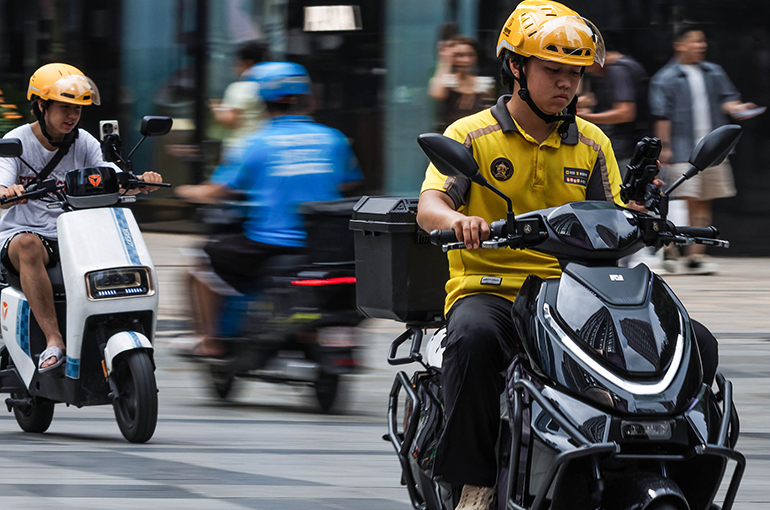
On Sept. 6, 2024, a 55-year-old delivery rider identified by the surname Yuan was found unconscious on his electric scooter outside a residential complex in Hangzhou. He had been lying there for hours before anyone realized something was wrong.
Other riders thought he was napping — because that was how Yuan rested. He worked 16 to 18 hours a day, taking orders from multiple platforms, lying down on his scooter between deliveries and getting back up the moment the next order hit his phone.
He never got up again.
He was the product of a system in which an app — not a supervisor, not a union, not the worker — decided how fast he had to ride, how many orders he had to take and what happened to his pay if he slowed down.
The factory foreman carried a stopwatch. The platform’s foreman is in the worker’s phone. The app gives the order, sets the clock and docks the pay when the rider falls behind.
Now the Communist Party of China and the central government have ordered that the platform algorithm itself — the machinery that assigns work, sets delivery times, calculates pay and imposes penalties — be opened to workers and unions.
On April 26, 2026, China issued new central guidelines for workers in “new forms of employment” — delivery riders, ride-hailing drivers, livestream sellers, logistics workers and others who work through platforms such as Meituan, Didi Chuxing, Alibaba’s Ele.me and JD.com.
China has about 240 million workers in gig and other nonstandard jobs. About 84 million are in newer platform-based jobs such as delivery, ride-hailing, online marketing and logistics.
The new guidelines do not end the struggle over platform labor. They shift the ground of that struggle. The boss’s algorithm becomes a work rule, open to inspection, challenge and change. The platform bosses must consult unions and worker representatives before changing the rules that govern workers’ daily lives.
That moves the algorithm onto the bargaining table. That is the class meaning of the new rules: how the work is assigned, timed and paid can no longer be treated as the private property of the platform bosses.
What the guidelines require
This is a central political directive. The Party Central Committee and State Council are instructing the ministries and provincial governments to enforce these rules on Meituan, Didi, Ele.me and JD.com. The treatment of these workers is no longer the platform bosses’ private business.
The guidelines set a minimum floor. Platforms must improve written labor arrangements, protect workers’ rest rights, pay at least the local minimum wage, pay wages in full and on time, and compensate holiday work.
Rest time is not left to the worker’s exhaustion or the platform’s goodwill. Enterprises must consult with unions or worker representatives over maximum consecutive order-taking time and maximum daily hours. When those limits are reached, the app must stop sending new orders and remind the worker to rest.
The corporate technology itself is brought under labor regulation. Platforms must consult unions and worker representatives before changing algorithmic rules. They must disclose the results, and the algorithms are subject to filing, audit and supervision.
This goes beyond disclosure. It puts the rules that decide the working day — pay, order assignments, delivery times, rewards and penalties — under union and public scrutiny.
Why the union matters
The union in question is the All-China Federation of Trade Unions (ACFTU), the country’s national labor federation and, with more than 300 million members, the largest in the world.
This matters because the platform worker, standing alone before the app, has no power. Through the union, platform workers stand as an organized force instead of isolated app users.
Since 2021, the ACFTU has driven a major organizing push into the platform economy. Under a three-year program launched in 2023, more than 10 million workers in new forms of employment joined unions, according to a February 2026 federation report. The federation has brought nearly 3,000 platforms and companies into collective bargaining since 2023. In an ACFTU campaign targeting 16 major platform companies, 15 have completed negotiations over the algorithms that manage their workers — including the country’s first platform algorithm and labor rules agreement, signed between Ele.me and Shanghai delivery riders in 2025.
For union committees, this is concrete material. The dispatch formula, the delivery clock, the penalty schedule and the disclosed results are no longer hidden inside the app. They become questions the union can take up on the workers’ behalf.
The role of unions in a workers’ state is not a new question. Lenin took it up directly in the Soviet trade union debate of 1920 and 1921. If the workers now held power, why did they still need unions?
Lenin’s answer was clear. The workers needed their unions, and would for a long time to come. The unions had a double task: to help run the economy and to defend the workers’ immediate interests, even against managers and officials acting in the state’s name.
Lenin called the unions a school of communism: a school of administration, a school of management, the place where workers learned to take the economy into their own hands. They were also, he insisted, the workers’ own defense, retaining their own role even under a government that ruled in the workers’ name.
That is what is at stake here. Through their unions, workers can challenge the rules that run their working day.
How the system worked
In September 2020, the Chinese magazine Renwu published “Delivery Workers, Trapped in the System,” an investigation based on six months of research. It documented how Meituan and Ele.me’s algorithms progressively shortened delivery windows, forcing riders to run red lights, drive against traffic and sprint up staircases.
Pay was determined by a formula that factored in average daily orders, punctuality, customer ratings and complaints — a calculation opaque to the riders whose income depended on it.
The platform used the formula to intensify labor: more orders, less time, greater risk and no clear way for the rider to challenge the calculation.
In Shanghai in the first half of 2017, one delivery rider was injured or killed every 2.5 days. In Chengdu over seven months in 2018, according to Chengdu traffic police, delivery riders were involved in roughly 10,000 traffic violations, 196 accidents and 155 injuries or deaths — nearly one accident a day.
Ele.me’s response to the Renwu investigation was to introduce a button allowing customers to “wait five extra minutes” — widely criticized as shifting responsibility from the platform to the consumer. The algorithm kept shortening delivery windows anyway.
Why Beijing moved
China moved because private platform capital had collided with the goals of a planned economy. The platforms treated labor power as something to burn up and replace. A socialist country cannot raise workers’ living standards, protect public safety or keep production stable while exhausted riders are sleeping on scooters and dying.
The 15th Five-Year Plan, covering 2026 to 2030, makes raising household incomes and living standards a central goal. Living standards do not rise by decree. Workers need wages they can live on, hours that leave time to rest, and the ability to support a healthy family. When platforms push wages down, stretch the working day and leave social insurance uncovered, they attack all three.
Exhausted riders, falling pay and deadly speedups become a social problem. The guidelines answer that problem as labor policy: they rein in private platform capital before the bosses’ super-exploitation of riders damages the whole economy.
Pledges are not paychecks
Some platform companies have already announced pledges. JD.com said it would sign labor contracts with full-time riders and provide social benefits. Alibaba-linked platforms have announced social-security support for delivery workers. Other companies have promised subsidies or income support.
But pledges are not enforcement. The platform bosses have not given up the power to set pay, shorten delivery times and impose penalties. In 2021, eight government departments issued guiding opinions on platform labor covering income, safety, social insurance and dispute resolution. The companies acknowledged them and carried them out only in a limited way. Delivery times kept shrinking. Riders kept dying. Algorithms kept optimizing for speed over safety.
This time there is a target. The guidelines call for written contracts, wage standards, rest protections and algorithm consultation to become the norm across the platform economy by 2027. Every rider, driver and union committee can measure the bosses against that standard.
What U.S. workers don’t have
Platform workers in the United States — delivery riders, rideshare drivers, logistics workers — face the same algorithmic control with almost none of these protections. The platforms force their workers to sign on as independent contractors — take the label or get no work — putting them outside labor law: no federal minimum wage, no overtime protection, no requirement for algorithmic transparency, and no right to bargain over the algorithmic rules that govern their working lives.
Years of driver organizing forced California to pass Assembly Bill 5 in 2019, writing into law that platform workers are employees — covered by minimum wage, overtime and unemployment protection.
The gig companies struck back with Proposition 22, spending more than $200 million — the most expensive ballot campaign in U.S. history — to buy back their exemption at the ballot box in November 2020. When Proposition 22 took effect in December 2020, more than a million California drivers were demoted back into independent-contractor status, stripped of the protections they had won. In July 2024, the California Supreme Court upheld Proposition 22. The $200 million stuck.
That is the U.S. model: the app commands the worker, the corporations buy the law, and the courts give the purchase a legal seal.
Where U.S. platform workers have won anything, organizing won it. New York City’s deliveristas fought for more than three years to win the country’s first minimum pay rate for app delivery workers — a rate built from data the city forced the platforms to disclose. Massachusetts rideshare drivers had their union certified on May 22, 2026 — the first certified union of rideshare drivers in the country.
China has shown that corporate algorithms are not above society. They can come under public authority and union scrutiny. U.S. platform workers face the harder task: building the power to force the bosses to open the algorithmic rules, bargain over the system and take control of the conditions of their own labor. Every gain U.S. platform workers have made so far — the deliveristas’ pay rate, the Massachusetts drivers’ union — came through organization. The next step is the same: riders and drivers acting together as workers, a bargaining force the bosses have to answer to.
Join the Struggle-La Lucha Telegram channel