
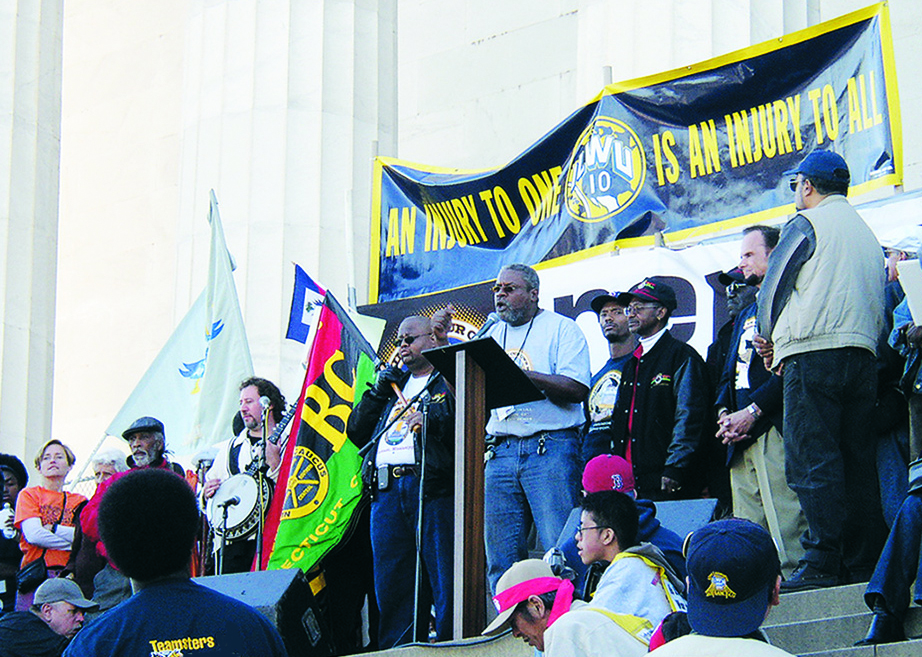
The U.S. labor movement lost a beloved giant on June 12. F. Christophe “Chris” Silvera. He served as secretary-treasurer of Teamsters Local 808, representing a diverse group of workers including railroad, building maintenance, factory and public sector workers. Silvera was the longest serving principal officer in the Teamsters and one of the most important radical voices in the long history of struggle of the Teamsters, as well as among all workers, organized and unorganized.
Silvera died June 12 of a heart attack en route to the Teamster national convention. Undoubtedly, this charismatic leader was on his way to support the Fearless Slate, led by Richard Hooker, and a new generation of Teamsters poised to take on the pro-Trump leadership of Sean O’Brien.
In 1999, Chris Silvera became the first chairman of the Teamsters National Black Caucus (TNBC) to be elected by the membership. As a chair of TNBC, Silvera was a critical East Coast organizer of the Million Workers March at the Lincoln Memorial on Oct. 17, 2004.
The following year he became a co-convener of the Millions More Movement, which gathered in Washington on Oct. 15, 2005, and called for a workers’ blockade to force President George W. Bush to rescind his executive order suspending the Davis-Bacon Act in the rebuilding of the Gulf Coast after Hurricane Katrina. Eleven days later, Bush rescinded the anti-labor order.
Silvera played a critical role in reclaiming May Day in the labor movement. A contract provision ratified by divisions of Local 808, along with other unions, made May Day a paid union holiday in their collective bargaining agreement.
Trent Willis, a leader of International Longshore and Warehouse Union (ILWU) Local 10 in San Francisco, reported to the Longshore Caucus on June 12: “Silvera addressed the Longshore Caucus in 2004, regarding his union’s support of the MWM, endorsed by the ILWU Longshore Caucus! He addressed our members and guests on Bloody Thursday, July 5, 2024. He spoke of the shared history of the West Coast waterfront strike and the Teamsters strike in Minneapolis, Minnesota, both taking place in May of 1934. He was a true freedom fighter and a champion for the working class.”
Silvera’s book, “1934: A Year of Good Trouble,” describes the police killing of two striking dockworkers, Nick Bordoise and Howard Sperry, who were shot in the back. Their deaths helped spark the San Francisco general strike.
Clarence Thomas, a co-author of the book, submitted the resolution inviting Chris Silvera to speak at the Bloody Thursday commemoration. Thomas is a retired leader of ILWU Local 10 and an initiator of the 2004 Million Worker March.
Silvera spoke of the 1934 labor upsurge that gave birth to the Congress of Industrial Organizations (CIO): “The CIO chose to organize all workers, significantly increasing the mass of workers who were unionized and fighting to include more Africans in America. The break with the craft unionism of the AFL was generated by three historic strikes: Toledo AutoLite; West Coast Longshoremen and the Minneapolis Teamster strike.”
Silvera said: “Today, workers are threatened by greed and technology. Our wellbeing in the workplace and in retirement is threatened as never before. We must reach back and call our ancestors in the workplace and imbue the militancy of 1934 to protect our future and the future of our children and grandchildren.”
According to LaborPress, in 1995 Silvera led a four-year-long battle with Metro North. “Then AFL-CIO President, John Sweeney to comment in 1995 before the Association for a Better New York that Local 808’s actions have re-energized the labor movement. In contrast, the MTA referred to Silvera in the New York Times as a labor terrorist. That struggle brought significant wage and benefit improvements to the workers at Metro North. Under Silvera’s leadership, Local 808 is a beacon of labor activism and militancy, continuing a history of militancy since the Local was chartered in 1922.”
His record at the bargaining table matched his record in the streets. Silvera negotiated a groundbreaking “shutdown agreement” with Swingline’s parent company, Fortune Brands, winning workers extended health coverage and enhanced pension benefits.
Asked what had been most meaningful over more than three decades leading Local 808, Silvera told LaborPress in November 2024: “Changing the trajectory of peoples’ lives.”
Join the Struggle-La Lucha Telegram channel