
The Pentagon bombed Iran’s drinking water.
On June 10, U.S. strikes destroyed two water reservoirs in Sirik, a town in Iran’s southern Hormozgan province near the Strait of Hormuz. Iranian Foreign Ministry spokesperson Esmaeil Baghaei said the reservoirs held 2,500 cubic meters and supplied drinking water to more than 20,000 people in 10 villages. He called the attack a “calculated war crime.”
A New York Times visual analysis published June 11 confirmed the account: precision-guided U.S. munitions struck two drinking-water facilities, and the Times’ analysts noted that deliberately targeting civilian infrastructure would constitute a war crime.
The strikes came during a heat wave, with temperatures in the region running between 113 and 122 degrees Fahrenheit. The villages around Sirik were already struggling with chronic water scarcity before the bombs fell.
This was no accident of targeting. On March 7, a U.S. strike hit a desalination plant on Qeshm Island, cutting off water to some 30 villages. Asked on June 10 whether attacking civilian infrastructure amounts to a war crime, Defense Secretary Pete Hegseth dodged the question. The same day he told reporters the U.S. would “negotiate with bombs” if needed.
Iranian crews repaired the damage and restored the water supply within 12 hours, Al Jazeera reported. The bombs accomplished nothing militarily. The war crime stands.
The pretext
The excuse fell apart within a day.
On June 9, a U.S. Army AH-64 Apache attack helicopter went down near the coast of Oman. Both crew members were rescued unharmed. Initial U.S. statements said the crash was under investigation. Trump first played down the incident.
Then came the war story. After a Pentagon briefing, Trump claimed Iran had “shot down” the helicopter and ordered retaliation.
The Associated Press reported a different story: the Apache went down after colliding with an Iranian drone, and it was not clear the collision was intentional. Iran’s Islamic Revolutionary Guard Corps denied attacking the helicopter, and Iran’s deputy foreign minister said any contact was not deliberate. Military analysts noted that the Shahed-type drone the Pentagon blamed carries a large explosive warhead and flies a preset course to a fixed target — if one had actually struck the helicopter, the crew would not have walked away.
None of that mattered to Washington. Within hours, U.S. forces struck roughly 10 targets across southern Iran — Sirik, Jask, Minab, Qeshm Island and the port of Bandar Abbas — hitting radar and communications equipment, a telecommunications tower and the Sirik water reservoirs. U.S. Central Command called the attacks “self-defense strikes.”
Iran answered the same night, launching some 20 missiles and drones at U.S. military installations in Kuwait, Bahrain and Jordan. The IRGC said the targets included F-35 hangars and a command center. Iran’s message was direct: the response was proportional, and if the attacks continue, more will follow.
On June 10, Trump announced that more U.S. strikes were coming.
The strikes came. Around 5 p.m. Eastern time on June 10, U.S. Central Command announced “additional self-defense strikes” on Iran — the second wave in two days. The targets included surveillance systems, air-defense sites and communications networks.
Trump told Fox News that Iranian officials had asked him to halt the bombing. Then he threatened more strikes unless Tehran signed an agreement.
Sign or be bombed. Those are Washington’s peace terms.
Iran answered overnight. In the early hours of June 11, the Islamic Revolutionary Guard Corps said it had struck U.S. military targets in Jordan, Bahrain and Kuwait with ballistic missiles and drones. The targets included aircraft hangars, command facilities and U.S. installations across the region.
Every round costs Washington multimillion-dollar interceptors to defend bases it has no right to occupy. Iran answers with cheaper weapons it has in depth. That is part of the war Washington did not count on: every U.S. escalation also exposes the cost of maintaining an empire of bases across West Asia.
Indian seafarers pay for the blockade
The U.S. naval blockade of Iran is also killing and maiming the workers who crew the world’s merchant fleet.
On the evening of June 9, a U.S. aircraft fired what CENTCOM called “precision munitions” into the engine room of the Settebello, a Palau-flagged tanker transiting the Gulf of Oman. The Pentagon’s charge: the ship was carrying Iranian oil, in violation of the U.S. blockade, and its crew failed to follow orders from U.S. forces.
Twenty-four of the Settebello’s 28 crew members are Indian sailors. Three of them are missing. The ship reported an engine room fire about 20 nautical miles off the Omani port of Sohar, and the Omani navy responded to the distress call.
On June 10, India summoned the deputy chief of the U.S. Embassy in New Delhi to protest. It is at least the third vessel crewed by Indian sailors struck since the war began Feb. 28.
The pattern is clear. The blockade’s enforcers sit in air-conditioned command centers in Tampa and Bahrain. The blockade’s casualties are workers from the Global South — merchant seafarers from India crewing tankers for shipowners hiding behind flags of convenience, fired on by the most powerful navy on earth for the crime of moving oil that Washington has not approved.
Bombing and ‘negotiating’ at the same time
Trump claims the war is nearly over. On June 10 he claimed on social media that a month-long “secret mission” had moved more than 100 million barrels of oil and 200 commercial ships through the Strait of Hormuz, declaring that the U.S., not Iran, controls the strait.
The claim collapsed within hours. No major news organization could verify the figures. A Pentagon official had told CNBC the week before that U.S. forces were not escorting vessels at all, only communicating with ships seeking to transit. Energy Secretary Chris Wright, testifying before Congress the same day, appeared caught off guard by the president’s announcement and refused to give any numbers of his own. Hours before the post, Trump gave an incoherent Oval Office version: 22 ships had moved “late at night with no lights,” he said, because Iran had no radar after “we blasted the crap out of it.”
Analysts offer a simpler explanation for whatever oil is reaching the market. JPMorgan estimated in a June 4 note that roughly 2 million barrels per day may be leaving on tankers that switched off their transponders — so-called ghost ships — while additional Saudi crude bypasses the strait entirely through the East-West pipeline to the Red Sea port of Yanbu. The oil moving has little to do with the U.S. Navy.
Take Trump’s figures at face value and the boast still concedes defeat.
One hundred million barrels over a month is roughly 3 million barrels a day. Before the war, about 20 million barrels a day moved through the Strait of Hormuz. Trump is bragging about forcing through a fraction of what used to move freely.
And at what cost? A downed Apache helicopter. Expended drones. Multimillion-dollar interceptors. A blockade burning billions of dollars a month.
Even 100 million barrels amounts to only about five days of U.S. oil consumption. By Trump’s own numbers, the strait remains overwhelmingly shut.
That boast measures how far the war’s aims have shrunk. Washington launched this war Feb. 28 for regime change — opening with the assassination of Iran’s head of state and strikes meant to decapitate the government. The government did not fall. Instead, Iran closed the Strait of Hormuz and has kept control of it ever since — a position Tehran never held before the U.S. attacked. Before Feb. 28, the strait was open and a quarter of the world’s seaborne oil moved through it without a single U.S. escort.
So the war for regime change has been reduced to a war to reopen a waterway that Washington’s own aggression shut — and even that reduced war is going badly enough that the president has to invent victories in it. That a fabricated “secret mission” is the trophy on offer after 103 days tells the story: the original war was lost, and the boast is the cover.
The numbers tell a different story than the victory talk. Shipping journal Lloyd’s List reports more than 160 tankers still trapped in the Persian Gulf after more than 100 days of war, with departures slowing. Oil is holding near $92 a barrel. U.S. inflation has climbed above 4%, driven by energy prices, and U.S. workers are paying for the war at the pump and at the grocery store.
The negotiations are theater staged alongside the bombing. On the morning of June 10, a Qatari delegation arrived in Tehran to meet Iranian negotiators — and was still in the country when the new U.S. strikes began. Washington talks peace and bombs water tanks in the same news cycle.
Iran, for its part, has refused to be lulled. When Israeli warplanes bombed Beirut’s Dahiyeh district on June 7, Iran answered with missile strikes on Israeli air bases, and its Emergency Command declared that aggression against Lebanon would be answered as aggression against Iran. The fronts of the resistance are one front. Trump told the Financial Times that he “calls all the shots” with Israel — while an Israeli official boasted that Israel had acted against Trump’s stated position twice in 24 hours without damaging the partnership. The supposed daylight between Washington and Tel Aviv is a stage effect. U.S. aerial tankers refuel the Israeli jets; U.S. air defenses cover them.
Who pays, who profits
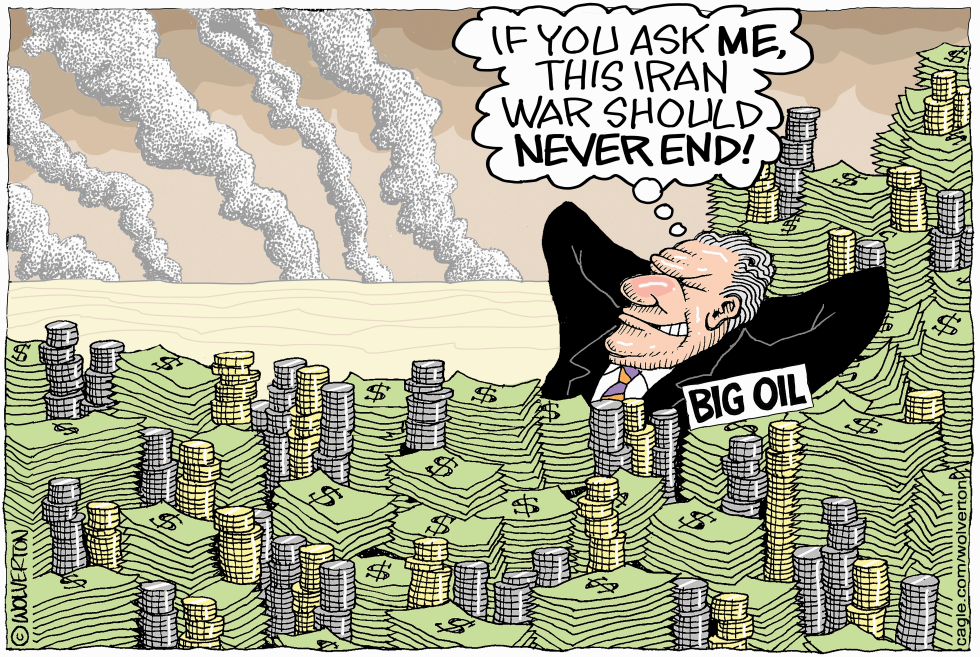
After 103 days, the war has settled into the form that suits Big Oil, the Pentagon’s contractors and the shipping insurers: a long siege, punctuated by strikes, that keeps oil prices high and military budgets fat. Exxon and Chevron are making out like bandits on $92 oil. Lockheed and RTX replace every expended missile at cost-plus. The shipping insurers collect war premiums.
The bill goes to everyone else: villagers in Hormozgan hauling water in 120-degree heat, Indian sailors missing in the Gulf of Oman, Lebanese families under Israeli bombs, and workers in the U.S. watching wages shrink against 4% inflation to finance a war the ruling class started and refuses to end.
A war launched to overthrow a government now grinds on so that the men who launched it never have to say it failed. It continues on pretexts a day’s reporting can demolish.
Join the Struggle-La Lucha Telegram channel