
A UPS driver in a brown uniform carries the union card, the contract, the grievance procedure, overtime pay, safety rules, a pension and a guaranteed wage. Down the same street, a driver in a personal car carries a package for a UPS-owned platform. No union card. No contract. No grievance. No overtime. No safety rules. No pension. No guaranteed wage.
That second driver works for Roadie, a delivery platform UPS bought in 2021. Roadie hires drivers as independent contractors. The driver supplies the car, the gas and the insurance, takes a flat rate per delivery, and must hold a four-star rating to keep getting work. UPS classifies these drivers as independent contractors, so the company owes them none of what it owes a Teamster.
This is the same UPS that signed the largest private-sector union contract in North America. In 2023, 340,000 UPS Teamsters ratified a five-year national agreement after coming to the edge of a national strike. That contract is in force now. Beside it, UPS runs a non-union contractor operation — one the union says is being fed with union work.
Teamsters Local 804 charges that UPS is diverting package pickups and deliveries to Roadie’s gig drivers in violation of the contract, to dodge overtime and skirt safety law. The union is telling members to document every Roadie package moving through the UPS network, and says Roadie is spreading into 30 cities and metropolitan areas, taking work that belongs on union trucks.
Here is the platform model in a single company. The boss builds a contractor operation inside the most heavily unionized package company in the country and uses it to hollow out the contract from within. What the platform bosses are doing to scattered workers across the economy, UPS is doing to its own union, one delivery at a time.
The bosses call it flexibility. It means no wage floor, no grievance, no recognized employer — and an app that controls the worker every hour.
The Uber driver is told they are independent. The Lyft driver is told, “You are your own boss.” The DoorDash courier, the Instacart shopper, the Amazon Flex driver, the UPS Roadie driver are told they are contractors, partners, entrepreneurs — anything but employees.
But who sets the rate? Who controls access to the customer? Who changes the pay formula? Who tracks every movement? Who decides when a worker is “deactivated” and cut off from income?
The app does. The algorithm does. AI does.
The app is the boss. The algorithm is the foreman. AI is the personnel department.
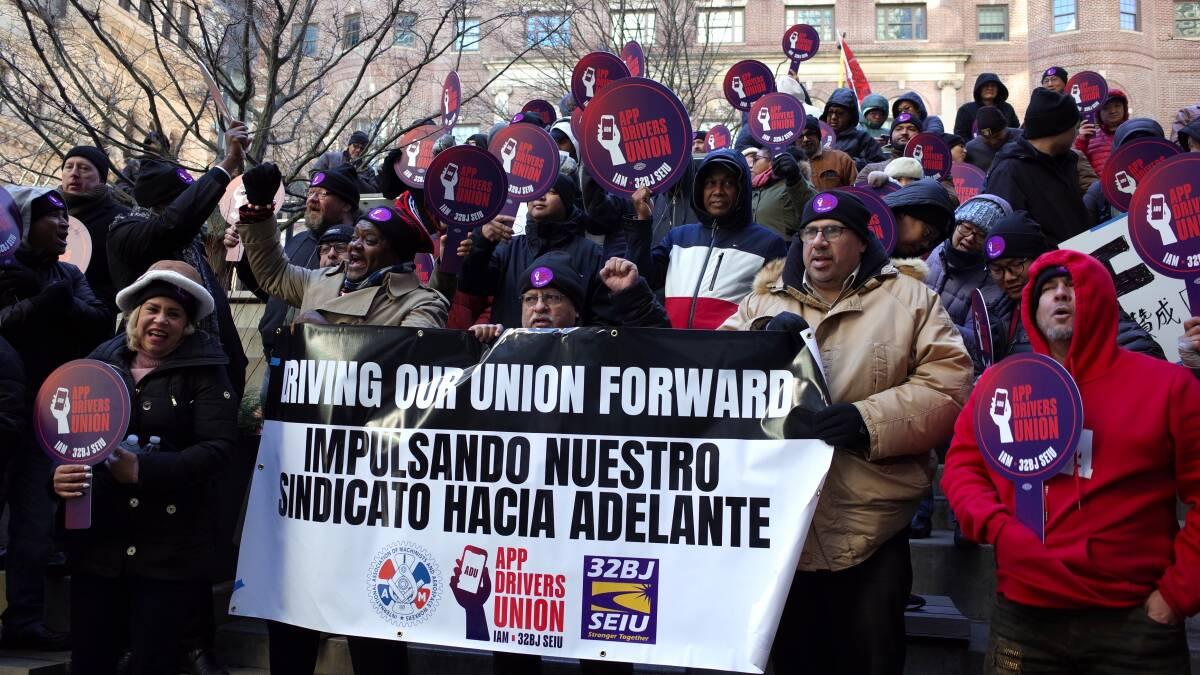
Now workers have answered the bosses in practice. On May 22, 2026, Massachusetts certified the App Drivers Union as the bargaining representative for an industry-wide unit of nearly 70,000 Uber and Lyft drivers — the first recognized union of rideshare drivers in the country. Labor leaders called it the largest private-sector organizing win since autoworkers joined the UAW at Ford in 1941.
The drivers won this while still classed as independent contractors. The victory does not end contractor status or defeat the platform monopolies. But it proves the central point: workers the bosses treat as isolated contractors can act together as a class.
New York City’s deliveristas proved it first. App-based delivery workers organized as Los Deliveristas Unidos fought for more than three years — and beat back lawsuits from Uber, DoorDash and Grubhub, which together account for 99% of food deliveries in the city — to win the country’s first minimum pay rate for app delivery workers, covering all working time, waiting included.
The rate was built from the platforms’ own books: the city compelled Grubhub, Uber Eats and DoorDash to hand over confidential records, producing the first accurate accounting of the workforce’s numbers, wages and expenses. The workers forced open a piece of the code, and the law was written from what they found inside.
The rate rises to $22.13 an hour on April 1, 2026, and as of Jan. 26, 2026, covers grocery delivery workers, with the apps required to provide itemized statements showing how pay is calculated. And in January 2026, the city announced a $5 million settlement and the reinstatement of as many as 10,000 wrongfully deactivated delivery workers — workers fired by the algorithm, put back to work by organized pressure.
Scattered drivers organized industry-wide in Massachusetts. Scattered couriers cracked open the pay formula in New York. The bosses’ claim that platform workers cannot organize is already broken in practice.
This is one of the central labor questions of our time. Platform work is the model monopoly capital wants to impose on the whole working class: no stable job, no recognized employer, no grievance procedure, no unemployment insurance, no workers’ compensation, no minimum wage tied to all hours worked.
By McKinsey’s count, 36% of employed people in the U.S. identify as independent workers — gig workers, freelancers, contractors, temporary workers and people doing side work to survive. A high-paid, self-employed consultant and a delivery worker waiting outside a restaurant in the rain do not face the same conditions. But the size of the category shows the direction capital is moving: a vast zone of precarious labor where the boss sheds the responsibilities of employment while keeping control over the worker.
That control is sharpest in app-based platform work.
Who pays and who profits
The platform did not fall from the sky. For decades, high technology under capitalism has driven higher-paid union work into lower-paid work and built a vast pool of low-wage labor. Sam Marcy named this tendency in “High Tech, Low Pay“: capital seizes each advance in technology to cheapen labor and swell the ranks of the low-paid. The same process that gutted steel and auto now reorganizes the rideshare driver and the delivery worker, scatters them, strips the work of its protections, and calls the result flexibility. The platform is where that tendency arrives.
The worker supplies the equipment, the time, the body and the risk. The company supplies the platform and takes the profit. The worker may never meet a supervisor, but every movement is watched and timed.
The gig worker carries the company on credit. The driver buys the car, fills the tank, pays the insurance, pays for maintenance and works the hours before a single dollar arrives. Marx pointed out that every worker advances labor power to the boss before payday and so extends credit to the capitalist. The platform driver advances far more — the whole cost of the equipment and the wait. The worker is the platform’s principal creditor, financing its operation out of their own pocket, and is paid last and least.
The fraud of ‘independent’
The terminology itself is part of the struggle. “Gig workers” is the broadest term. “Platform workers” is more precise: workers whose labor is organized through a digital platform — Uber, Lyft, DoorDash, Instacart, Amazon Flex, UPS Roadie and similar companies. “Flexible workers” is the bosses’ term, because it makes exploitation sound like freedom.
But the class question is plain. These workers sell their labor. The companies profit from that labor. The companies control the conditions under which it is performed. That makes it a labor struggle.
The word “independent” is part of the fraud, meant to make workers think they are not workers at all.
A driver who owns a car is no boss. A delivery worker who owns a bicycle is no capitalist. A shopper who owns a phone is no entrepreneur. They do not own Uber, Lyft, DoorDash, Instacart or Amazon. They do not own the platform, the customer list, the payment system, the data, the algorithm or the market. They do not set the price of their labor. They do not hire other workers and live off their labor. They sell their labor power to survive. That is what makes them workers.
The companies call them independent contractors to break that consciousness. A worker who is made to think of themselves as a small business is pushed away from the union, away from collective action, away from seeing the boss as the boss. The legal category becomes an ideological weapon.
The legal fiction of “independent contractor” status is worth billions to the platform monopolies. It lets them deny they are employers while exercising employer power every hour of the day.
California showed how much that fiction is worth. In 2019, the state passed Assembly Bill 5, classifying gig drivers as employees and entitling them to the minimum wage, overtime and unemployment insurance. Uber, Lyft, DoorDash and Instacart wrote Proposition 22, a ballot measure to exempt themselves, and spent more than $200 million to pass it — the most expensive ballot campaign in California history. They won. Two hundred million dollars to protect billions, and capital bought its own law. Prop 22 promised drivers 120% of the minimum wage; a University of California, Berkeley, study found that once unpaid waiting time and costs were counted, the pay came to about $5.64 an hour.
And here the bosses’ own machine turns against their story. The app, the algorithm, the whole platform did not appear from nothing. Programmers, engineers and data workers built it. It is their labor, already performed and frozen in code and servers — what Marx called dead labor, the labor of the past locked inside the means of production.
The capitalist does not create it. The owner takes it. The means of production — the factory, the machine, now the platform — are made by workers and seized by capital, which turns them into instruments to command the living labor of other workers. Dead labor in the hands of the boss becomes a weapon to pump unpaid hours out of the living.
And dead labor creates no new value. The machine, the algorithm, passes on the value already inside it and not a cent more. Only living labor makes new value. The driver, the courier, the shopper produce more than they are paid, and the unpaid portion is the profit. Marx wrote in “Capital”: “Capital is dead labor, that, vampire-like, only lives by sucking living labor, and lives the more, the more labor it sucks.” The platform proves it — it grows the more it drains.
The app distributes the work, sets the pace, and squeezes the unpaid hours harder. Strip away the platform and the work still gets done. Strip away the worker and the platform produces nothing.
That is why the bosses want every workplace to look more like the platform. The contractor dodge and the algorithm do the same job: push every cost onto the worker and squeeze more unpaid labor out of every hour.
Trump’s war on unions
Trump’s war on labor unions belongs in the same picture.
The Trump administration has moved to strip collective bargaining rights from federal workers, weaken and paralyze the National Labor Relations Board, weaken wage protections for workers on federal contracts, and aid the corporate legal assault on the labor board itself. This is the federal government acting for the most aggressive sections of capital. Richard Hooker Jr., secretary-treasurer of Teamsters Local 623 in Philadelphia, named the record plainly: Trump “comes in and eliminates contracts for workers.”
The platform bosses attack workers from below by denying they are employees. Trump attacks workers from above by tearing away the right to organize and the right to withhold labor — the labor rights of the whole working class, union or not. The two attacks meet in one program: destroy collective power.
The history matters. U.S. labor law was built to restrict the working class. Taft-Hartley, passed in 1947 after the great CIO upsurge, banned secondary boycotts, outlawed sympathy strikes, attacked union security, opened the road to right-to-work laws, and handed the government wider power to break strikes. It was the ruling class’s answer to the power workers had built in the 1930s and 1940s.
Taft-Hartley left the unions standing and confined them. It tried to isolate workers in one shop, one employer, one contract, one legal channel, and to weaken the solidarity that had let workers act as a class.
The platform companies go further. They try to deny there is a shop at all.
Scattered, but still workers
The Uber driver sits alone in a car. The delivery worker waits outside a restaurant. The shopper moves through the aisles under time pressure. The Amazon Flex driver carries packages across scattered neighborhoods. The Roadie driver hauls a single delivery across town in their own car. Capital has reorganized the job to scatter the workers.
But scattered workers are still workers.
That is the starting point. The gig workforce stands inside the working class, under a newer and sharper form of control. Many gig workers are immigrants. Many are Black, Latine and Asian workers. Many are women. Many were pushed into platform work by layoffs, low wages, unstable schedules, discrimination or the need for a second income.
And the algorithm turns that need into a lever. It can set a different rate for each worker, reading how long they stay logged on, which jobs they take and how fast they accept, to gauge how badly the money is needed — then pays the least it can to the worker with the fewest options.
Those workers are disproportionately Black, Latine and immigrant workers, pushed onto the platforms because stable jobs were closed to them. Black and Latine workers make up almost 42% of workers for Uber, Lyft and other electronically mediated work companies, although they are less than 29% of the overall U.S. workforce. In New York City, 86% of app-based ride-hail drivers are immigrants. The headline unemployment rate was 4.3% in May 2026. For Black workers it was 6.6% — and for four of the first five months of the year, it stood above 7%.
First the bosses shut workers out of stable jobs. Then the app measures who is desperate enough to take less.
The bosses count on this — a workforce too scattered, too diverse, too temporary to organize. The class answer runs the other way. High technology is pushing more workers into low-paid, unstable work. The center of gravity in the working class is shifting toward exactly these workers — Black, Latine, Asian, Indigenous, women and immigrant. The low-paid multinational workforce is where the leadership of the whole class is emerging.
Bargain over the algorithm
The demands must be concrete. Minimum pay for all time worked, including waiting time. Full transparency in pay formulas. Protection against arbitrary deactivation. Workers’ compensation. Unemployment protection. Company payment for the costs now pushed onto the worker. The right to organize, to bargain across the platform, and to strike without retaliation.
And above all, the right to bargain over the algorithm. The algorithm assigns the work, sets the pace, fixes the pay, polices the worker and cuts off income. That makes it a workplace rule, and workers must have the right to know it, challenge it and bargain over it. This is a form of workers’ control over the rules that govern the job. The job itself is a property right. Deactivation is not the loss of an app feature; it is the loss of livelihood. A worker cannot be stripped of it by a line of code.
A workers’ government has already begun to write these rights into law. China amended its Trade Union Law in 2021 to extend the right to organize to gig workers. On April 26, 2026, the general offices of the Communist Party Central Committee and the State Council made public a national framework for workers in new forms of employment — including food delivery riders, ride-hailing drivers, couriers and livestreamers.
China puts this platform-based workforce at 84 million, within a broader gig workforce of more than 240 million. The policy requires fair and timely pay, stronger social security, and transparency in how platforms use algorithms to assign work, set income distribution, prices and delivery times, with a 2027 target for standardized labor practices across the sector. What the platform monopolies in the U.S. spend hundreds of millions to defeat, a state representing workers is putting into law.
The deed comes first
The companies will say this is impossible. Every boss says that before workers force it to happen. The steel bosses said industrial unionism was impossible. The auto bosses said the same. The warehouse bosses say it now. The platform bosses say drivers and couriers are too scattered, too temporary, too flexible to organize.
Massachusetts drivers have already broken that argument. They organized first, and recognition followed. That is the rule in labor history. The great organizing strikes came before the law recognized them. The deed comes first, and the law ratifies the struggle after the workers have made it real. The right to bargain over the algorithm will come the same way.
One class, many fronts
The fight to organize gig workers is about more than one industry. The federal worker stripped of bargaining rights, the warehouse worker driven by surveillance, the delivery driver ruled by an app, the airport worker threatened by privatization, the temp worker denied stability — these are different fronts of the same class struggle.
Trump’s attack on unions is the administration clearing the road. The platform bosses’ contractor model is the destination. AI and algorithmic management are the new machinery of control.
The labor movement should answer this by looking back at what it once won. The bosses gave nothing. The union contract, the grievance procedure, the eight-hour day, overtime, safety rules, seniority, unemployment insurance — workers won all of it by organizing, striking, defying injunctions and fighting as a class.
That is what is needed again.
The app is the boss. The algorithm is the foreman. AI is the personnel department. The platform is the workplace. The worker is a worker.
Organize gig workers.
Join the Struggle-La Lucha Telegram channel