
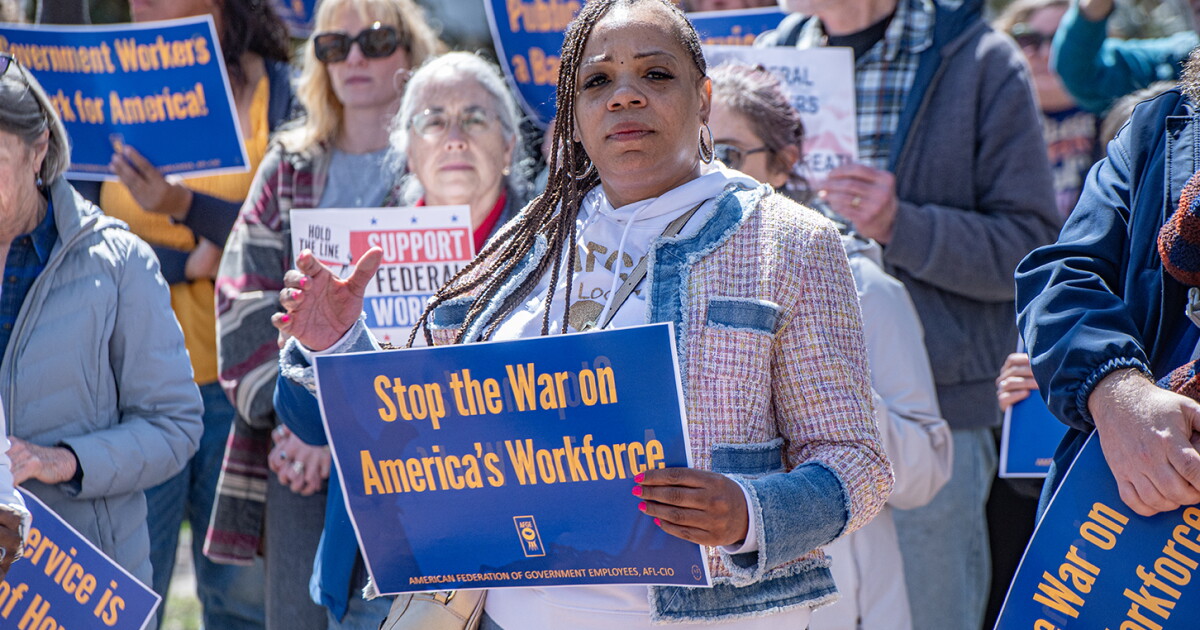
The bosses came after the unions the moment Trump took office, and they have not let up since.
In a little over a year, the Trump administration has paralyzed the National Labor Relations Board, stripped collective bargaining rights from more than a million federal workers, slashed wages for hundreds of thousands of private-sector workers on government contracts, and joined Elon Musk, Jeff Bezos and other union-busters in a court fight to abolish the labor board outright.
It is the largest anti-union offensive the country has ever seen.
Paralyzing the labor board
The first blow landed before Trump had been in office a week. On Jan. 27, 2025, he fired Gwynne Wilcox, chair of the National Labor Relations Board and one of its last three members. By law the board needs three members for a quorum. Without three, it could no longer act.
The blow fell on the private-sector labor movement. The NLRB runs union elections, rules on unfair labor practice charges, and orders bosses to rehire workers fired for organizing in warehouses, hospitals, retail stores and other private workplaces. With no quorum, every case stalled. Workers fired for organizing waited 345 days for a final ruling on whether the firing was legal. Organizing drives lost their footing. Bosses could fire organizers, stall elections and keep operating while the cases sat dead at the board.
Trump fired Wilcox for opinions he said “unduly disfavored” employers — a warning to any future board member about the price of ruling for workers. For permanent general counsel, he picked Crystal Carey, a former partner at Morgan Lewis, the firm defending SpaceX against the labor board. At her confirmation hearing, Carey refused to say whether she believed the NLRB was even constitutional. The agency’s own chief prosecutor would not promise to defend it.
The Department of Government Efficiency piled on. A whistleblower from the board’s IT department reported that DOGE operatives had likely pulled roughly 10 gigabytes of sensitive data out of the case management system — live unfair labor practice cases, election disputes, worker protection proceedings, all potentially compromised.
Then came the corporate court attack. On Aug. 19, 2025, the Fifth Circuit gave SpaceX and two other companies a green light to block NLRB cases against them. The court accepted the corporate argument that the labor board itself is unconstitutional. If that ruling stands or spreads, the board can be made impossible to operate — threatening the legal right to organize that tens of millions of private-sector workers have held since 1935.
SpaceX had faced the board for firing workers who signed an open letter criticizing Musk. Amazon faced complaints over its long war on the Amazon Labor Union, the independent union that won a historic election at the Staten Island JFK8 warehouse in 2022 and has fought Amazon’s union-busting ever since. Musk — Trump’s biggest campaign donor and head of DOGE — runs companies that are themselves targets of active board cases.
The coordination is direct. Musk, Bezos and the other tech monopolists work through the federal government and the courts: a DOGE that loots case files, a White House that fires board members, a Fifth Circuit that may strike the agency down, and a general counsel who will not defend the agency she runs. They are hollowing out the labor board from within and battering it from without at the same time.
The largest union-busting act in U.S. history
The most visible blow came March 27, 2025. Trump signed an executive order stripping hundreds of thousands of federal workers of their bargaining rights, reaching for the national security exemptions buried in the 1978 Civil Service Reform Act.
Georgetown labor historian Joseph McCartin called it the single largest act of union-busting in U.S. history. Overnight, twice as many federal workers lost their union protections as there are members of the United Auto Workers. The AFL-CIO traced the order straight to Project 2025 and said it stripped bargaining rights from workers across more than 30 agencies — the workers who track disease, inspect food, protect public health, manage public lands and respond when disaster strikes.
A federal judge blocked the order, ruling that the administration had ripped up union rights in retaliation for the unions’ court challenges to DOGE’s mass firings, and that the “national security” excuse was a pretext. A federal appeals court lifted that block in July 2025, and the administration resumed.
The administration escalated in August. A second executive order on Aug. 28, 2025, on top of an earlier move to end bargaining at the Transportation Security Administration, brought the total to 84.4% of the unionized federal workforce stripped of rights — one in every 15 workers in the country covered by a union contract.
More than 400,000 workers at the Department of Veterans Affairs and the Environmental Protection Agency saw their contracts torn up. In December 2025, the Department of Homeland Security terminated the union contract covering 47,000 TSA workers at airports across the country. The cancellation came one day after the House passed bipartisan legislation to overturn Trump’s original order and restore federal bargaining rights. The timing was a deliberate slap.
All told, Trump’s orders have hit nearly a million federal workers, the AFL-CIO reports.
Cutting wages, gutting the workforce
The attack reached private-sector workers directly too. On March 14, 2025, Executive Order 14236 revoked the increase of the minimum wage to $17.75 an hour for workers on federal contracts. For some workers, the wage floor dropped to $13.65 an hour — a cut of more than $4. Others lost their executive-order wage floor entirely, leaving them with whatever lower rate applies, or the $7.25 federal minimum.
The same order scrapped the union-neutrality rule on federal infrastructure projects. Trump cut wages, weakened union leverage and handed contractors more power over the lowest-paid workers doing government-funded work.
DOGE, under Musk, ran a parallel assault through mass firings aimed at agencies with the highest union density. Before formal layoffs even began, some 175,000 federal workers were shoved onto six months of paid leave with no jobs at the end of it, surfacing in the unemployment rolls in October 2025. The firings gutted the IRS, USAID, the Social Security Administration and the Department of Housing and Urban Development. They tore up services that workers and the poor depend on, while weakening some of the strongest union footholds inside the federal government.
The ground was Taft-Hartley
The bosses did not build this from nothing. They started from Taft-Hartley.
The Labor Management Relations Act of 1947 was the bosses’ counterattack on the working-class upsurge that won the Wagner Act of 1935 and built the CIO. It came at the height of postwar labor militancy, when workers had shown their power in strikes that shook whole industries.
Taft-Hartley was written to break that power. It outlawed the kind of solidarity that lets workers in one shop defend workers in another. It banned secondary boycotts and sympathy strikes. It attacked the closed shop. It gave employers a freer hand to campaign against unions and helped create the union-busting consulting industry that thrives today. It let presidents break strikes with injunctions in the name of “national health or safety.” And it opened the door to right-to-work laws, designed to starve unions of dues, above all across the South.
Some workers were never let in at all. The Roosevelt administration and Southern Democrats wrote agricultural and domestic workers out of the Wagner Act of 1935 from the start. In the South in those years, those were the jobs most Black workers held — field hands, sharecroppers, cooks, maids and laundry workers. Leaving farm labor and domestic service out of the law meant leaving most Black workers out of it, and the same exclusion swept up Mexican and other oppressed workers across Southwestern agriculture. Taft-Hartley widened the circle in 1947, stripping supervisors and independent contractors of coverage too. The right to organize was rationed by race from the day it was granted.
Federal workers were left outside this system entirely. Not until President Kennedy’s Executive Order 10988 in 1962 did they win formal recognition of the right to organize. The Civil Service Reform Act of 1978 codified those rights — but far weaker than the private-sector law, and with national security exemptions the Trump administration is now weaponizing.
No Democratic administration repealed Taft-Hartley. No Congress restored the right to secondary boycotts, sympathy strikes or a closed shop. The bans stayed. The right-to-work laws stayed. The president’s power to break strikes stayed — ready for the next offensive.
The International Trade Union Confederation already rated the U.S. among countries with “systematic violations of rights,” and in 2026 put it on its worker-rights Watchlist for the first time, citing Trump’s attacks on federal workers, workplace protections and immigrant workers. Compared with workers in other major industrial countries, U.S. workers are denied labor rights.
The result is plain: in 1983, one in five U.S. workers carried a union card. Today the Bureau of Labor Statistics counts 14.7 million union members — one in 10 wage and salary workers, and fewer than one in 17 in the private sector. That was the ground Trump built his offensive on.
Beyond the law, into struggle
The paralysis of the labor board left private-sector workers fired for organizing with nowhere to appeal for nearly a year, from the biggest Amazon warehouse to the smallest hospital unit. The Fifth Circuit ruling, if the Supreme Court upholds it, could end the legal right to organize in the private sector. The executive orders stripped a million federal workers of their contracts. DOGE tore the union presence out of the federal workforce. The contractor wage cuts hit the lowest-paid private workers in the country. And a general counsel sits atop the labor board who will not defend it.
For the bosses, the attack buys time: time to fire organizers, stall elections, scare workers and break momentum. For workers, it proves that labor law is no shield when the government, the courts and the corporations move together. It becomes a trap unless workers are organized enough to fight beyond it.
The answer cannot wait for a friendlier administration. The bosses are using every weapon they have — the White House, the courts, the labor board, the budget and the police power of the government. Workers have only one answer strong enough to meet it: organization in struggle. That means solidarity across shops, industries and borders, and the confidence to use the power workers still hold — to withhold their labor at the point of production.
Join the Struggle-La Lucha Telegram channel