
U.S. Secretary of War Pete Hegseth went to Singapore on May 30 with an order for Washington’s allies and partners in the Indo-Pacific: spend more on war or face consequences.
Hegseth used China as the pretext to demand that U.S.-aligned governments spend more on war, buy more weapons and bind their militaries more tightly to Washington.
At the annual Shangri-La Dialogue, Hegseth told defense ministers, military chiefs and diplomats that U.S. military power had carried the region for too long. “The era of the United States subsidizing the defense of wealthy nations is over,” he said. “We need partners, not protectorates.”
That is the language of empire collecting rent.
Washington arms the region. It bases troops across it. It commands the alliance structure. Then it demands that every subordinate government reshape its budget to fit U.S. war plans.
Hegseth said the U.S. expects its allies and partners to raise military spending to 3.5% of gross domestic product — the same demand the Trump administration has pressed on NATO. Governments that comply will move to “the front of the line” for arms sales, intelligence sharing and military-industrial cooperation, he said. Those that refuse will face “a clear shift in how we do business.”
This is not “burden sharing.” It is a demand that governments turn more workers’ wages into missiles, submarines, drones, warships and bases. Every percentage point added to military spending means less for housing, health care, schools, pensions and disaster relief.
Hegseth claimed there was “rightful alarm” over China’s military buildup and warned against “a Pacific dominated by any hegemon.”
This turns reality upside down. China is not surrounding the United States. The United States is surrounding China.
China again declined to send its defense minister to the Shangri-La Dialogue. Beijing was represented instead by a delegation led by PLA Major General Meng Xiangqing, who pointed to the concrete threats Washington and its allies are advancing in the region: Japan’s military expansion and AUKUS, the U.S.-British-Australian submarine pact.
Meng tied Japan’s buildup to history. He noted that 2026 marks the 80th anniversary of the opening of the Tokyo Trials, which condemned Japanese militarism after World War II. He questioned whether a country that has not fully reckoned with that legacy has any standing to lecture Asia about defense cooperation.
That was the point Washington wants covered up. U.S. imperialism now needs Japan — the former colonial and military oppressor of much of Asia — as a forward base for confrontation with China.
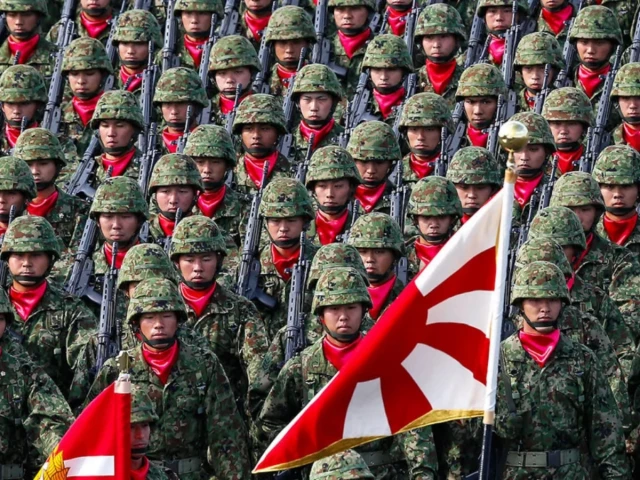
Japan’s cabinet has approved a record defense budget exceeding 9 trillion yen, roughly $58 billion, for fiscal 2026. The budget funds long-range strike missiles, drone systems and next-generation fighter development. The buildup marks a major break from Japan’s postwar “exclusive self-defense” doctrine, long understood as limiting Japan’s military to defensive operations.
Washington is not worried about the return of Japanese militarism. It is encouraging it, so long as that militarism is tied to U.S. strategy against China.
The military map Hegseth pointed to is the First Island Chain — the arc running from Japan past Taiwan to the Philippines along China’s eastern coastline. Washington calls this “deterrence by denial.” In plain language, it means using bases, fleets, missiles, war exercises and allied governments to hem China in, with Taiwan turned into a forward position in U.S. war plans.
On the sidelines, Hegseth met Philippine Defense Secretary Gilberto Teodoro and pledged stronger military cooperation along the First Island Chain. The two governments pointed to the latest Balikatan war exercise, which brought troops from Australia, Japan, Canada, France and New Zealand onto Philippine soil.
Hegseth praised South Korea for pledging to spend 3.5% of GDP on its military. He praised the Philippines for a 12% increase. He commended Japan for accelerating its “defense transformation.” He cited Australia for deeper integration with U.S. forces.
In every case, the praise was for governments moving their budgets, industries and armed forces closer to U.S. war planning.
Meng also targeted AUKUS, the military pact among the U.S., Britain and Australia formed in 2021. Its central project is equipping Australia with nuclear-powered attack submarines.
On the sidelines of the forum, the three AUKUS partners revised the submarine plan. Australia had been expected to buy at least two used Virginia-class submarines and one new one. Under the revised plan, it will buy three secondhand Virginia-class submarines from the U.S. instead.
Australia showed the pressure beneath Hegseth’s praise. Canberra has already announced that military spending will rise to 3% of GDP by 2033, with about $10 billion more over four years and $38 billion over the decade. But that still falls short of Hegseth’s 3.5% demand.
This is how the Pacific war buildup works in practice: Australian workers pay, U.S. shipyards and weapons firms collect, and the Pentagon tightens its grip on the region.
Australia is also building a submarine construction yard at Osborne in South Australia. Assembly of the first domestically built submarine is expected to begin in the early 2030s, with delivery projected in the early 2040s. The program binds Australia’s military future to U.S. war planning for decades.
China has condemned AUKUS as stoking bloc-to-bloc confrontation in the Pacific. Meng’s remarks made clear that Beijing sees it as part of the same encirclement strategy behind the First Island Chain buildup.
Washington’s direction is clear.
The Shangri-La Dialogue is not a peace conference. It is an annual assembly of military planners and arms buyers. Hegseth’s speech was its keynote sales pitch.
Join the Struggle-La Lucha Telegram channel