
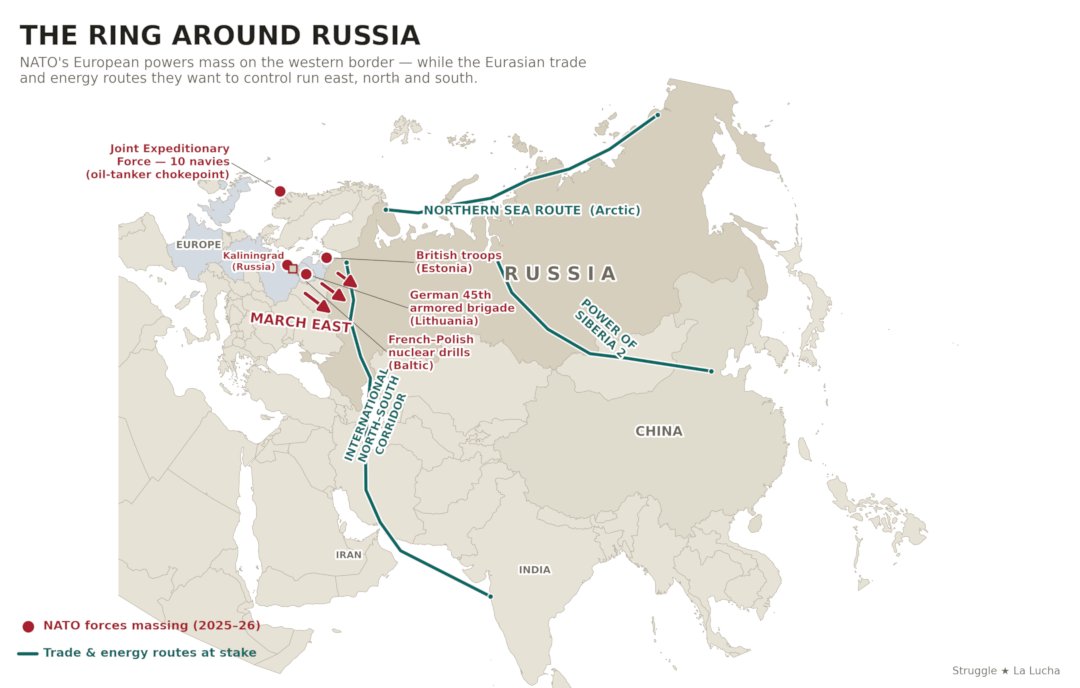
British troops are dug in along Russia’s border in Estonia. A new German armored brigade has opened in Lithuania, next to Russia’s Kaliningrad enclave. French warplanes are set to rehearse nuclear strikes alongside Poland’s.
Britain, France and Germany are pushing their armies, weapons and nuclear plans right up to Russia’s borders. Their governments call it defense. Russia has not attacked Western Europe. The danger of a wider war comes from the ring NATO is throwing around Russia.
These are not small countries being dragged along by Washington. Britain, France and Germany are the leading European imperialist powers — old colonial powers whose banks, arms makers, energy monopolies and military commands still reach far beyond their borders. They are acting inside NATO, a military alliance of 32 countries built around the Pentagon and commanded through U.S. military power.
Many people in the U.S. picture NATO as a kind of United Nations — a forum where countries talk things over. It is not. NATO’s top general is always a U.S. officer. Its member armies are organized to plug into the Pentagon’s war machine — the same ammunition, the same fuel, the same battle networks — and to buy much of their weaponry from U.S. arms makers.
All of it grows out of one fact: the U.S.-run order that has ruled the world since 1945 is cracking. Washington is pushing its crisis onto Europe — forcing bigger war budgets, more U.S. weapons purchases, more troops on Russia’s border, more money for Ukraine and deeper dependence on U.S. gas.
Europe’s ruling classes are going along because their own banks, arms makers and energy monopolies stand to profit. But they also know the U.S. can no longer guarantee their place in the old order. So they are building their own war machine inside NATO — and pointing it east.
Behind the flags are the arms makers, banks, energy monopolies and shipping insurers that profit from rearmament, sanctions and military protection.
Massing on Russia’s border
Britain has poured more troops into Estonia, a small country on Russia’s border. Germany has set up a new armored brigade — the 45th — in neighboring Lithuania and plans to build it into a permanent force of about 5,000 troops by 2027.
The buildup runs to the sea as well. Britain is pulling the navies of 10 northern European countries into a single bloc — the Joint Expeditionary Force — aimed at Russia across the northern seas. One of its targets is the fleet of tankers that carries Russia’s oil to market. Move to blockade those ships, and that is an act of war.
France is taking the buildup into the nuclear field. Macron calls it “forward deterrence” — extending France’s nuclear umbrella eastward and training for nuclear-capable strikes closer to Russia. On April 20, he met Polish Prime Minister Donald Tusk in Gdańsk, where the two agreed to prepare regular nuclear exercises in the Baltic. French Rafale fighters are to fly nuclear-capable strike runs alongside Polish F-16s. France’s own doctrine includes what it calls a limited “nuclear warning shot” — a single strike meant to force an opponent to back down. In plain language, Paris is rehearsing how a European war with Russia could cross the nuclear threshold.
The Netherlands, Germany and Poland are knitting these moves together with a planned “military Schengen” — fast lanes to rush troops and equipment toward Russia’s borders. Road by road, base by base, NATO’s European powers are laying the track for war: the depots, the commands, the fleets, the nuclear drills.
The buildup hides a rivalry. Germany and France are driving it together, but they are not equals and they do not trust each other. Berlin leans on its factories and its Lithuania brigade to shape the ground war. Paris waves its nuclear arsenal to claim the lead in Europe’s war planning. Each wants command of the same war drive.
The war they say they’re not in
Germany has gone furthest. Berlin has signed a deal with Ukraine to jointly build long-range missiles and drones — weapons that can hit targets up to 930 miles away — and to manufacture deep-strike arms for the war on Russia. Zelensky says Ukraine will set up 10 joint weapons ventures across Europe in 2026.
The deal caps two years of escalation. Back in May 2024, the Biden administration let Ukraine fire U.S. weapons in limited strikes near the Kharkiv border. Britain, France and Germany followed. That November, Biden widened it again, clearing U.S. ATACMS missiles for deep strikes inside Russia.
A European war industry is growing up around Ukraine, aimed straight at Russia. Sevim Dagdelen, a former German lawmaker on the antiwar left, calls it a German-Ukrainian military-industrial complex taking shape under Berlin’s command.
NATO never had to put the order on paper. When the alliance eased its limits on strikes inside Russia in 2024, then-Secretary-General Jens Stoltenberg said each government was deciding for itself. But the weapons are NATO’s, the satellites are NATO’s, the targeting is NATO’s, and the orders run back through NATO command.
Ukraine’s deep strikes ride on all of it. U.S. and Ukrainian officials have told the U.S. press that Washington helps set the route, the altitude, the timing and the mission plan for Ukraine’s long-range drones. By some accounts, U.S. officials help pick the targets. The drones lean on U.S. spy satellites, Starlink links, GPS guidance and preloaded maps to slip past Russian air defenses. The CIA helped build the drone program in the first place. One U.S. official called Ukraine’s drone force the “instrument” Washington uses to wreck Russia’s economy.
This is NATO’s war. Its weapons, its satellites, its intelligence and its targeting are doing the fighting, while its governments insist they are not in it.
Washington pulls back, Europe arms up
Trump has ordered NATO governments to spend far more on war and warned that the U.S. may no longer carry the alliance the way it once did. Europe’s rulers heard him loud and clear.
In late May, the Pentagon told NATO it would cut the forces it holds ready for Europe in a crisis by a third to a half — strategic bombers, long-range strike units, warships and refueling tankers. Washington said the cut would push its allies to take “primary responsibility for Europe’s conventional defense” while it moves more forces to the Pacific against China. It had already pulled an Army brigade out of Romania and scrapped an armored brigade headed for Poland.
The cuts go deep. They reach the bombers, tankers, ships and spy planes that hold NATO’s war machine together. Washington is telling Europe’s rulers the U.S. backbone of NATO can no longer be counted on. If they want the war to go on, they will have to build more of it themselves.
That is where the war economy comes in. Washington is pushing its own crisis onto Europe: buy U.S. gas, buy NATO-standard weapons, replace U.S. troops, bankroll Ukraine and turn European industry toward war. Then Europe’s governments turn around and tell workers there is no money for hospitals, schools, pensions, transit or wages.
Germany shows how the trick works. In March 2025, Berlin changed its constitution to punch a hole in the “debt brake” — the rule that caps how much the government can borrow. Everyday spending still lives under that cap. War spending no longer does: every euro of military spending above 1% of GDP can now be borrowed without limit. Berlin has set aside roughly €108 billion ($117 billion) for the military in 2026 and is racing toward 3.5% of GDP — money for weapons, bases and the new brigade in Lithuania.
Berlin points to a separate €500 billion ($540 billion) fund as proof it is also rebuilding roads, rail, hospitals and schools. But that money is borrowed and one-time. The everyday budget — wages, pensions, welfare, the daily cost of running those hospitals and schools — stays chained to the cap. War gets an open tab. Workers’ needs are told to wait.
The rearmament is the domestic face of NATO’s march east: a war economy at home, austerity for the working class, profits for arms makers, energy giants and banks, and deeper dependence on Washington’s military and energy system.
The U.S. war on Iran has sharpened the crisis for Europe’s rulers. Washington failed to force Iran to surrender, failed to reopen the Strait of Hormuz on its own terms and failed to restore its old hold over the Gulf. The fighting has shaken oil markets, shipping lanes and insurance rates. For Europe’s governments, the lesson is plain: the U.S. war machine can be tied down and weakened. If they want the war drive against Russia to continue, they will have to build more of it themselves.
The war is hitting Europe’s big capitalists too. The Hormuz squeeze has driven up energy and shipping-insurance costs. German industry was already staggering from the cutoff of cheap Russian gas. Now Germany and its neighbors buy U.S. liquefied natural gas at far higher prices, pouring European wealth into the bank accounts of U.S. gas companies. Chemical, steel and glass bosses pay more for fuel. Workers pay with layoffs, higher prices and speedup. And still their governments arm against Russia and chain themselves tighter to the U.S. energy market.
Washington planned it this way. In February 2025, Trump set up a National Energy Dominance Council to ramp up U.S. oil and gas and to use energy as a weapon. Driving Russian energy out of Europe and selling U.S. gas in its place is that plan doing its job.
The arms makers, energy giants, banks and shipping insurers are in the driver’s seat. They are pushing the rearmament, the subsidies, the sanctions and the call for military protection.
Russia’s growing ties with China, India, Iran and the Global South make that target even clearer. The imperialist powers are not just facing Russia alone, but a shifting world they can no longer command as they once did.
Europe’s rulers see the ground shifting, and they are scrambling to lock in their place in the war before any Ukraine settlement cuts them out. The British foreign-policy establishment says so out loud. The London think tank Chatham House warned that a Russia-Ukraine ceasefire could “imperil” European security.
Read that again: they call peace the danger. Europe’s NATO governments have lined up roughly another $104 billion for Ukraine, while Ukrainian forces step up drone strikes on Russian oil refineries, power plants and the supply lines into Crimea. They are paying to keep the war burning — before peace can get in the way of their plans.
There are hard reasons Russia is the target. It sits on enormous natural wealth and straddles the great land, energy and shipping routes between Europe and Asia. It anchors the International North-South Transport Corridor, a 4,500-mile freight network tying India, Iran, Russia and Central Asia to Europe without the Suez Canal and the Red Sea. It controls the Northern Sea Route through the Arctic, another path for trade between Europe and Asia that skips the southern sea lanes long policed by Western navies. And it is pushing the Power of Siberia 2 pipeline, which would lock in long-term energy ties with China and send more Russian gas east.
Russia is a capitalist state itself. But its ruling class has refused to hand strategic firms like Gazprom, Rosneft and Sberbank over to Western finance capital, and it has built ties with China, India and the Global South that Europe’s rulers want to break or take over. Behind every talking point about security lies the old hunger of finance capital — to crack open state-held resources, banks, pipelines and trade routes and feed on them.
The lines being drawn around Russia are about one thing: whether the imperialist powers can still command the wealth, markets and infrastructure of Eurasia as the U.S.-run order falls apart. Security is the cover, not the cause.
Every border scare becomes a war drum
Europe’s leaders are turning drone crashes and border scares into a drive for more troops, more weapons and national unity behind escalation. The danger from these incidents is real. But each one gets turned into a demand for more NATO surveillance, more air defenses and a harder line on Russia.
Early on May 29, a drone slammed into a high-rise apartment block in Galați, Romania, injuring two people and forcing about 70 residents from the building. Romania’s defense minister identified it as Russian. Bucharest expelled Russia’s consul in Constanța and ordered the consulate shut. Russia denied responsibility, and President Vladimir Putin said no proof had been produced.
Romania’s own president, Nicușor Dan, said the drone had been knocked off course — one of a group of Russian drones that Ukrainian air defense engaged over the Danube, near the city of Reni, before it veered into Romanian territory and struck Galați. By his account the crash was spillover from the fighting. European officials seized on it within hours all the same, turning the crash into one more demand for a harder line on Russia.
The drone traffic runs both ways now. Ukrainian strikes have hit Russian targets more than 1,000 miles from Kiev, and some of those drones have crossed into NATO territory or crashed there on the way. On May 19, a NATO fighter jet shot down a Ukrainian drone over southern Estonia — the first time the alliance had shot one down. Ukraine apologized for the “unintended incident.”
Every crash, every shootdown, every accusation turns into the same demand: more NATO surveillance, more air defenses, a harder line on Russia.
The rearmament does not stop at the border. The same governments, generals and ruling parties readying war abroad are working the home front. They make swollen military budgets look normal, shove antiwar voices to the margins, and lean on unions and movements to fall in line behind “national security.”
Workers should give them no such unity. The job is to build working-class opposition to NATO’s buildup, its war budgets and its drive toward a wider war.
The danger of a wider war
On May 25, the escalation went official. On orders from President Vladimir Putin, Russian Foreign Minister Sergey Lavrov called U.S. Secretary of State Marco Rubio and told Washington that Russian forces were beginning “systematic and consistent strikes” on military sites in Kiev and on what Moscow called its decision-making centers. The same day, Russia’s Foreign Ministry told the United States and other governments to get their diplomats and citizens out of the Ukrainian capital.
Moscow said the strikes answered a Ukrainian drone attack on Starobelsk, in Lugansk, overnight on May 21. Russian authorities said the drones hit a college dormitory and classroom building and killed 21 students, most of them young women, with 86 teenagers inside at the time. Russian officials said the drones were guided by Starlink, the satellite network run by Elon Musk’s SpaceX and used across Ukraine’s deep-strike campaign — private corporate infrastructure wired straight into the U.S. war machine. Rubio said he relayed Lavrov’s message to Trump and warned that the war risked “spreading into something new.”
Inside Russia the talk has hardened too. Prominent figures are now openly discussing strikes on European factories and infrastructure if those are used for deep attacks on Russia, and some are calling for a lower bar for using tactical nuclear weapons. That is how NATO’s proxy war can become a direct war: deeper strikes on Russia, Russian retaliation, and then new demands for Europe and the U.S. to enter even further.
Europe’s rulers are arming for a fight over their place in a world Washington can no longer hold together. They wave the banner of “Russian aggression,” but what they are after is control of Eurasia’s resources, pipelines, ports and trade routes. The powers massing on Russia’s borders are imperialist contenders reaching for a bigger share — and willing to risk a wider war to seize it. Workers have no stake in that war. National unity behind the war makers is a trap. The task now is to build working-class opposition to NATO’s march east, its swelling war budgets and its drive toward world war.
Join the Struggle-La Lucha Telegram channel