
Bolivia’s Congress has cleared the road for martial law.
On May 24, the Senate voted to remove legal limits on emergency rule. The Chamber of Deputies followed two days later. President Rodrigo Paz signed the repeal into law on May 27. The legal change gives Paz the machinery to use the army against a general strike.
The vote came in the fourth week of an indefinite general strike, after Washington and its right-wing allies had closed ranks behind Paz. The repeal passed both chambers by more than two-thirds and cleared Congress in less than 48 hours, bypassing normal debate. Deputies met virtually because blockades had cut physical access to La Paz.
Bolivia’s Constitution already allowed emergency rule. Law 1341, passed after the Áñez coup regime’s massacres, put limits on how far a president could go in suspending rights and unleashing state forces.
Congress has now stripped those restraints away. The same Assembly that removed the limits would now be asked to bless Paz’s use of soldiers against the strike.
Paz himself has warned that the crisis is “reaching a breaking point.” “The country needs order,” he told the press. “Time is running out.” In the mouth of a president who was just handed broader emergency powers, “order” means police, soldiers and arrests against the strike.
The crackdown
The government is using every arm of the state — Congress to remove legal limits, prosecutors to file terrorism charges, police to make arrests and the army to break blockades.
On May 18, about 2,500 police and 1,000 soldiers carried out pre-dawn operations against the largest demonstration of the conflict in La Paz. More than 127 people were detained that day alone. Prosecutors have charged Mario Argollo, executive secretary of the Bolivian Workers Central (COB), with terrorism. Arrest warrants on terrorism charges have been issued against 25 union leaders.
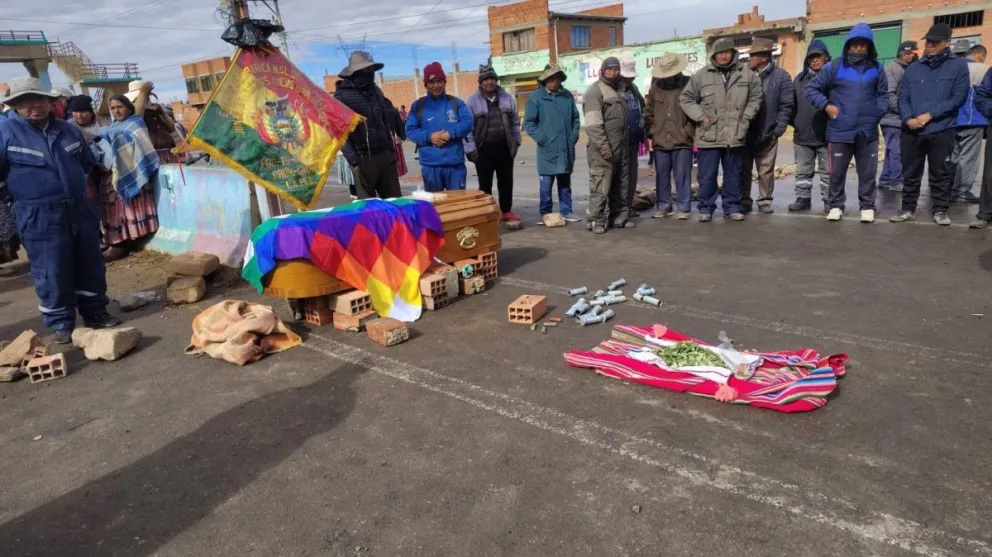
On May 23, a 3,000-strong police-military operation tried to force open the La Paz-Oruro highway. The government called it the “White Flags Humanitarian Corridor.” Aymara communities along the Altiplano route stopped the combined forces and forced them to withdraw by dirt roads. It was the second failed government attempt to clear the highway. After the convoy passed, blockaders rebuilt the barriers with dirt, rocks and logs.
During the operation, 24-year-old Indigenous community member Víctor Cruz Quispe was shot in Vilaque, in Calamarca municipality, and died within minutes. The forensic certificate found penetrating cervical trauma from a firearm projectile.
The government first denied any deaths and tried to discredit photographs of the killing by claiming they were from 2024. Once the autopsy was public, the government acknowledged Cruz Quispe’s death but insisted riot police had been instructed not to use firearms. The La Paz prosecutor opened a homicide investigation. The Ombudsman’s Office has registered seven dead, 23 wounded and 321 arrested over the course of the strike.
By May 28, blockades had spread across six departments. The road agency counted 66 blockade points; police put the number at more than 150 checkpoints nationally. Sucre, Bolivia’s constitutional capital, has been isolated from all road connections by blockades in Chuquisaca.
The strike is widening in the cities. New marches descended from El Alto to La Paz on May 22, May 25 and May 27, with the May 25 mobilization drawing the largest crowds of the conflict so far. Drivers in La Paz declared an indefinite strike over fuel shortages, adulterated gasoline and broken government commitments. Protesters also blocked passengers and cargo from entering and leaving El Alto International Airport.
Fuel shortages are spreading the crisis into Cochabamba, Oruro and Potosí, while the government uses the disruption to justify more repression.
Washington backs the crackdown
Washington has given Paz political cover to crush the strike.
On May 19, at the Council of the Americas’ annual assembly in Washington, Deputy Secretary of State Christopher Landau put Washington’s lie in plain words. He called the Bolivian uprising “a coup that’s being financed by this unholy alliance between politics and organized crime throughout the region.” Then he pressed other South American governments to repudiate the protests, warning that Washington would “hate to see this very promising opening go down the drain.”
The next day, Secretary of State Marco Rubio put the same threat in drug-war language. He posted on X that the U.S. government stood “squarely in support of Bolivia’s legitimate constitutional government” and would not allow “criminals and drug traffickers” to overthrow elected leaders in the hemisphere. That is Washington’s translation machine at work: striking miners, teachers and Indigenous communities become “criminals,” while U.S.-backed politicians become “constitutional government.”
This is not diplomacy. It is a threat. Washington is using the familiar drug-war script it has used across Latin America and the Caribbean: label resistance “criminal,” label U.S.-backed repression “constitutional,” and prepare the ground for force.
When Washington says “constitutional government,” it means a government that will impose IMF austerity, protect foreign capital and use police and soldiers against workers and Indigenous communities.
An IMF mission was in La Paz negotiating Bolivia’s first loan from the Fund in five years as workers were being shot. IDB Invest, the Inter-American Development Bank’s private-sector arm, announced plans to expand its Bolivia portfolio twentyfold — up to $450 million over the next three years — as part of a $4.5 billion IDB loan package nearly six times the bank’s previous allocation. Paz’s Decree 5503, which more than doubled fuel prices overnight in December 2025, showed what that program meant: make workers pay more for fuel, open the economy wider to foreign capital and call repression “constitutional order.”
Colombia expelled, arms flowing in
Colombia broke ranks with the governments backing Paz. President Gustavo Petro called the situation a popular insurrection and offered to mediate. Bolivia answered by expelling Colombian Ambassador Elizabeth García Carrillo on May 20.
Eight governments — Argentina, Chile, Costa Rica, Ecuador, Guatemala, Panama, Paraguay and Peru — had already issued a joint statement backing Paz. Most are tied to Trump’s Shield of the Americas military alliance.
Argentina’s far-right president Javier Milei has sent at least two Hercules cargo planes to Bolivia, presented as humanitarian aid. Former Argentine ambassador Ariel Basteiro and Bolivian deputy Rolando Pacheco charge that the cargo included tear gas and crowd-control equipment, and was also used to airlift Bolivian police and military from outlying regions to La Paz.
The pattern recalls the 2019 coup against Evo Morales. When the coup regime of Jeanine Áñez took power, then-Argentine President Mauricio Macri sent 40,000 cartridges and tear gas canisters to help it crush resistance.
On the same day Paz signed away the limits on emergency rule, he flew to Santa Cruz to meet with the presidents of the Civic Committees of all nine Bolivian departments. The Civic Committees represent the agro-industrial and financial oligarchy and have a long history of paramilitary mobilization against workers and Indigenous communities. They provided the civilian shock troops for the 2019 coup.
Far-right groups linked to that coup are again demanding martial law and lethal force against the opposition. Journalist Joseph Bouchard, reporting from La Paz, described many of these groups as openly fascist and white supremacist. They are the street force of Bolivia’s racist, pro-U.S. oligarchy.
Lithium, loans and U.S. capital
Bolivia sits on top of one of the world’s largest lithium reserves. It is also rich in tin, silver, zinc, copper and natural gas. U.S. Southern Command has named the lithium triangle — Bolivia, Argentina and Chile — a region of strategic competition with China. In plain terms, Washington wants to seize control of Bolivia’s resources and tear up the country’s existing contracts with Chinese and Russian firms.
With Milei in Argentina and Kast in Chile, Washington has governments in two corners of the lithium triangle ready to let U.S. corporations take control of resources, infrastructure and public wealth. Bolivia remains the country where Indigenous and working-class resistance can still block that program.
That is why Paz needs emergency rule: to break the strike and clear the way for the selloff.
Paz has moved to open Bolivia’s lithium and rare earth reserves to foreign capital. His government is drafting new lithium and hydrocarbons laws to attract foreign investment and revise existing contracts with Chinese and Russian firms. It is also moving to bring in U.S. tech companies — Tesla, Amazon and Oracle among them — to invest in Bolivian data centers and infrastructure.
Paz restored Bolivia’s diplomatic ties with Israel in December 2025, two years after Arce broke them over Israel’s war on Gaza. Morales warned that the renewed ties place Israel back inside Bolivia’s security apparatus, where Washington has long used Israeli military and surveillance ties to extend U.S. power in Latin America.
Paz also dissolved the Ministry of Environment and Water in his first days in office. After mass resistance forced Paz to repeal Law 1720 — a measure that would have made it easier for creditors and large land interests to seize small farmers’ and Indigenous communities’ land for debt — the Chamber of Deputies announced it would draft a new land law “with the same spirit.”
This is what Paz is trying to impose: open the mines, turn infrastructure over to foreign capital, strengthen the security apparatus and break the Indigenous and working-class resistance.
The terrorism charges, soldiers, IMF mission, Argentine cargo flights, lithium opening and repeal of Law 1341 are one operation: make Bolivia’s workers, peasants and Indigenous Peoples pay through fuel hikes, privatization, foreign control of resources and military repression.
Bolivia’s workers and Indigenous Peoples are refusing to pay.
Join the Struggle-La Lucha Telegram channel