
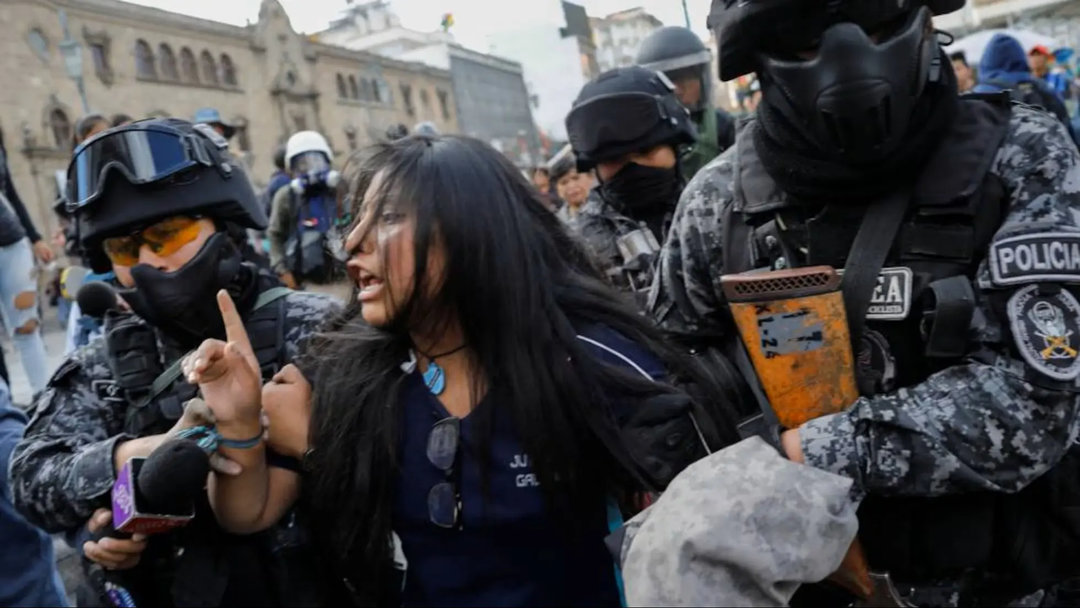
On May 19, Bolivia’s government charged the head of the country’s main labor federation with terrorism. The charge is aimed not only at one leader. It is aimed at workers, Indigenous Peoples and poor communities — including miners, teachers, transport workers and health workers — who have entered an indefinite general strike against President Rodrigo Paz.
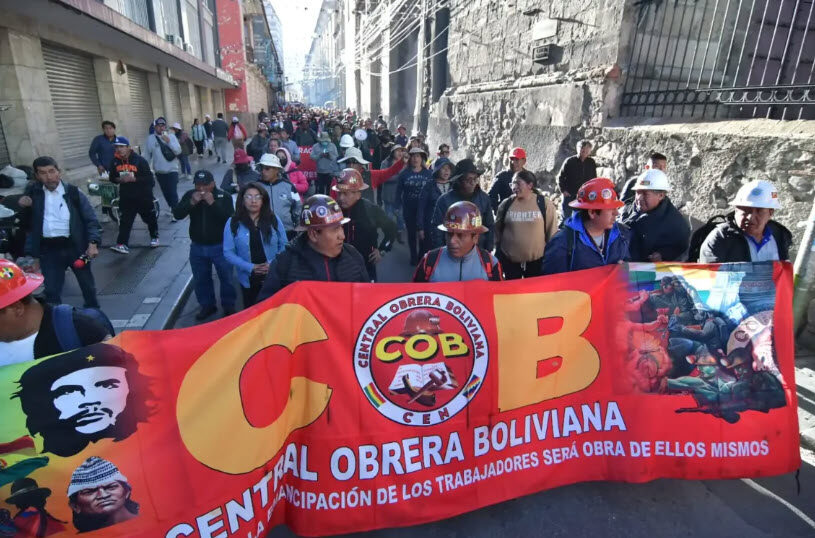
Attorney General Roger Mariaca confirmed that Mario Argollo, executive secretary of the Bolivian Workers Central (COB), is being prosecuted for alleged public incitement to commit crimes and terrorism. A separate arrest order was issued against Justino Apaza Callisaya, leader of the Federation of Neighborhood Councils of La Paz (FEJUVE).
“They will not break us in the struggle we have begun,” Argollo said, accusing the government of trying to silence the movement’s leadership with legal actions and criminal complaints.
That is what the terrorism charge means. It turns a labor struggle into a criminal conspiracy. When workers block highways to defend wages, land and fuel, the government calls it terrorism. When the government sends soldiers, police, armored vehicles and tear gas against them, it calls that “restoring order.”
TeleSUR reported that at least four protesters have been killed since May 16. AP reported that prosecutors announced 90 arrests on May 18; by May 19, TeleSUR reported that the number had risen to more than 127. The strike has not collapsed. At least 67 highways remain blockaded. The government-owned oil company YPFB has suspended gas supply to municipalities because fuel tankers cannot move.
Washington wants the spoils
Paz was elected president in October 2025 after the Movement Toward Socialism — Movimiento al Socialismo, or MAS — split and Morales was kept off the ballot. MAS, rooted in Bolivia’s Indigenous, labor and coca-grower movements, brought Evo Morales to power in 2005 and governed for nearly two decades. Paz took office after years of U.S. sanctions, aid cuts and drug-war pressure battered Bolivia’s economy, fuel supply and ability to defend its resources. Washington used the U.S. Drug Enforcement Administration, or DEA, as a weapon against Morales and Bolivia’s coca-growing regions. In 2019, Morales was forced from office after the military demanded his resignation, and Trump praised the coup.
Washington destabilized Bolivia and now wants the spoils. Paz quickly aligned with the Trump administration. The U.S. State Department backed him as his government moved to hand Bolivia’s land and natural wealth over for exploitation by foreign capital.
Bolivia is one of South America’s richest countries in strategic resources: lithium, tin, silver, zinc, lead, copper, antimony, tungsten, natural gas, forests and water. The oligarchy wants to turn these resources — and the Indigenous territories that stand in the way of the grab — over to banks, agribusiness, mining companies and imperialist capital. Law 1720 is part of that larger plan.
The current wave of struggle began with Law 1720, the land measure passed in April. Indigenous communities saw it as an opening for land theft. The movement spread because years of U.S. economic warfare and the Paz government’s austerity program had already hit workers and poor communities through fuel shortages, rising prices, low wages and privatization threats.
In December 2025, Paz issued Decree 5503, eliminating decades-old fuel subsidies overnight and sharply raising fuel prices. Bolivia once earned dollars by exporting natural gas. But U.S. sanctions, trade punishment, drug-war pressure and support for the 2019 coup weakened the country’s ability to defend its resources, invest in production and control its fuel supply. Falling gas production and the dollar squeeze left Bolivia dependent on imported diesel and gasoline. Then the U.S. war against Iran and the blockade of the Strait of Hormuz made every fuel shipment more expensive, deepening the squeeze Paz was already shifting onto workers and Indigenous communities.
Paz and Bolivia’s rich shifted the crisis onto workers and Indigenous communities. His first legislative act eliminated taxation on large fortunes. Fuel prices doubled, wages lagged, and the wealthy got relief.
That is the class issue behind the strike: who will pay for Bolivia’s fuel shortages, rising prices, debt and land crisis — workers, Indigenous Peoples and poor communities, or the rich, the banks, the landlords and the importers.
Facing a massive May Day assembly in El Alto, the COB moved to declare an indefinite general strike on May 2. The first demand was Paz’s resignation. The movement also demanded repeal of Law 1720, higher wages and pensions, an end to privatization plans and lower taxes for small businesses. More than 70 unions have joined the mobilization.
Land theft dressed up as credit
Law 1720 exposed the land question behind the crisis. The issue was not simply high-cost, extortionate credit for “small farmers.” The law went much further. In Bolivia, small agricultural property is a protected legal category rooted in the struggles that broke up the old landlord system. It is protected family land: it cannot be seized, divided up or taxed as ordinary agrarian property.
Law 1720 allowed titled small agricultural properties to be reclassified as medium-sized holdings through a fast administrative process at INRA, Bolivia’s agrarian reform agency. Once reclassified, the land could be used as collateral for bank loans. That meant land protected from seizure could be mortgaged and lost for debt.
For Indigenous and rural communities, the danger went beyond individual plots. Many small titled parcels exist inside larger community territories. Pulling those parcels into the land market without community consent threatened to fracture collective territory from within. Indigenous land is not simply a commodity. It is held and defended as the basis of community life, production, culture and self-government.
The government called Law 1720 rural credit. Indigenous communities saw it as land theft dressed up as credit.
The Amazon march
The march began April 8 in Cobija, Pando, in Bolivia’s northern Amazon lowlands, and was joined by people from Beni and other regions along the route. Bolivian reports put the route at roughly 1,000 kilometers — more than 600 miles — over nearly a month, from the tropics into the near-freezing Andes, before the marchers reached La Paz on May 4.
“Our life is collective, not individual,” rural union leader Oscar Cardozo said in La Paz. “The land must be respected; it’s not for sale.”
That sentence cuts through the official language. The issue is collective life against private profit. It is Indigenous territorial rights against banks, landlords and corporations.
Paz retreats, then cracks down
On May 13, Rodrigo Paz formally repealed Law 1720. But the Chamber of Deputies said it would draft a new law with the same intent. Protesters rejected the repeal as a maneuver and kept their demand for Paz’s resignation.
The government’s next answer was repression. On May 17, about 3,500 soldiers and police carried out a pre-dawn sweep of roadblocks around El Alto and along the La Paz–Oruro highway. When negotiation failed to stop the strike, the Paz government turned to force. It sent police and soldiers against workers and Indigenous communities defending the blockades.
The Paz government has tried to blame former President Evo Morales for the uprising. Morales rejected that charge, saying there are no “sinister plans,” only “a country tired of being lied to” while the government protects business owners, bankers and agribusiness.
The previous week, authorities issued a warrant against Morales on contempt charges in a politically driven case that Morales and his supporters denounce as part of the effort to sideline him.
The meaning is clear. The Paz government is trying to smear labor and Indigenous resistance as terrorism. Roadblocks, strikes and union organization are tools of mass struggle, not terrorist acts. Prosecutors are trying to rename them as crimes: a roadblock becomes an “attack on transportation security,” a strike becomes an “attack on public services,” and a labor federation becomes a “terrorist network.” It is a political fraud meant to break the strike.
Washington, the IMF and the crackdown
Washington and Trump-aligned governments in the region quickly closed ranks behind Paz. Eight Latin American governments — Argentina, Chile, Costa Rica, Ecuador, Guatemala, Panama, Paraguay and Peru — issued a joint statement May 15 backing him and condemning the mobilizations. Most are tied to Trump’s Shield of the Americas network, a U.S.-led bloc of right-wing governments built to police Latin America for imperialism.
Blackwater founder Erik Prince called publicly for U.S. military intervention. Bolivian lawmaker Rolando Pacheco of the Popular Alliance has alleged that Argentina’s far-right President Javier Milei sent two planeloads of tear gas and crowd-control equipment to Paz’s forces.
An IMF mission was in La Paz as of May 19, negotiating terms for Bolivia’s first loan from the Fund in five years. That is the other side of the terrorism charges. While labor leaders are threatened with prison, the IMF is negotiating the next round of austerity.
Paz had already weakened environmental and water oversight by dissolving the Ministry of Environment and Water as one of his first acts in office. Then, after the government was forced to repeal Law 1720 — the measure that would let protected small agricultural property be reclassified, mortgaged and lost for debt — the Chamber of Deputies said it would draft a new land law “with the same spirit.” The message was clear: the government had not abandoned the land grab. It had only retreated and repackaged it.
The target is not only land in the narrow sense. It is Bolivia’s whole material base: land, forests, water, lithium, gas and minerals. These lands and resources were first stolen from Indigenous Peoples through conquest and landlord rule, then partly won back and defended through decades of Indigenous, worker and popular struggle. The same forces demanding “credit,” “investment” and “legal certainty” want to turn those gains back into property claims for banks, agribusiness, mining companies and imperialist capital.
One mining leader put the movement’s position plainly: “The sole demand of the mobilized people is the removal of the president due to his inability to solve this country’s structural problems. He is leading us adrift, giving away our natural resources, mortgaging the country for our children and grandchildren.”
That is why the Paz government reaches for terrorism charges. The terrorism charge is a weapon to break the strike. It puts prosecutors, police, soldiers and prisons at the service of the rich, the banks, the landlords and Washington. The aim is to clear the roads, break the blockades, bust the unions and push through fuel hikes, privatization and land theft. Bolivia’s workers and Indigenous Peoples are refusing to pay for a crisis made by capitalism and imperialism.
Join the Struggle-La Lucha Telegram channel