
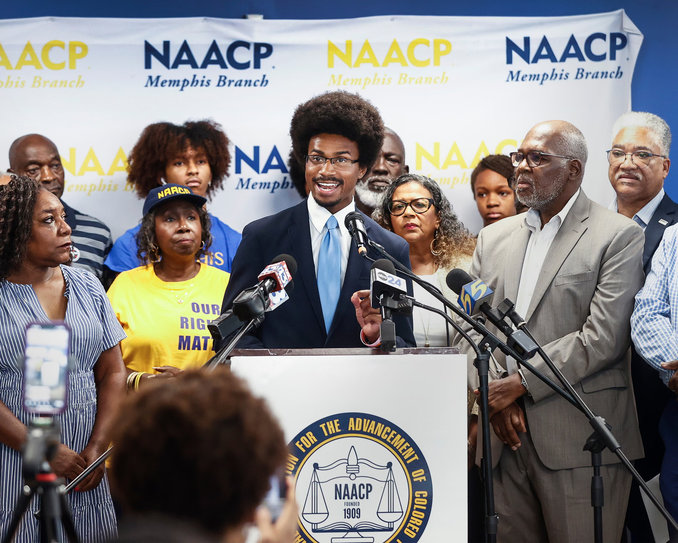
The NAACP has sued Elon Musk’s AI company xAI over a massive gas-burning power plant it built without permits in a Black working-class community outside Memphis. The plant is now one of the largest fossil fuel power plants in Mississippi. The U.S. Justice Department, citing a Trump executive order, has moved to back xAI in that lawsuit.
The NAACP and its Mississippi State Conference filed the suit April 14 against xAI and MZX Tech. The companies installed 27 gas-burning turbines in Southaven, Mississippi, starting in August 2025 to power Colossus 2, xAI’s data center just across the state line in South Memphis. They did it without Clean Air Act permits. Tens of thousands of people live within a mile of the turbines. Homes are half a mile away. An elementary school is a mile away.
By the time the NAACP asked the court for an injunction on May 6, the number of turbines on site had grown to at least 33. State regulators later confirmed 46.
The plant is already a major source of air pollution across the Memphis region. Memphis has been named an asthma capital. Both Shelby County, Tennessee, and DeSoto County, Mississippi, received failing grades for ozone pollution from the American Lung Association. xAI’s plant is expected to be the largest single industrial source of smog-forming nitrogen oxides in the 11-county Memphis metropolitan area. An independent study projected the permanent installation would cause between $30 million and $44 million in annual health damages — through premature deaths, new asthma cases, heart attacks and hospital visits across North Mississippi and West Tennessee. The plant is also projected to release 19 tons of cancer-causing formaldehyde into the surrounding communities every year.
xAI’s playbook: install first, permit later
xAI used the same approach when it opened Colossus 1 in Boxtown, a majority-Black South Memphis neighborhood, in June 2024. It powered that facility with up to 35 unpermitted gas turbines. Residents reported foul air and worsening health. University of Tennessee researchers confirmed the turbines had measurably worsened pollution. Only after the Southern Environmental Law Center sent a notice of intent to sue did xAI remove the unpermitted turbines and obtain permits for 15 remaining units.
Then xAI did it again. When SELC sent a second notice of intent to sue over the Southaven turbines in February 2026, the turbines were already running. They had been running since at least October 2025.
xAI’s legal defense is that the turbines are “mobile” — they sit on flatbed trailers — and therefore exempt from Clean Air Act permits for stationary sources. SELC says a turbine that has been parked and generating power for months is a stationary source under the law, not a mobile one.
Mississippi state regulators have not shut the plant down. In March 2026, the Mississippi Department of Environmental Quality Permit Board issued a permit for xAI to operate 41 permanent gas turbines at the Southaven site — making it one of the largest fossil fuel power plants in the state.
But that permit did not cover the turbines named in the lawsuit. SELC says the 27 original turbines and the units added later are not part of the March permit, and MDEQ confirmed that the 46 temporary-mobile turbines were not covered by it.
The board approved the permit over overwhelming public opposition. Every community member who testified at the Southaven public hearing spoke against xAI. The Permit Board meeting itself was held in Jackson on Election Day — nearly three hours from the communities most affected.
DOJ intervenes for Musk
The Justice Department’s filing turns Trump’s AI policy into xAI’s courtroom defense.
DOJ attorney Adam R.F. Gustafson filed a notice in federal court in Mississippi saying the federal government is considering intervening in the case, or submitting an amicus brief, because the NAACP lawsuit could conflict with Trump’s policy of promoting U.S. “AI dominance.” The basis for this position is Trump’s executive order of Jan. 23, 2025, directing federal agencies to clear obstacles to AI development. That order was never debated in Congress and no member of the public — including the communities now living next to Musk’s turbines — had any opportunity to challenge it before it became policy.
The DOJ’s Environment and Natural Resources Division — the office responsible for enforcing federal environmental protections — filed the intervention notice. The division argued that AI development serves “human flourishing, economic competitiveness, and national security.” It did not address the formaldehyde, the nitrogen oxides, or the health of Southaven residents.
The filing also backed xAI’s request for more time to respond to the NAACP’s demand for an injunction. Earthjustice senior attorney Elias Quinn said the plaintiffs would accept a delay only if xAI shut off the turbines in the meantime. xAI refused.
The Clean Air Act is a law passed by Congress. Trump’s executive order did not repeal it. The DOJ is now using that order to subordinate enforcement of federal environmental law to the expansion needs of Musk’s company.
Tennessee state Rep. Justin J. Pearson, whose district includes part of the affected area, was direct: “This is a clean, clear-cut case of environmental racism.”
A national pattern
What xAI is doing near Memphis is part of a wider pattern. AI companies are demanding more power, and utilities are answering with more fossil fuels. Mercury emissions from coal plants rose roughly 9% in 2025, reversing years of decline, according to a New York Times analysis of EPA data published May 11. In Indiana, where AI data centers have expanded rapidly, one coal plant increased its mercury emissions by 160% in 2025, generating 90% more power to meet rising demand.
The Trump administration has compounded the damage by scrapping the stronger mercury limits adopted in 2024 and sending coal plants back to the weaker 2012 rules. The rollback saved the industry $120 million a year in compliance costs. Harvard researchers calculated the public health cost at $200 million in the first year alone.
For families in Southaven and South Memphis, this is not a policy debate. The turbines have been running since at least October 2025. Every delay is more poison in the air.
Join the Struggle-La Lucha Telegram channel