
Cuba’s energy minister declared May 14 that the island had exhausted its entire supply of diesel and fuel oil — the fuels that power its electricity grid.
“We have absolutely no fuel oil, absolutely no diesel. We have no more reserves,” Vicente de la O Levy said in a televised statement.
Hours later, CIA Director John Ratcliffe flew to Havana with Washington’s demand for “fundamental changes.”
That sequence tells the story. U.S. imperialism first tightened the fuel siege. Then it sent the head of the CIA to deliver the political ultimatum.
A CIA official said Ratcliffe carried a direct message from President Trump: the U.S. is “prepared to seriously engage on economic and security issues, but only if Cuba makes fundamental changes.” Ratcliffe urged the Cuban side to take a lesson from the Jan. 3 operation in which U.S. forces kidnapped Venezuelan President Nicolás Maduro.
The message was clear: comply or face the same fate.
The human cost of Washington’s blockade is not abstract. It is measured in darkened homes, hospital wards, broken equipment, uncollected garbage and infants who should have lived.
Blackouts in Havana now exceed 20 to 22 hours per day. Hospitals are struggling to maintain basic care. At Havana’s Eusebio Hernández Pérez maternity hospital, high-voltage surges from repeated blackouts have damaged incubators. Doctors manually pump ventilators to keep newborns alive. Only about 41.5% of the capital’s 106 garbage trucks are running, with waste piling on street corners. Canadian mining company Sherritt has suspended operations at its Moa nickel facility.
Since Washington began tightening sanctions in 2017, Cuba’s infant mortality rate has risen from 4.0 deaths per 1,000 live births to 9.9 in 2025. An estimated 1,800 Cuban infants died in those years who would have survived without the intensified sanctions. Washington’s policy of collective punishment produced those deaths.
The current energy collapse was triggered by executive order on Jan. 29, when Trump imposed an oil blockade on the island, threatening tariffs against any country that supplied Cuba with fuel. Cuba’s two largest oil lifelines — Venezuela and Mexico — were cut off under U.S. pressure. Venezuelan shipments were choked off after the January seizure of President Nicolás Maduro. Mexico halted deliveries under tariff threats.
A Russian tanker, the Anatoly Kolodkin, arrived on March 31 with approximately 730,000 barrels of crude — enough to cover roughly 12 to 14 days of demand. That supply is now gone.
Two-thirds of Cuba’s energy had been met by fuel imports. Eighty percent of its grid runs on thermoelectric units and diesel and fuel oil engines. What remains is Cuba’s own scarce crude, natural gas, and 1,300 megawatts of installed solar capacity — much of which cannot be stored due to grid instability.
This is how imperialist siege works in practice: not only through soldiers and warships, but through oil contracts, shipping insurance, banks, tariffs and sanctions — the everyday machinery of monopoly capital — that decide whether a hospital has power.
As the pressure campaign intensified, the State Department publicly formalized an offer of $100 million in aid — to be distributed through the Catholic Church and conditioned on “meaningful reforms to Cuba’s communist system.”
The figure works out to roughly $10 per Cuban man, woman, and child. It does not include a single barrel of oil. Washington created the crisis. The $100 million offer is a ransom note.
Cuban Foreign Minister Bruno Rodríguez Parrilla said Cuba was “willing to hear the details” but named the only assistance that would actually matter.
“The best assistance the U.S. government could provide to the noble Cuban people at this time — or at any time — is to de-escalate the measures of the energy, economic, commercial, and financial blockade,” he said, describing the current siege as intensified “as never before in recent months.”
The offer arrived as Cuba’s energy minister said there was nothing left to run the grid. The offer is a public relations maneuver attached to a political ultimatum.
Washington is escalating on every front simultaneously. Reuters reported May 15 that the Justice Department is moving to indict 94-year-old Raúl Castro over Cuba’s 1996 shootdown of planes operated by Brothers to the Rescue. U.S. media presents the group as a humanitarian exile organization. It was not. Brothers to the Rescue was part of the U.S.-created anti-Cuban terrorist network based in Miami. Its founder, José Basulto, was a CIA operative and Bay of Pigs veteran who had worked in intelligence, communications, explosives, sabotage and subversion. He later acknowledged a CIA-sponsored commando mission into Cuba and an armed 1962 attack in which he fired a 20mm cannon at a Cuban hotel. Brothers to the Rescue repeatedly violated Cuban sovereignty, including flights over Havana to drop leaflets. On Feb. 24, 1996, its planes again entered Cuban airspace. Cuba shot them down after repeated warnings. Washington now revives that decades-old provocation as one more instrument of pressure.
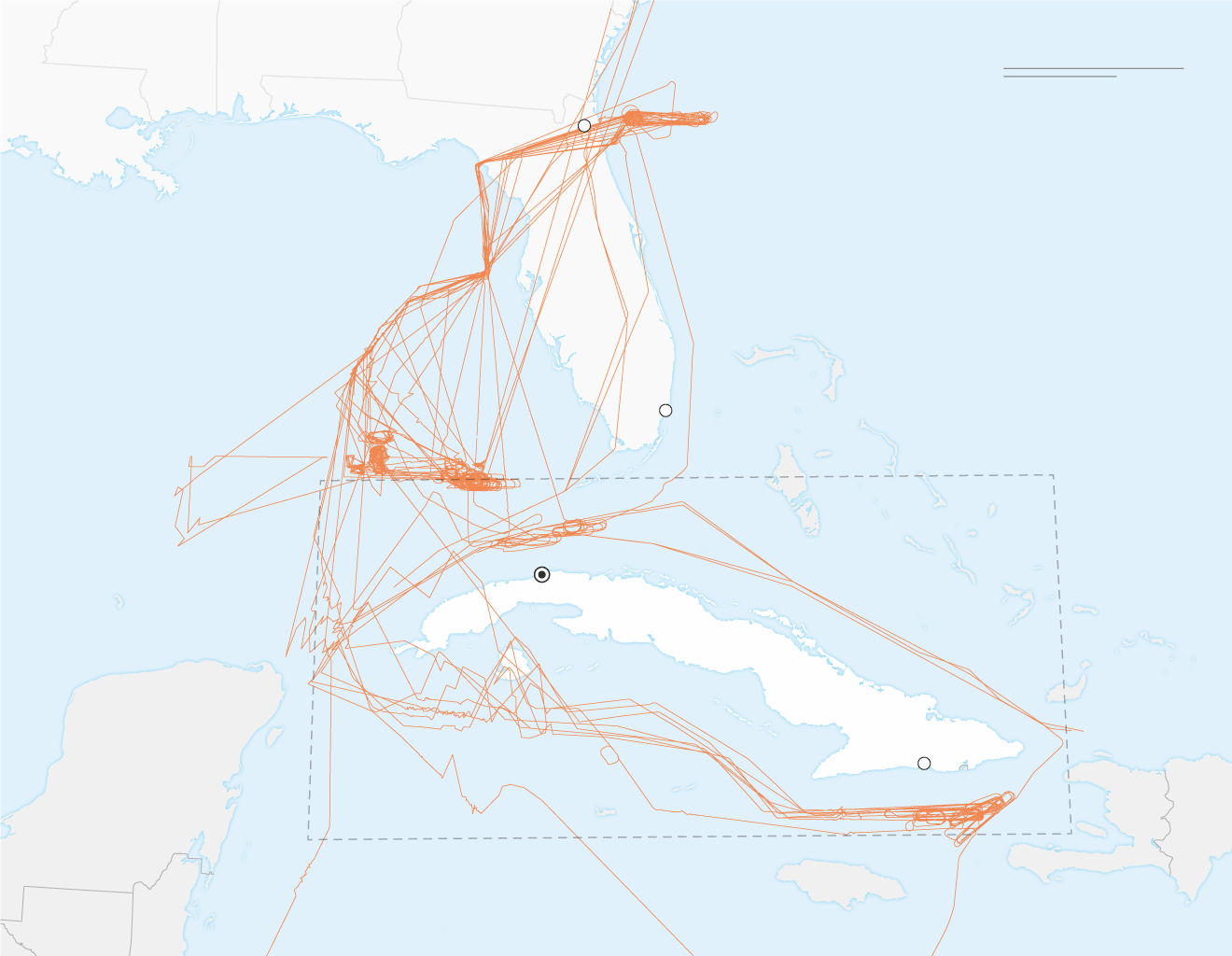
Since Feb. 4, U.S. Navy and Air Force surveillance planes and drones have conducted at least 25 intelligence-gathering flights near Cuba’s coast, some within 40 miles of shore. CNN analyzed publicly available aviation data from Dec. 28, 2025, to April 28, 2026, and found the first such flight during that period occurred Feb. 4. The same platforms — P-8A Poseidons, RC-135V Rivet Joints and MQ-4C Tritons — were deployed before the Jan. 3 Venezuela operation.
The flights are being conducted visibly, with transponders active on public tracking sites.
“When preparing for operations, we go completely dark,” retired Navy Commander José Adán Gutiérrez, an intelligence specialist, told the New York Times. “The fact that these flights were purposely made public basically indicates that there is a message.”
Cuba’s Deputy Foreign Minister Carlos Fernández de Cossío described the military buildup as “part of a coldly calculated communications strategy” and warned that those participating in it “would be complicit in the eventual bloodbath.”
A senior U.S. administration official offered his own summary to Axios: “They have no fuel. They have no money. They have no one coming to rescue them.”
CIA pressure, State Department ransom, Justice Department charges, Pentagon surveillance, Treasury sanctions and economic strangulation — the coordinated machinery of the imperialist state, all aimed at the same goal: forcing Cuba to surrender its sovereignty.
Washington is using Venezuela as the warning and Cuba as the next target.
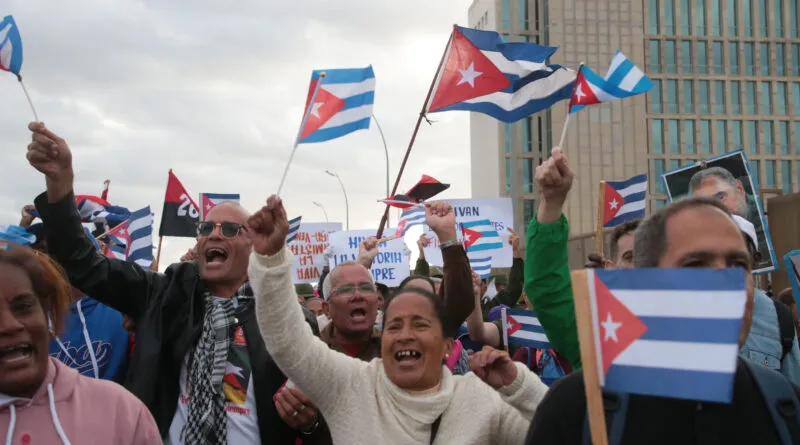
President Miguel Díaz-Canel made Cuba’s position clear: Cuba will defend its sovereignty. The Cuban people have resisted U.S. aggression, blockade and sabotage for more than six decades. That resistance demands active solidarity from workers and oppressed people inside the United States.
The demand is straightforward: end the blockade now. No invasion. No regime-change ultimatums delivered by CIA directors. U.S. hands off Cuba.
Join the Struggle-La Lucha Telegram channel