
The following statement published in the Cuban trade union newspaper Trabajadores was written by Francisco Rodríguez Cruz, a gay Cuban journalist, activist, and communist thinker.
LGBTQ+ activists in Cuba, along with other social organizations, advocate today for the island’s right to exist and defend itself against external aggression, particularly from the United States and its “hybrid war,” placing the struggle for diversity within the broader framework of national sovereignty.
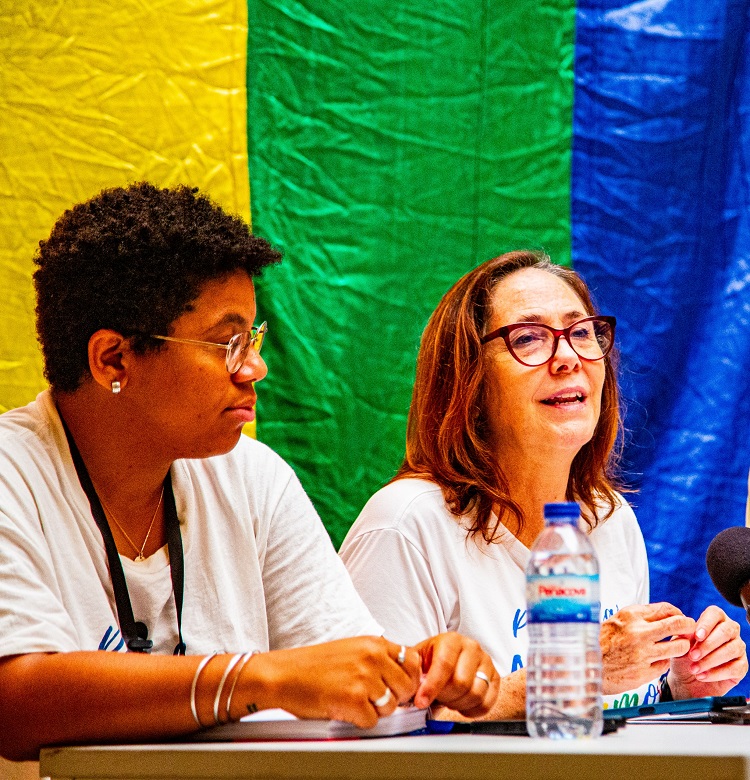
This was stated by Dr. Mariela Castro Espín, director of the National Center for Sexual Education (Cenesex), speaking at a press conference held at its headquarters on Wednesday, on the occasion of the 19th edition of the Cuban Days Against Homophobia and Transphobia.
The deputy to the National Assembly of People’s Power also recalled that LGBTQ+ groups identified with the Revolution are considered an integral part of the Cuban social system, assuming both collective rights and duties, in contrast to the global setback affecting vulnerable populations and minorities in countries such as the United States and Argentina.
Castro Espín emphasized that, despite economic limitations and uncertainty, the movement has the support of the country’s top leadership, reaffirming that the Cuban State and the Communist Party maintain funding for these activities as an unwavering political and ideological commitment.
“Faced with a global trend of regression, Cuba is positioning itself at the international forefront in the protection of the rights of the LGBTQ+ community, consolidating itself as a positive benchmark,” said the director of Cenesex during her speech.
Regarding the main activities, Maiteé Navarro, national coordinator of the Days Against Homophobia and Transphobia, reported that on May 4 a sports meeting was held at the center of 23 and B, in El Vedado, with the participation of directors and the social networks of Cenesex: TransCuba, Network of Lesbian and Bisexual Women, and MSH Network.
The academic program includes the tenth edition of the international colloquium “Trans-Identities, Gender and Culture,” which opened on Tuesday with the participation of Dr. Geydis Fundora Nevot, director of FLACSO-Cuba, and which concludes on Thursday, with the presence of national specialists and specialists from other countries.
The Cuban Gala Against Homophobia and Transphobia will take place at the Teatro América this Thursday, May 14, at 5:00 pm, with the presentation of the Cenesex awards and under the artistic direction of Efraín Sabás.
Next Sunday, May 17, the date on which the International Day Against Homophobia, Biphobia and Transphobia is celebrated, the traditional Conga and the Diversity Festival will be held, culminating in the Cuba Pavilion.
These popular celebrations are not only festive, but also represent the taking of public space by a citizenry aware of its rights and duties, it was explained.
As a prominent community activity, a health fair was held in El Vedado, involving various institutions to offer services and direct information to the population, as well as the screening of the documentary “Umbral” at the Chaplin cinema.
Regarding the historical background, Mariela Castro Espín recalled that the process initiated with the Family Code of 1975 generated debates and dissatisfactions that drove decades of scientific research and social practice, with a fundamental role played by the Federation of Cuban Women and Vilma Espín.
The sexologist explained that the “Love is the Law” campaign celebrated the approval of the new Constitution in 2019 and the Family Code in 2022, achieving for the first time that the rights of the LGBTQ+ community were protected under the supreme law, positioning Cuba among the few countries with explicit constitutional protections.
Castro Espín highlighted that in addition to Havana, this year Artemisa is a shared venue for the Conference, as it is one of the provinces where a less favorable vote was recorded in the referendum on the Family Code, making it a priority target for educational work.
As a recent milestone in the work for the rights of LGBTIQ+ people, a collaboration agreement was formalized between Cenesex and the Ministry of Justice, specifically with the Ombudsmen’s Offices—a young institution created in 2023—to channel cases of rights violations, and an upcoming meeting was announced with the Ministry of the Interior to raise awareness about the treatment of LGBTQ+ people in criminal proceedings and in light of the new facilities offered by the Civil Registry Law to trans people.
The launch of the podcast “After the Closet,” produced by the Network of Lesbian and Bisexual Women, was also announced, and the first workshop “Uniting Voices,” to be held on Friday, May 15, was highlighted. This workshop aims to define research priorities from within the LGBTQ+ population itself, including causes of cancer mortality in lesbian women and the life expectancy of trans people, among other issues.
Historically, these events have evolved from visibility gatherings to becoming processes of real political influence that transform the Constitution. This path has been marked by constant dialogue between grassroots activism and state structures.
The importance of these conferences lies in their capacity for self-criticism and constant evolution, ensuring that no one is left behind, according to their organizers. Each year, weaknesses and strengths are analyzed so that the next edition can be a further step towards full social justice.
“The conference will be held ‘even if it’s under the tunnels,’ because the Cuban State’s commitment to diversity is unwavering,” concluded Mariela Castro Espín, alluding to the threats of military aggression from the United States government against Cuba, and reaffirming that in June the analysis will be carried out to begin planning the twentieth edition next year.
Translated by Melinda Butterfield
Source: Trabajadores
Join the Struggle-La Lucha Telegram channel