
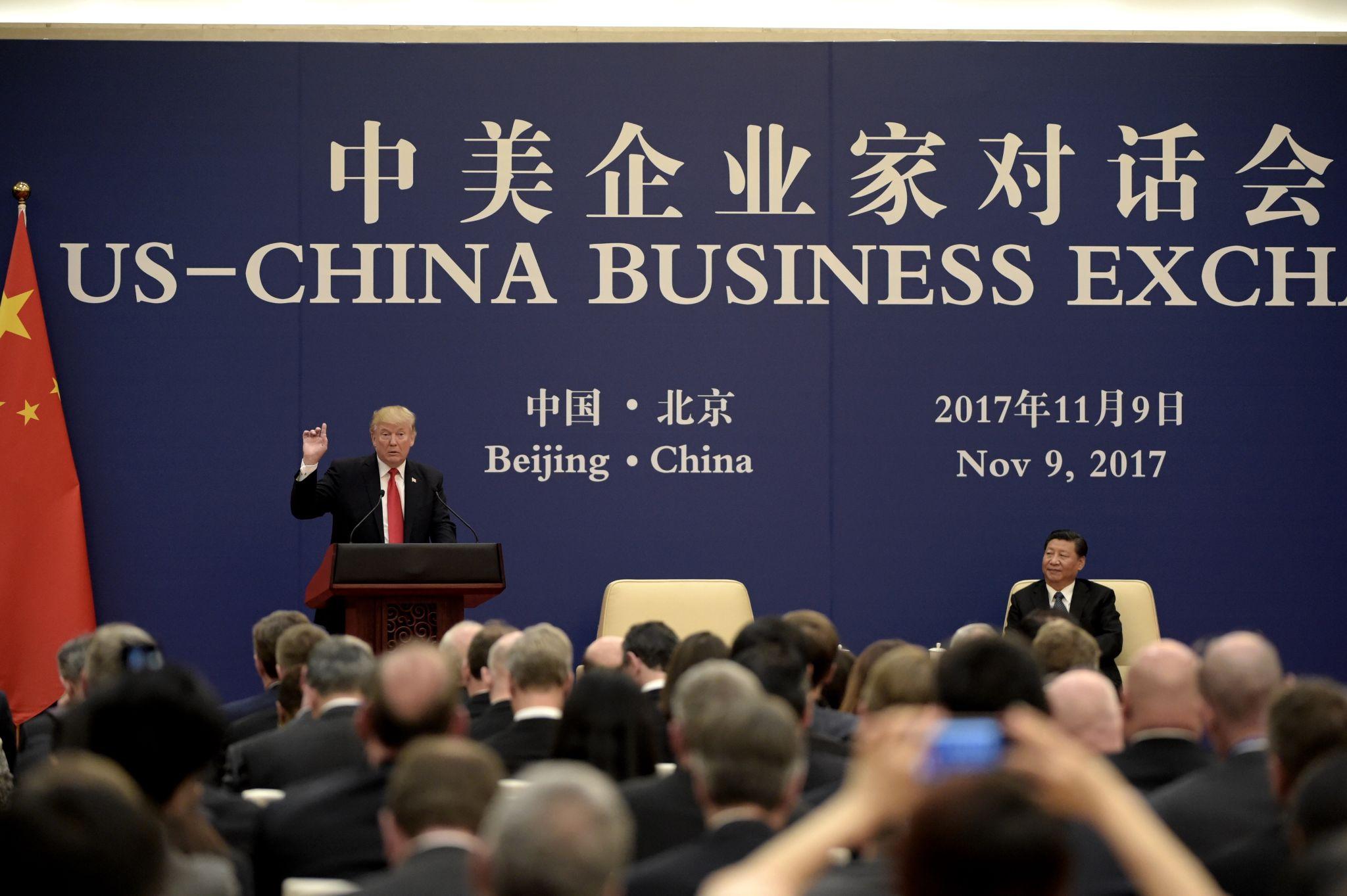
President Donald Trump arrived in Beijing on May 13 ahead of two days of talks with Chinese President Xi Jinping — the first visit by a sitting U.S. president to China since Trump’s last trip in 2017.
He will bring with him a delegation from the biggest U.S. banks, tech firms, manufacturers and financial monopolies: Nvidia’s Jensen Huang, Tesla’s Elon Musk, Apple’s Tim Cook, BlackRock’s Larry Fink, Blackstone’s Stephen Schwarzman, Goldman Sachs CEO David Solomon, Boeing CEO Kelly Ortberg, Citigroup CEO Jane Fraser, Mastercard CEO Michael Miebach, Micron CEO Sanjay Mehrotra, Qualcomm CEO Cristiano Amon, Visa CEO Ryan McInerney, Meta executive Dina Powell McCormick, and others.
Trade, technology controls, Taiwan and the U.S. war on Iran are the immediate issues around the Beijing meeting. Artificial intelligence may also be discussed. But understanding what is really at stake requires stepping back from the daily headlines.
China is not what the headlines say
The U.S. corporate media covers the Trump-Xi summit as a clash between rival powers. That is the language of “geopolitics” — a way of describing world events that hides classes, hides imperialism and hides the struggle over who controls production, technology and the wealth created by workers.
China is not a mirror image of the United States. By nominal GDP — measured at market exchange rates — China’s economy is roughly two-thirds the size of the United States’. In purchasing power terms, which adjusts for price levels and better reflects real productive output, China’s economy is larger. Still, China is not a rich imperialist country like the United States. Its enormous economy is spread across more than 1.4 billion people, including a vast rural population. Hundreds of millions have been lifted out of extreme poverty, but China still carries the burdens of a formerly oppressed country that industrialized late and unevenly.
But something historically unprecedented has happened in China over the past four decades.
For the entire history of capitalist development, industrial production — and the industrial working class it created — was concentrated in a handful of countries. Britain first, then Germany, France, the United States and Japan — these were, and remain, the imperialist centers. Their dominance rested in no small part on the fact that they controlled the world’s factories, technology and productive capacity. The rest of the world supplied raw materials, cheap labor and markets for exports.
China’s industrial rise has upset the old imperialist division of labor. It now accounts for roughly 30% of world manufacturing output. Its manufacturing production exceeds that of the next nine largest manufacturing countries combined. It leads the world in robotics. China accounted for 54% of all new industrial robot installations in 2024 and now has the world’s largest operational stock of industrial robots, exceeding 2 million. China’s new robot installations rose 7% in 2024. In the United States, robot installations are shrinking, down 9% a year. Its automaker BYD outsold Tesla globally in battery-electric vehicles in 2025 by more than 600,000. Its open-source AI models have pulled close to U.S. flagship systems at a fraction of the cost.
That is what Washington cannot accept. The issue is not “geopolitical rivalry” in the abstract. It is that U.S. imperialism no longer has an uncontested monopoly over the factories, technology, supply chains and industrial labor that shape the world economy. The industrial proletariat — historically the driving force of labor movements, of revolutionary politics, of the organized power of working people — is now concentrated in China. The center of gravity of the world working class has shifted. That is what underlies every major issue surrounding the summit — trade, chips, Taiwan, oil, Iran and artificial intelligence — whether the participants acknowledge it or not.
Iran, trade, Taiwan and AI
The most immediate issue in public reporting is Iran. The U.S. and Israeli assault on Iran began February 28, 2026. The subsequent closure of the Strait of Hormuz — through which roughly 20% of global oil trade passes — has sent Brent crude oil surging more than 65%, to above $113 per barrel. Around 20,000 seafarers remain stranded on roughly 2,000 vessels in and around the waterway.
China is the largest buyer of Iranian oil. It has also built up enormous strategic oil inventories — nearly 1.4 billion barrels by December 2025, according to U.S. Energy Information Administration estimates, including about 360 million barrels in government-held reserves and about 1 billion barrels in commercial stocks that function as a second layer of emergency reserves. China has also positioned itself as a potential intermediary between Washington and Tehran. Iranian Foreign Minister Abbas Araghchi met with Chinese Foreign Minister Wang Yi in Beijing on May 6, ahead of the summit, updating Beijing on negotiations with the United States.
Washington wants Beijing’s help. U.S. Treasury Secretary Scott Bessent said on May 4 that China should “join us in supporting this international operation” and “step up with some diplomacy and get the Iranians to open the strait.” The United States launched the war to force Iran to submit. Instead, Iran did not concede, the Strait of Hormuz was effectively closed, and Washington was left trying to manage an energy crisis it could not control. Even Robert Kagan, one of the architects of the Iraq War and a lifelong defender of U.S. military domination, has described the outcome as a U.S. defeat. Trump now goes to Beijing as the head of an imperialist power seeking help with the consequences of its own war.
On trade, the two sides are expected to extend a truce reached at their October 2025 meeting in South Korea. Trump had at one point imposed tariffs of 145% on Chinese goods. China threatened to restrict exports of rare earth minerals and magnets — materials essential to semiconductors, AI hardware and advanced manufacturing. China does not control all rare earth mining, but it dominates the decisive stages of the supply chain, controlling more than 90% of processed rare earths and rare-earth magnet production. The tariffs came down. The rare earths kept flowing. That truce is now up for extension.
Taiwan is also among the issues surrounding the summit. Beijing is pressing Trump to delay, reduce or halt U.S. arms sales to the island, including an $11 billion package approved in December and a possible second package reportedly worth $14 billion. Taiwan is part of China — a fact recognized in words by the United States and the United Nations, even as Washington has spent decades militarily and politically sustaining separation. Beijing has described the question as “the core of China’s core interests.” Xi is also likely to push for a shift in U.S. language — from “does not support” Taiwanese independence to “opposes” it — a change that sounds minor but carries significant diplomatic weight.
Artificial intelligence and semiconductor export controls are also expected to be raised.
Also on the international agenda
But the summit sits inside a wider world crisis — one where China has the weight to be heard and, as a socialist country, every reason to speak from the standpoint of sovereignty, peace and opposition to imperialist coercion.
Cuba has endured a U.S. blockade for more than 65 years. The country is in a severe energy crisis. Any discussion of trade, energy and sovereignty that excludes the blockade of Cuba leaves out one of the longest-running examples of U.S. economic war.
Then there is Venezuela. On Jan. 3, 2026, U.S. forces kidnapped Venezuela’s elected president, Nicolás Maduro, and his partner Cilia Flores. Before the operation, China was importing roughly 82% of Venezuela’s total oil exports and held significant investment stakes in Venezuelan oil production. After the kidnapping, Trump said U.S. oil companies would go into Venezuela’s oil industry, while U.S. officials said Washington would control Venezuelan oil sales indefinitely. China lost a major source of discounted crude and its oil investments in the country.
Gaza is another. The Israeli assault — carried out with U.S. weapons, U.S. diplomatic cover and U.S. military support — continues. Israel functions as a forward base for U.S. power projection in West Asia. A socialist country should speak plainly for a free Palestine and against the U.S.-backed settler state that enforces imperialist domination in the region.
This is what sits behind the Beijing meeting. Washington wants China’s help cleaning up crises U.S. imperialism created, especially the war on Iran and the oil shock spreading from Hormuz. At the same time, it wants to block China’s industrial rise and keep control over technology, oil routes and world markets. But the old setup has already been broken. The center of world production has shifted. So has the weight of the world working class.
Join the Struggle-La Lucha Telegram channel