
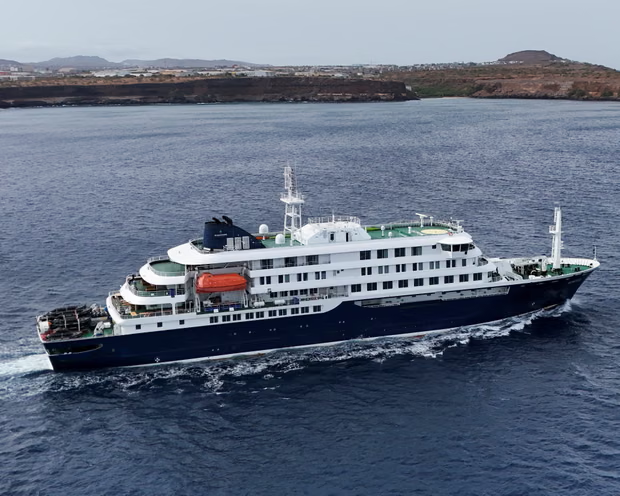
Three passengers are dead after an outbreak of Andes hantavirus on the Dutch-flagged cruise ship MV Hondius, the first known hantavirus outbreak linked to a cruise ship.
Eight cases have been reported so far: six laboratory-confirmed Andes hantavirus infections and two probable cases. Passengers left the ship before authorities recognized the outbreak and returned home across several countries, including the United States. The ship is expected to arrive at Tenerife’s port of Granadilla on May 10.
Asked about the outbreak on May 7, Trump told reporters: “It’s very much, we hope, under control. We have a lot of people, a lot of great people, are studying it.” Asked whether people in the U.S. should be concerned about further spread, he said: “I hope not. I mean, I hope not. We’ll do the best we can.”
In early 2020, Trump told the public the coronavirus was “very much under control” and that U.S. case counts would soon be “close to zero.” The words are nearly identical.
Public health workers don’t say that. Experts in infectious disease say the risk to the general public remains low. But keeping it low requires assessing the danger and developing the protocols needed to contain the outbreak. That is the very capacity Trump has cut from the U.S. public health system: contact tracing, disease surveillance, fast testing, clear public communication, infectious-disease research and international cooperation.
The Hondius left Ushuaia, Argentina, on April 1 for Antarctica and South Atlantic islands. The first known patient, a Dutch man, became sick on April 6 and died on April 11 during the voyage. His wife, already ill, went ashore at Saint Helena on April 24 and was flown to Johannesburg the next day. She died on April 26.
A German woman died aboard the Hondius on May 2 — the same day the World Health Organization (WHO) was notified of the cluster, three weeks after the first death. When the outbreak was reported to WHO, 147 passengers and crew were still aboard. Another 34 had already disembarked.
The ship had stopped at Tristan da Cunha, a remote South Atlantic island, from April 13 to April 15 — two days after the first passenger died. The captain told passengers on April 12 that the ship was “safe.” Passengers and crew went ashore and mixed with islanders. WHO has since listed a probable case involving an adult male who disembarked at Tristan da Cunha on April 14 and later developed symptoms there.
WHO has identified the Hondius cluster as the first known hantavirus outbreak linked to a cruise ship, with probable person-to-person transmission aboard. Laboratory testing in Switzerland and South Africa has confirmed Andes hantavirus in samples from passengers, backing WHO’s early assumption that the outbreak involved the only hantavirus known to spread between people.
Andes hantavirus can spread through close and prolonged contact with an infected person — a household member, caregiver or intimate partner — in a way most hantaviruses cannot. It can kill up to 30% to 40% of those infected. There is no specific cure for hantavirus infection; survival depends on early recognition and intensive supportive care. It is not known to spread through casual contact.
WHO and public health experts say genomic testing is still underway, but they have not seen anything so far suggesting a new, more dangerous form of the virus. Experts also stress that Andes hantavirus does not spread as easily through the air as COVID or flu. The confirmed cases are linked to the ship or to close contact with people connected to it.
WHO acknowledged that residents of Tenerife had reason to worry. A cruise ship carrying a deadly virus toward an island port inevitably recalls the early COVID pandemic and the quarantined ships of 2020. But WHO stressed that Andes hantavirus is not another COVID: it does not spread as easily, and the known cases remain tied to the ship or close contact.
Cruises sell escape
Cruise corporations sell escape from the world. But the MV Hondius was never outside the world. It depended first on workers: the ship’s crew who kept the vessel running, dockworkers who would receive it, sanitation workers who would handle waste, nurses and medical teams who would treat the sick, and translators who would help coordinate across borders. It also depended on ports, airports, hospitals, laboratories, local health departments and international agencies — systems that do not function without labor.
That is what the glossy cruise brochure hides. The company sold the trip. Society is handling the danger.
That danger falls first on workers. It falls on the crew still aboard, who live and work inside the ship, clean cabins, handle food, laundry and waste, and cannot simply walk away from the workplace. It falls on dockworkers, port sanitation workers and baggage handlers asked to receive the vessel, handle lines, supplies, luggage and potentially contaminated refuse, and then go home to their families and neighborhoods. It falls on the people of Tenerife if the company and governments treat the port as a place to dump risk.
That is why dockworkers at Santa Cruz de Tenerife protested the decision to receive the Hondius. It was the basic right of workers and the island community to know what protections are in place, how the ship will be disinfected, how refuse and medical waste will be handled, and how crew, passengers, dockworkers and residents will be protected from exposure.
When the disease first appeared, the cruise corporation focused on profit. It kept the cruise going, and passengers were told the ship was safe. It did not trace contacts, test samples, warn doctors or organize safe evacuations. That takes public health workers. It takes laboratories. It takes local health departments. It takes international cooperation.
That is the public health system Trump and his cronies have attacked: the workers, laboratories and procedures needed to prevent disease, detect outbreaks and contain them before they spread.
The international response has been substantial. WHO has coordinated with multiple countries and held public briefings. The European Centre for Disease Prevention and Control deployed an expert to the ship. Amid protests by Tenerife dockworkers and concern on the island, Spain prepared a controlled disembarkation operation, with passengers to be evaluated aboard and repatriated or quarantined under strict protocols.
The U.S. response tells a different story.
Severely limited by Trump’s cuts, the CDC did not begin moving publicly until May 8 — six days after WHO was notified and 27 days after the first known patient died. Only then did CDC announce passenger guidance, state and local monitoring instructions, and medical teams.
U.S. scientists who specialize in outbreak response and pandemic prevention are working with WHO and other agencies. But they are doing it after staffing has been gutted, budgets have been slashed and infectious-disease research — including research on emerging viruses — has come under attack.
The attack is not confined to public health. On April 24, the administration fired the entire 22-member National Science Board, the body that oversees the National Science Foundation. More than 30% of NSF staff have also left the agency since Trump’s January 2025 inauguration, while scientists have been pushed out of key research posts across the federal government. The result is the same everywhere: less independent science, less public protection and more political control over what research is allowed to continue.
The CDC’s Division of High-Consequence Pathogens and Pathology — the unit that handles deadly infectious diseases, including hantavirus — had also lost its director. Dr. Fernando Torres-Vélez left CDC in February for a senior New Zealand government post after overseeing diagnostics, emergency response and medical countermeasures work for some of the world’s deadliest pathogens. Whatever the reason for his departure, it meant another loss of high-level expertise after Trump’s attacks on the public health system.
Health Secretary Robert F. Kennedy Jr. has not addressed the outbreak. Acting CDC Director Jay Bhattacharya has held no press conference. In 2020, Bhattacharya co-authored the Great Barrington Declaration, which opposed pandemic containment and told low-risk people to resume normal life and build immunity through infection. But COVID did not produce the lasting population immunity that strategy depended on. People could be reinfected, new variants could evade prior immunity, and the most vulnerable could not be kept protected while the virus spread through workers’ homes, nursing homes and hospitals.
NIH shut down the Centers for Research in Emerging Infectious Diseases on June 5, 2025. One of those 10 centers had been studying how the Andes strain of hantavirus passes from rodents to humans. Eleven months later, that same virus is forcing emergency evacuations and quarantine plans from the Canary Islands to Nebraska.
Trump began the U.S. withdrawal from the WHO in January 2025, and the U.S. Department of Health and Human Services says the U.S. formally exited in January 2026.
In July 2025, the administration also rejected the 2024 amendments to the International Health Regulations — the legal framework WHO uses for outbreak notification and coordination. “The Centers for Disease Control and Prevention is not a part of that routine engagement,” said Dr. Daniel Jernigan, who ran the CDC’s emerging disease center before resigning in protest. “When something emerges, we’re not going to get that call immediately.”
WHO said Tenerife was chosen under the International Health Regulations because it was the nearest port with enough medical capacity to protect the safety and dignity of those aboard. Spain honored that obligation. Washington, meanwhile, has been pulling the United States away from the same international health system.
The CDC still exists. Its scientists are still working. But the agency is operating under reduced staffing, budget cuts, restricted communications and diminished international ties after Trump’s restructuring of the public health system. That is why experts looking at the Hondius outbreak are asking why CDC was not more visible sooner. AP reported that CDC did not deploy teams to the Canary Islands and Offutt Air Force Base or issue a health alert to doctors until late in the week.
A WHO advisory group of experts from Brazil, Britain, India, the Netherlands and other countries is scheduled to meet on May 11 to assess the latest hantavirus findings. The CDC has no seat at the table. “Especially at the moment, it doesn’t seem that the CDC is very functional,” Tulio de Oliveira, director of the Centre for Epidemic Response and Innovation at Stellenbosch University in South Africa, told the New York Times.
The Hondius outbreak shows why international health cooperation is not optional. A virus can move from South America to a cruise ship, to Saint Helena, South Africa, Europe and the United States before governments even know what they are dealing with.
The cruise ship owners, port bosses and travel corporations want ships to move, planes to fly, passengers to pay and money to circulate without interruption. But they treat the workers and public systems that make that movement possible — and safe — as costs to cut.
Longshore workers have fought this before. During the 2020 Grand Princess COVID crisis in Oakland, ILWU Locals 10, 34, 75 and 91 demanded that employers sanitize equipment and facilities and protect workers loading and unloading ships. They warned that infection at the docks could spread to port workers, their families and the surrounding community. They also demanded information on the condition of hundreds of crew members kept aboard the Grand Princess and whether the terminal had been disinfected after the ship left.
ILWU Local 10 President Trent Willis put the issue plainly: port workers are also members of the community, and the health and safety of workers and the community come before keeping the port moving. That is the same lesson Tenerife dockworkers are raising now. The bosses want ships to move, passengers to pay and money to circulate. Workers are asking who bears the risk.
This virus is one danger. The deeper danger is a system that keeps the ships moving, keeps the money flowing, and cuts the workers, labs and public agencies needed before the next outbreak hits.
Join the Struggle-La Lucha Telegram channel