
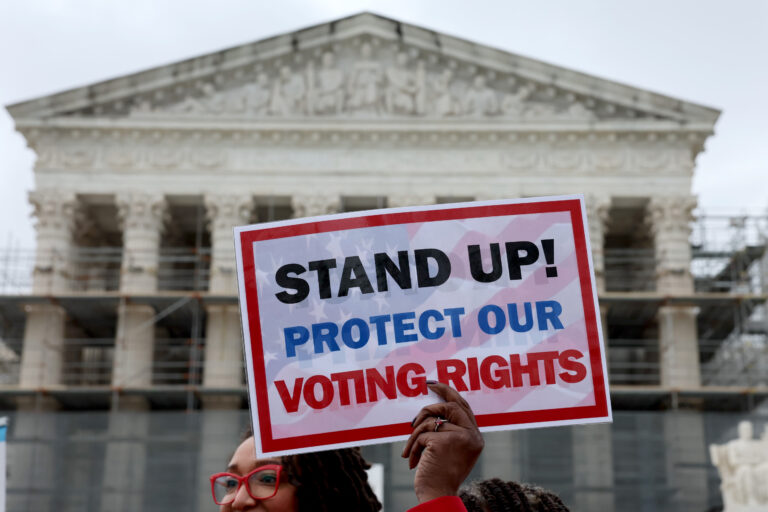
The U.S. Supreme Court did not stop with gutting the Voting Rights Act. On May 4, it moved from ruling to enforcement.
Five days after its April 29 ruling in Louisiana v. Callais, the court took the unusual step of ordering its judgment sent down immediately, bypassing the normal 32-day waiting period. The result was political and immediate: Louisiana’s Republican state government got the cover it needed to halt U.S. House primaries already underway, redraw the map and move to lock Black voters out of representation before the November midterm elections.
What is happening in Louisiana is the first test run of a Trump-era coup by law: using his Supreme Court majority to gut voting rights, then using racist governors like Jeff Landry to cancel elections and redraw maps to eliminate Black representation.
This is not only a legal maneuver. It is a direct move to repress Black voting rights.
The April 29 ruling struck down Louisiana’s congressional map, which included a second majority-Black district after years of Voting Rights Act litigation. The court did not formally repeal Section 2 of the Voting Rights Act. It did something more useful to the ruling class: It made Section 2 harder to enforce when Black voters seek districts that allow them to elect representatives of their choice.
Then Landry moved. On April 30, he issued an executive order suspending Louisiana’s U.S. House primary elections. The governor’s own office said the order applied only to U.S. Representative races, while other May 16 offices and ballot measures would continue as planned.
That means the state did not shut down the whole election. It targeted the congressional races affected by the fight over Black representation.
The court joins the operation
The May 4 order shows the Supreme Court was not finished after the ruling. It stepped in again to help move the attack from decision to enforcement.
Under the court’s normal rules, the losing side has time to seek rehearing before the judgment is formally sent to the lower court. Justice Ketanji Brown Jackson, dissenting from the May 4 order, pointed out that the court almost never rushes judgment this way over a party’s objection. She wrote that the court was no longer content to decide the law, but was now taking steps to shape how its ruling would be carried out.
Justice Samuel Alito, joined by Clarence Thomas and Neil Gorsuch, answered with anger. He accused Jackson of using rhetoric that “lacks restraint.”
But Alito’s anger was meant to obscure the central point: The court used a discretionary procedural power to turn its attack on voting rights into an election weapon.
The sequence matters. On April 29, the Supreme Court struck down Louisiana’s congressional map. On April 30, Landry used that ruling to declare an “electoral emergency” and suspend the U.S. House primaries scheduled for May 16. Early voting was set to begin May 2. Absentee ballots had already been mailed, and some voters had already returned them. The Federal Election Commission reported that Landry’s order pushed the congressional primaries back until July 15, unless the Louisiana Legislature sets another date.
That is the point. First the Supreme Court struck down the map on April 29. Then Landry used the ruling on April 30 to suspend congressional primaries with absentee voting already underway. Then, on May 4, the Supreme Court rushed its own paperwork to help make the power grab look legal.
Cancelling votes already cast
The attack is not abstract.
Absentee ballots had already been mailed, and more than 42,000 had already been returned before Landry suspended the U.S. House primaries, according to the Louisiana Illuminator.
The ACLU of Louisiana said a court had allowed Landry “to suspend part of an election already in progress and disenfranchise voters who have already cast their ballots.”
That is what repression looks like in legal form. Not troops at the polls. Not a formal declaration ending elections. A court ruling. An emergency order. A suspended primary. Congressional votes that officials can throw out. A new map rushed through before voters can organize a response.
Each step comes dressed as law. Together, they are a ruling-class attack on Black voting rights.
Coup by law
The old Jim Crow system used literacy tests, poll taxes, terror and one-party rule to crush Black political rights. The modern version uses court doctrine, emergency orders, redistricting and election calendars.
The target is the same: eliminating the democratic rights of Black voters.
Louisiana is the test case because the stakes are clear. Black people make up about one-third of the state’s population. The state had only one majority-Black congressional district after the 2020 census. Federal courts had found that map likely violated Section 2 of the Voting Rights Act because it denied Black voters a fair chance to elect candidates of their choice. Louisiana then adopted a second majority-Black district. The Supreme Court struck that down.
Now the ruling class wants to use Louisiana as the model: gut the Voting Rights Act, cancel or delay elections, redraw the maps and drive Black voters out of representation across the South.
The message is plain: If Black voters win representation under the Voting Rights Act, the courts can call that representation unconstitutional. If an election is already underway, a governor can stop it. If ballots have already been cast, officials can refuse to count part of them. If the normal court timetable gets in the way, the Supreme Court can speed itself up.
This is not neutrality. It is intervention.
The ruling class is moving fast
Louisiana shows how the attack will work elsewhere. The court creates the opening. Racist state governments move fast to carry out the ruling-class attack. Black districts are broken apart. Elections are delayed, rewritten or rerouted. By the time the courts finish hearing challenges, the political damage may already be done.
That is why the May 4 order matters. The Supreme Court was not watching from a distance. It was helping manage the result.
The attack comes during a wider crisis of U.S. imperialism. War on Iran and Venezuela and blockade threats against Cuba are feeding rising prices and sharper attacks on workers at home. A ruling class waging war abroad and austerity at home needs the old weapon of divide and conquer to weaken working-class resistance. That means deepening the historic national oppression of Black people. Black voting rights are a special target because Black struggle has been at the center of every major victory won by workers and oppressed people in this country. Breaking up Black representation is meant to weaken the whole working class before resistance can spread.
The Voting Rights Act was not a gift from the courts. It was won in struggle — in Selma, Birmingham, Montgomery and across the South — by Black people and their allies who faced jail, beatings, bombings and murder.
Now the Supreme Court is moving once again to take back what Black struggle won. This is the one branch of the federal government that the people never elect. Its justices sit for life. They are shielded from the voters and answer only to the ruling-class forces that put them there.
Its record is soaked in racist law. In Dred Scott, the court backed slavery and declared that Black people had no rights the white ruling class was bound to respect. In Plessy v. Ferguson, it made Jim Crow segregation the law of the land. Today, in Louisiana v. Callais, the same court is using the language of “equal protection” to attack the very voting rights Black people fought, bled and died to win.
The answer cannot be courtroom appeals alone, though every legal challenge matters. The answer must also be organized resistance in the streets, in unions, in churches, on campuses and in the Black communities being targeted.
Louisiana is the first test run. If they succeed there, they will try it everywhere.
Join the Struggle-La Lucha Telegram channel