
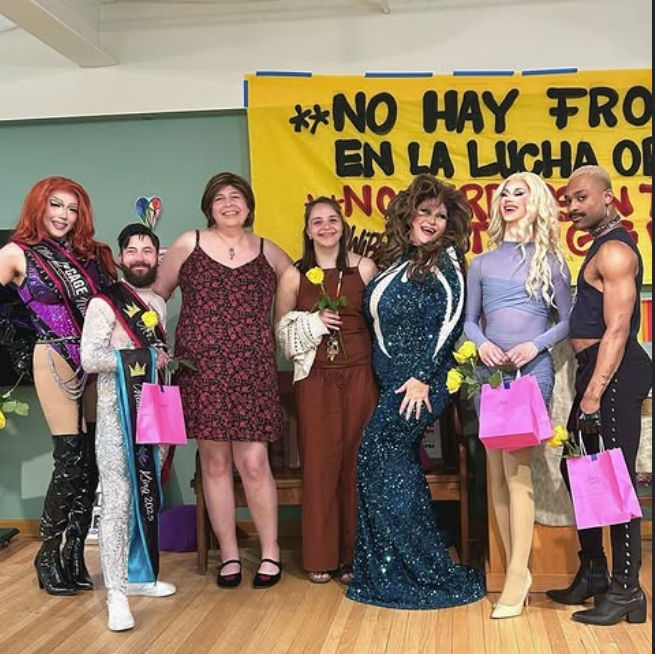
Talk given in Madison, Wisconsin, on April 25, 2026.
Good evening. My name is Melinda, my pronouns are she/her, I’m a proud trans woman, and I am thrilled to be back in my home state to celebrate the 15th anniversary of the Wisconsin Bail Out the People Movement.
There are a lot of queers here, so I know you understand it’s not always a good thing going back to where you grew up!
But I’ve watched the progress of this movement since its founding. It matters so much to have a group like this one, that fights for the rights of all poor and working people – not just on one issue, not just for one election season or one demonstration or one strike, and doesn’t stop fighting when certain politicians get elected.
When I was a teenager in rural Wisconsin, I dreamed of finding a group like this. I’m so glad it exists now.
So when my old friend and comrade Bryan Pfeifer invited me to come and speak about Leslie Feinberg’s legacy for the trans liberation struggle – well, that was a no-brainer.
During a talk at the University of Wisconsin-Madison in 2003, Leslie Feinberg said: “We live in a country where normal is defined by Rush Limbaugh, Trent Lott and Jesse Helms. If that’s normal, let me state unequivocally just how queer I am.”
The names have changed in the last 20 years, but I think we can all agree with that sentiment.
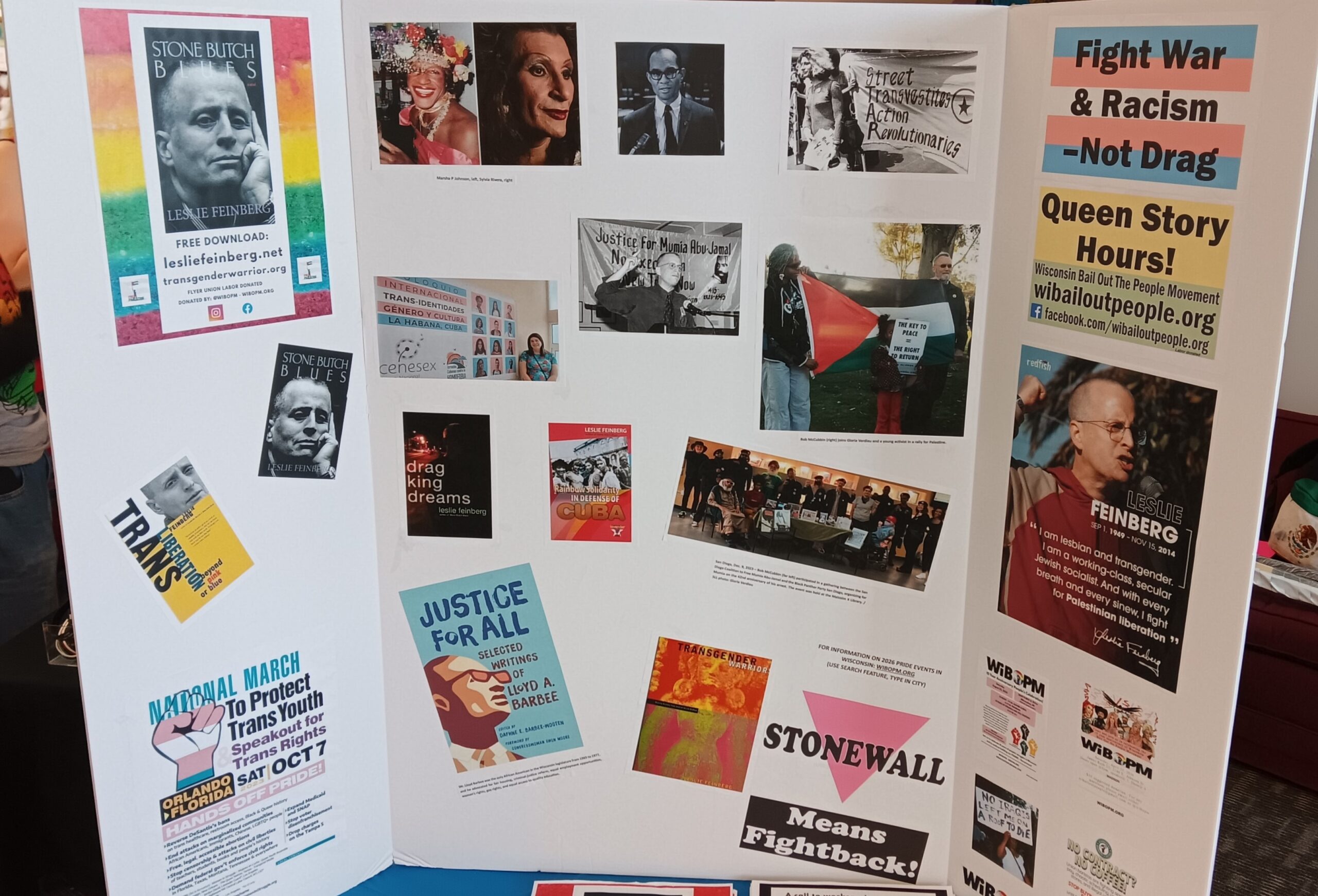
Leslie Feinberg (zie/hir) is widely known in the queer movement. Hir novel “Stone Butch Blues” is a classic found in feminist and radical bookstores and read in college courses worldwide. You may also know that Leslie said, “Remember me as a revolutionary communist” before zie passed away in 2014.
Leslie was not only a theorist and activist of trans identity and history. Zie was a working-class organizer who came up in the factories and queer bars of Buffalo, New York, and who fought, wrote, walked the picket line, and built solidarity on all fronts – just like WiBOPM does.
For Leslie, being trans and talking about it wasn’t a distraction from that work – on the contrary, it was an essential part of it. Because trans people are part of the working class. We’re factory workers, baristas, tech workers, teachers, sex workers. And all too often, we’re unemployed and underemployed workers.
Bryan and I both had the honor of working with Leslie over many years. I met Leslie when I was just 18, a very confused egg who packed her belongings in an old suitcase and moved from Eau Claire to New York. This was a few years before “Stone Butch Blues” was published.
Leslie immediately took me under hir wing, showing me the ropes of being an activist in the big city, and even took me along on a visit back to Buffalo for my 19th birthday. It was there, on the beach at Evangola State Park, that I saw Leslie’s top scars for the first time, spurring one of the most important conversations of my life – about the difference between sexuality and gender, something that had vexed me during my very challenging adolescence.
After “Stone Butch Blues” was published, Leslie was in high demand as a speaker at all kinds of meetings, protests, and campus events. Zie was also writing other important books, like “Transgender Warriors” and “Trans Liberation: Beyond Pink and Blue.” We didn’t get to see each other as often.
But when chronic illness forced Leslie to pull back from this grueling schedule and return to New York, we got to work together closely again. Zie taught me the art of editing for a radical news publication. It was another gift that continues to reverberate through my own life and work.
Solidarity in the LGBTQIA+ community
What is Leslie Feinberg’s legacy for our movement today? I would argue that hir most enduring contribution to trans and queer liberation is the importance of building, defending, and fighting for solidarity.
See, while Leslie was doing book tours in the 1990s and early 2000s, zie was also attending meetings at hundreds of queer and feminist spaces large and small across the country, arguing for the inclusion of trans people and trans issues at a time when we were often excluded, even in our own rainbow community.
When the Michigan Women’s Music Festival instituted its “women born women” ban on trans feminine people, Leslie could have still attended. But instead zie took hir stand with the dolls at the Camp Trans counter-protest.
Zie was always putting hir voice behind local trans and genderqueer initiatives. This unsung, unpublicized groundwork had a real, material effect within the community – as did hir long fight to be treated with dignity by health care providers.
That’s one pillar of Leslie’s legacy: strengthening solidarity within the LGBTQIA+ and Two-Spirit community. That struggle is just as important today. We see how certain groups co-opt feminism to join in the right-wing attack on trans lives, like the TERFs in Britain, and attempts on both sides of the Atlantic to establish astroturfed groups that are “LGB without the T.”
The other pillar of Leslie’s legacy is building solidarity between trans, Two-Spirit, intersex and gender-nonconforming people and other poor and working-class communities. And it’s this one that often seems more difficult and scary to confront.
Leslie spoke at a rally in Washington on Sept. 29, 2001, just two weeks after the 9/11 attacks, as the U.S. was gearing up for its so-called War on Terror. Zie said: “If we have learned anything from the struggle against AIDS and the intransigence of the government, it’s that racism and war are not the answer. We say health care and education and jobs and housing are the answer. Stopping racist terror in the United States is the answer.”
This theme of fighting all forms of oppression while uniting for the things we all need runs through all of Leslie’s work.
Outspoken for Palestine
As a Jewish worker, Leslie had a deep commitment to the struggle for Palestinian liberation. Zie would have loved to see the broad movement of young Jewish people coming out in solidarity with Gaza in the last few years.
But at that time, it was uncommon, and in many spaces, absolutely taboo. Just as it took a lot of courage to speak up as a trans person, it took a lot of courage to speak up as an anti-Zionist Jew. But that never stopped Leslie from being a vocal proponent of Palestine.
That commitment echoes through our community today. Queer and trans people have shown up for Palestine, all throughout the genocide in Gaza and attacks on student protesters. Last week in New York, Chelsea Manning and Hari Nef were among 100 people arrested at a protest demanding that Democratic Party leaders stop helping Trump send weapons to Israel.
The genocide trans people face today is different in form from the one being carried out against Palestinians in Gaza. But I think many of us see that there’s a real basis for solidarity between two communities that have been told for generations that we don’t really exist.
Queer and trans people have also shown up for our immigrant neighbors in the fight to stop ICE. Our lesbian sister Renee Good gave her life, but many other queer observers and protesters, both transgender and cisgender, were targeted in Minneapolis. Renee and her wife Becca had only recently fled Missouri before Renee was murdered by ICE.
An estimated 400,000 trans people fled from far-right-controlled states in the year following Trump’s election in 2024. Many other queer people have fled, too. But even if you haven’t seen the statistics, no one in our community is surprised by this. We’re living every day with the urgent need to help siblings relocate, organize mutual aid, and prepare for what may come next.
And what does it even mean for Democrats to declare a sanctuary state or city for trans people, if there are no provisions for jobs, housing, and health care?
There’s a massive internal refugee crisis, but you won’t hear about it from any major media or mainstream politicians, even though sensationalist and outright fabricated reports on trans people litter the media every day. Because those stories, and the policies they justify, are designed only to further our isolation from those who should be our natural allies.
A vital part of the working class
Solidarity is hard when it feels like you’re the only side showing up, when your health care and rights are being stripped away, and cisgender people, including many left and progressive organizations, seem mostly unaware and unconcerned.
It’s not unusual to hear frustrated voices in our community. And that’s understandable! A lot of us have been badly burned by people and groups we showed up for but didn’t show up for us.
We’re tired of hearing self-proclaimed liberal allies try to shove bigots like Gavin Newsom down our throats. We fantasize about setting up our own queer communes and giving the middle finger to the cis-het world.
I’ll admit, I indulge in it too.
But Leslie argued that, as hard as it may be, trans people can’t isolate ourselves from the rest of the working class. We are a small population – about 1% of people in the U.S. by current measures – and to advance, we need the solidarity of our working-class siblings.
But equally important, to change society, THEY need US.
Just like every advance in workers’ rights in U.S. history has been predicated on the Black freedom struggle, trans people, too, are part of the vanguard.
The way that our very existence challenges the underpinnings of capitalist patriarchy; the way our difficult life experiences teach us empathy, resourcefulness, and incredible internal strength – these things are necessary for the broader movement if we’re going to advance to a new, more humane system and save the planet.
And there are true allies out there. This room is full of them.
I was reminded recently of the work of Lloyd Barbee, a civil rights activist who for many years was the only African American member of the Wisconsin State Assembly. In 1967 – two years before the Stonewall Uprising – Barbee introduced the first bill to end so-called sodomy laws in the state. In 1971, he introduced the first anti-discrimination bill for LGBTQIA+ and Two Spirit people.
It took until the early 1980s, when Barbee was no longer a legislator, for those laws to finally be passed. But his groundbreaking acts of solidarity helped pave the way.
If you’re a cisgender activist or organizer and want to be a real ally to trans people, there’s something very concrete you can do: Make sure we are invited and included in whatever organizing work you’re doing, on whatever issues.
Show up for us, and we’ll damned sure show up for you.
Rainbow Flags for Cuba
That leads to the last point I want to share with you today, about another struggle near to Leslie’s heart: the Cuban Revolution.
In the 1990s, Leslie helped organize a group called Rainbow Flags for Cuba. Its aim was to bring together queer activists to counter the dominant narrative in the U.S. that Cuba was some kind of hell for LGBTQIA+ people, which was then parroted by many mainstream gay groups.
The truth is, even 30 years ago, the struggle for queer liberation was advancing rapidly on the fertile ground of the Cuban Revolution. Leslie felt this was so important that ze published a collection of hir writings called “Rainbow Solidarity in Defense of Cuba.”
In 2022, the Cuban people voted to adopt a new Family Code after several years of discussion and debate at all levels of society. This code enshrines the rights of trans and queer people as the law of the land, in ways far beyond anything we have experienced here. That includes the rights of trans and queer children, by the way, as well as women, disabled people, elders and all youth.
Cuba has advanced because its people made a profound revolution that removed the capitalists, landlords, and U.S. colonizers from power and empowered poor and working people.
It’s not that a revolution can fix centuries of patriarchal culture overnight, or that it won’t make mistakes. But it creates the basis for inequalities to be genuinely addressed at a societal level. Whereas, when we win a right in the United States, where the billionaires rule, it’s always conditional and subject to being taken away.
Today, Trump is targeting Cuba like never before, blockading fuel and other essentials, trying to starve the people and threatening military attack to overthrow their government and socialist system.
Cuba is not a threat to U.S. national security. What Trump and successive U.S. governments before him really fear is Cuba’s example.
What this small, blockaded country has been able to achieve in universal health care, education, housing, racial unity, women’s rights, queer rights, and international solidarity puts the world’s richest country to shame. That’s why they want to destroy Cuba. We must not let that happen.
Cuba has persevered for more than 60 years under continuous blockade and threats.
The Palestinian people have never surrendered, even when they were treated like international pariahs. Now, after decades of struggle, the whole world understands the justness of Palestinian liberation.
The trans, Two-Spirit, gender-nonconforming and intersex community can learn and draw strength from their examples.
Trans people have always found ways to survive, be ourselves, nourish and teach the next generation. But we shouldn’t have to just survive – we have to keep our eyes on the goal of trans liberation and human liberation.
Leslie would remind us that the material basis for a new world exists. It’s so close, even though it feels light-years away. We have to keep fighting so it can be born – if not for ourselves, then for those who come after us.
Join the Struggle-La Lucha Telegram channel