
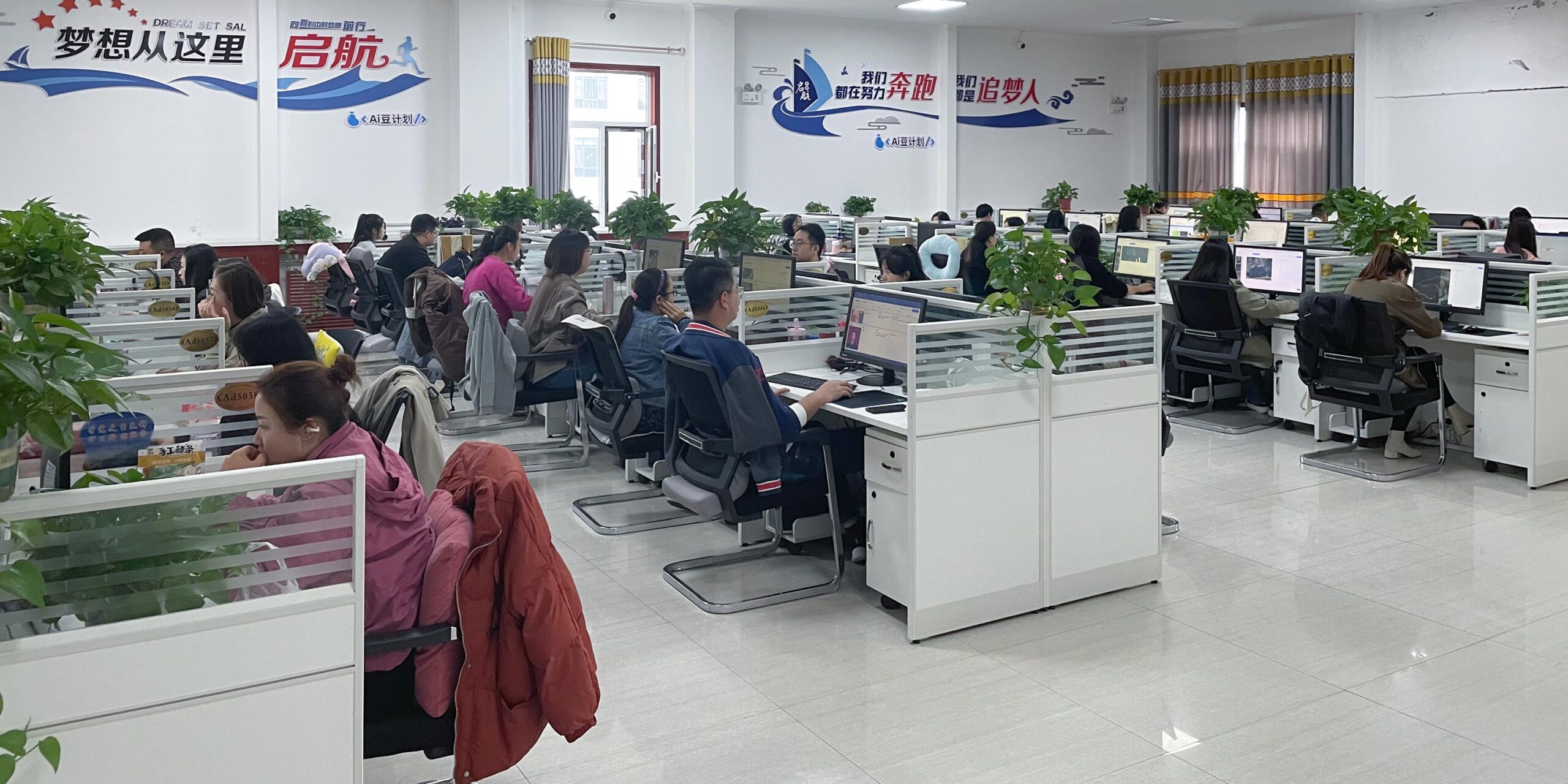
In the early 1980s, as the Reagan administration’s assault on labor accelerated and plant closures gutted the industrial Midwest, a grassroots campaign put forward a demand that U.S. ruling-class politicians dismissed as utopian: a job is a right. Workers, the campaign argued, acquire a stake in their jobs through years of labor that corporations cannot simply extinguish — the right to work is a social right, not a management prerogative.
U.S. workers never won that demand as enforceable labor law. In China, the Labor Contract Law recognizes that right in concrete form — not as an abstract promise, but as a legal limit on arbitrary dismissal. Two recent Chinese rulings — one in Beijing and one in Hangzhou — did not invent a new right for the AI age. They upheld existing labor law against employers trying to use AI as a shortcut around it.
The issue was not whether companies may use AI. It was whether management can treat its own decision to automate, restructure or cut labor costs as an outside force that cancels its obligations to workers. The answer was no. A company’s business decision is not a natural disaster. It does not by itself wipe out the worker’s claim under the labor contract.
The cases
The Beijing case came first. In late 2024, a tech company eliminated the department of a map data collector named Liu after switching to AI-powered automated data collection. The company terminated Liu’s contract, citing “major changes in objective circumstances” — language from China’s Labor Contract Law that permits dismissal in cases of genuine, unforeseeable disruption, such as natural disasters, company relocations, or regulatory shifts.
Liu challenged the firing. In December 2025, the Beijing Municipal Bureau of Human Resources and Social Security published the case as a model ruling for the year. The arbitration committee found that the company’s decision to adopt AI was a voluntary business choice to stay competitive — not an uncontrollable event outside the normal scope of management decisions. Terminating Liu’s contract on those grounds was ruled illegal. The company sued to overturn the arbitration award, but both the trial court and the appeals court upheld the ruling.
The Hangzhou case followed a similar arc. Zhou had worked since November 2022 as a quality assurance supervisor at an AI-related tech company, earning 25,000 yuan per month. His job involved matching user queries with large language models and filtering problematic content — tasks that AI systems eventually took over. The company tried to reassign him at 15,000 yuan per month. When Zhou refused the pay cut, the company terminated his contract and offered 311,695 yuan in compensation.
Zhou contested the sum. An arbitration panel ruled his dismissal unlawful. The company appealed, first to a Hangzhou district court and then to the Hangzhou Intermediate People’s Court — in Zhejiang Province, one of China’s main AI industry hubs. The intermediate court upheld the lower rulings on April 30, 2026, the day before Workers’ Day. The Hangzhou court published the case alongside a set of “typical examples of protecting the rights of AI enterprises and workers” — a deliberate signal timed to May 1.
The court found that AI-driven job displacement does not constitute a “major change in objective circumstances” under the Labor Contract Law. It also ruled that offering Zhou a 40% pay cut was not a reasonable reassignment proposal. The dismissal was unlawful on both counts.
The principle
Wang Xuyang, a lawyer at Zhejiang Xingjing law firm, summarized the legal logic running through both rulings: while companies may benefit from AI-driven efficiency gains, they must also bear the corresponding social responsibilities. The costs of technological transformation, legal scholars emphasized in both cases, should not be borne by workers.
Companies that automate cannot simply announce that AI has erased a job. They must deal with the worker — through negotiation, training, reasonable reassignment or lawful compensation — instead of dumping the cost of technology onto the worker.
The Beijing arbitration committee put the underlying principle plainly: the company’s termination of Liu’s contract was essentially shifting the risk of technological change onto the employee. That, the committee ruled, is illegal.
This is the legal recognition of what the “A Job Is A Right” campaign argued four decades ago in the United States — that a corporation’s voluntary decision to restructure does not erase workers’ claims. China’s Labor Contract Law, as interpreted by these rulings, encodes that claim as an enforceable right.
The rulings arrive as AI adoption accelerates across Chinese industry. China’s core AI sector exceeded 1.2 trillion yuan in 2025, with more than 6,200 AI-related enterprises operating across the country. The government’s 2026 work report called explicitly for measures to address AI’s impact on employment — marking the first time the issue entered the national policy framework at that level.
What U.S. workers don’t have
No equivalent legal protection exists in the United States. U.S. labor law does not restrict employers from eliminating positions due to automation. The Worker Adjustment and Retraining Notification Act requires 60 days’ notice before mass layoffs at large employers, but it does not prohibit AI-driven terminations or require negotiation, retraining, or reassignment. Workers in non-union workplaces — the vast majority of the U.S. workforce — have no contractual recourse at all.
U.S. tech companies have moved aggressively on AI-driven workforce reduction. Since 2023, major technology employers have cut tens of thousands of positions while publicly attributing the reductions to AI efficiency gains. But no broad U.S. rule treats AI replacement itself as an unlawful reason to fire a worker.
The demand that animated the streets of Detroit, Baltimore and Philadelphia in the 1980s — a job is a right — remains unmet in the country where it was raised. In China, labor law gives that demand legal form, and courts have now upheld it against employers trying to use AI as a firing weapon. Whether workers in the United States can ever win the same will depend, as it always has, on their fight for it.
Join the Struggle-La Lucha Telegram channel