
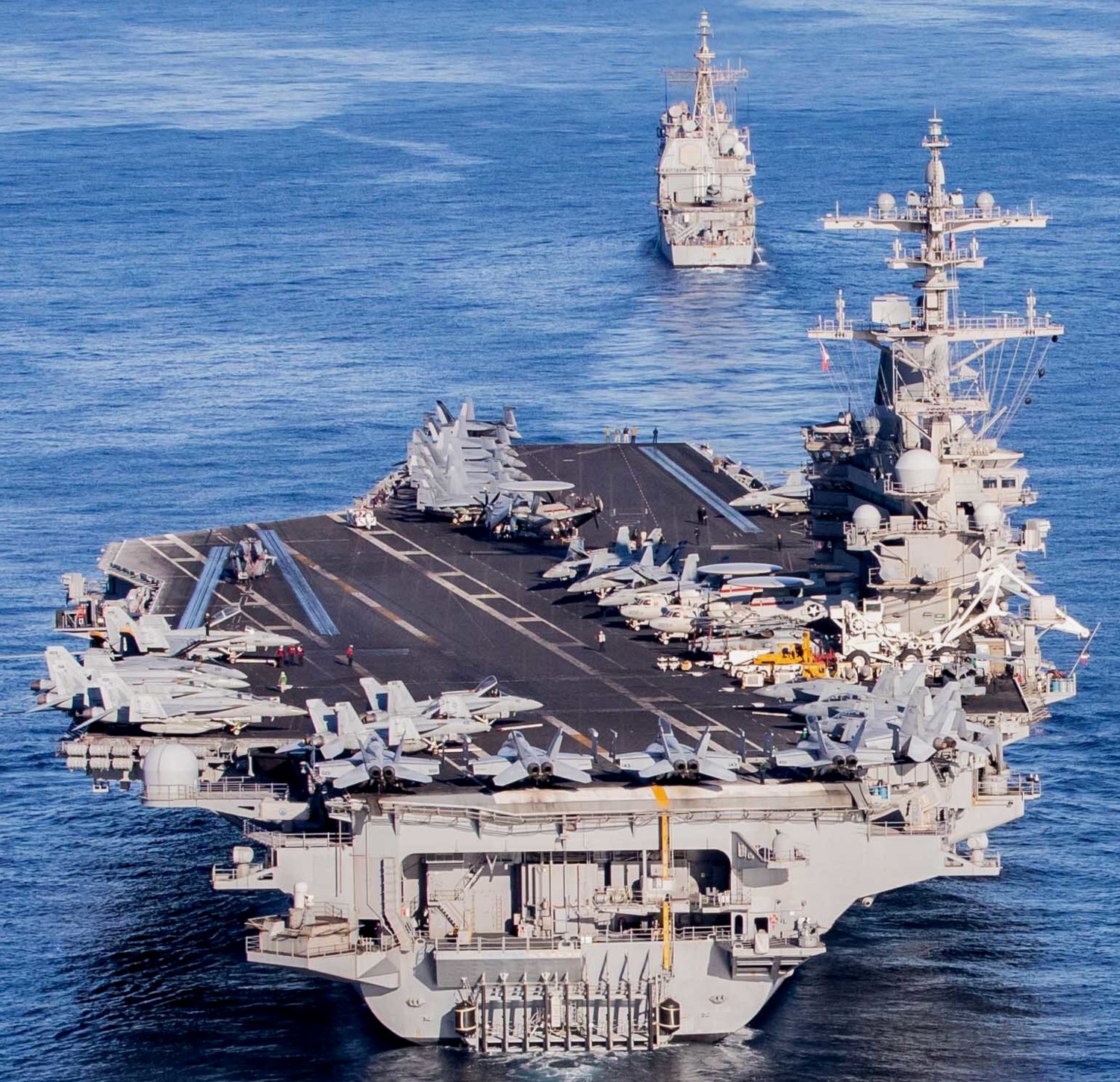
The USS George H.W. Bush did not take the direct route to the war zone near Iran.
The nuclear-powered supercarrier left Norfolk, Virginia, on March 31, then sailed more than 11,000 miles around the Cape of Good Hope with its strike group. The shorter route through the Mediterranean, Suez Canal and Red Sea would have cut thousands of miles and weeks of steaming.
The Bush arrived in the U.S. Central Command area on April 23, joining the USS Abraham Lincoln in the Arabian Sea and the USS Gerald R. Ford in the Red Sea. Three U.S. supercarriers are now operating in West Asia at once, the largest such concentration since the 2003 U.S. invasion of Iraq.
The carrier did not take the long way by accident. CNN described the route as a way to avoid the Suez Canal and the Red Sea, using the standard U.S. media label “Iranian-armed Houthi proxies” for Yemen’s Sana’a-based forces. The Pentagon offered no further explanation.
The acting foreign minister of Yemen’s Sana’a government said it plainly. In a recent interview with Canadian journalist Dimitri Lascaris, Abdulwahid Abu Ras was asked why the Bush had sailed around Africa instead of through the Red Sea.
“When this aggression began, Yemen declared that the Red Sea would not be used for aggression against Iran,” Abu Ras said. “Therefore the American side avoided the Red Sea.”
He continued: “They know from previous rounds. There were periods of engagement. Yemen engaged in solo combat against American aircraft carriers and more than one aircraft carrier left this region as a result of these clashes. The Yemeni armed forces showed they had the preparation and the will.”
The Navy remembers the Red Sea
The record explains why Washington avoided the route.
From November 2023 through June 2024, the USS Dwight D. Eisenhower carrier strike group operated continuously in the Red Sea under sustained missile and drone attack from Yemen’s armed forces. The Eisenhower departed in June 2024, earlier than expected, with the next carrier still weeks away. The U.S. Navy left a gap.
The USS Theodore Roosevelt and USS Abraham Lincoln rotated through. By December 2024, the USS Harry S. Truman was on station. On Dec. 22 of that year, the cruiser USS Gettysburg shot down one of its own F/A-18 fighters while attempting to defend the strike group against Yemeni weapons. Both pilots survived. On New Year’s Eve, Yemeni forces launched a coordinated drone and cruise missile attack against the Truman. U.S. Central Command confirmed it intercepted seven cruise missiles and several drones.
By the time the Truman strike group returned home in June 2025, the U.S. Navy had spent more than a year fighting one of the poorest countries in the world to a stalemate in one of the world’s most strategic waterways.
A long route exposes a thin fleet
The detour around the Cape of Good Hope adds roughly 4,500 miles and two weeks of steaming. For a nuclear-powered carrier with unlimited range, the fuel burden falls on the escort destroyers — the USS Ross, USS Donald Cook and USS Mason — and on the tankers and supply ships needed to keep a strike group at sea for the longer transit. The longer route means more replenishment, more watch rotations and more wear before the strike group even reaches the war zone.
The detour also shows how hard the Navy is running its carriers. The USS Gerald R. Ford left Norfolk on June 24, 2025. It did not stay on a routine deployment for long. In October, Washington sent it toward Venezuela as the U.S. military buildup in the Caribbean grew. Aircraft from the Ford later supported the Jan. 3, 2026, raid that kidnapped Venezuelan President Nicolás Maduro and First Combatant Cilia Flores. Weeks later, the carrier was sent again — this time toward the war on Iran. By April 23, the Ford had passed 300 days at sea and was heading toward an 11-month deployment, far beyond the standard seven-month rotation and one of the longest U.S. carrier deployments since the Vietnam War. A March laundry-room fire forced it back to the Mediterranean for repairs. Pentagon officials told reporters the Bush is partly there to relieve it.
At the Pentagon on April 24, Pete Hegseth tried to project total command of the seas. He said the U.S. blockade of Iran now reached “from the Gulf of Oman to the open oceans.” He said 34 ships had already turned back.
But the Bush’s route told another story. The blockade requires carriers. The carriers cannot take the most direct route to the blockade. Washington claims global command, but Yemen has made one of the world’s key sea passages too costly for the U.S. Navy to use freely.
This is more than a logistical problem. The Bush’s route is an admission in steel. The U.S. Navy has not sent a carrier through Bab el-Mandeb since December 2023. Now, with a blockade against Iran underway, another carrier has gone thousands of miles out of its way rather than test that passage again.
For Yemen, that is a functional victory. The Sana’a government has not sunk a U.S. carrier. It has done something else: It has made the world’s most expensive navy plan around Yemeni fire. Washington claims to police the seas. At Bab el-Mandeb, it no longer moves as though it owns them.
A poor country makes the empire pay
Yemen is one of the poorest countries in the world. For more than a decade it has endured Saudi-led blockade and bombing backed by U.S. weapons, refueling and intelligence. The war produced one of the worst famines on record. Millions remain dependent on humanitarian aid that the war has repeatedly cut off.
Israel killed Yemen’s prime minister, Ahmad Ghalib al-Rahwi, and other senior officials in an August 2025 airstrike on Sana’a. The Sana’a government has continued to function. Abu Ras took over as acting foreign minister.
That government has imposed measurable costs on the deployment of the most expensive navy in history. The Yemeni armed forces have done so with weapons the Pentagon describes as crude — anti-ship ballistic missiles, cruise missiles and drones built or assembled in workshops under bombing. The U.S. Navy chose a 4,500-mile detour rather than test those weapons again at the Bab el-Mandeb chokepoint.
Western media reports the route as a tactical choice. Abu Ras names it for what it is. A country of 35 million people, blockaded and starved for a decade, has made a strategic maritime corridor too costly for the U.S. Navy to use freely.
The carrier groups arrived to enforce a blockade against Iran. They arrived only by sailing around Yemen — the country that showed a blockaded people could make the U.S. Navy change course.
Join the Struggle-La Lucha Telegram channel