
On April 19, U.S. forces boarded and seized an Iranian-flagged cargo ship near the Strait of Hormuz. In the days that followed, Iranian forces seized cargo vessels attempting to transit the Strait without authorization. On April 24, Trump ordered the U.S. Navy to “shoot and kill” Iranian boats accused by Washington of laying mines in the Strait of Hormuz.
Iran has not said it is laying mines. The charge is a baseless U.S. military claim, made by the same war machine that sent an armada into the Caribbean under the banner of a “war on drugs,” then bombed small boats it called drug vessels without publicly producing evidence. The method is the same: make the accusation, destroy the target, kill the witnesses and call the wreckage confirmation.
For decades, Washington claimed it could keep the sea lanes open through naval force, sanctions and control over the dollar system. Hormuz now shows the limit of that claim. Washington invokes “freedom of navigation” after setting off the war that closed the Strait. It is trying to dress up a loss of power as a defense of law.
The legal fiction
Neither Washington nor Tehran has ratified the U.N. Convention on the Law of the Sea. The “freedom of navigation” Washington claims to defend has never operated as neutral law. It has been enforced by U.S. naval power, dollar-denominated trade and a hierarchy of states dressed up as universal rules.
The real practice was simple enough. U.S. warships moved where they wanted, and U.S.-backed cargo moved under protection. Countries targeted by Washington were told to obey rules enforced by U.S. warships, sanctions and insurance pressure. If they resisted, Washington treated that resistance as a violation of law.
Commercial shipping expert Sal Mercogliano has pointed out that maritime law assumes peaceful conditions. In a war, halting, boarding and seizing ships can be justified for national defense. Iranian Foreign Minister Abbas Araghchi put the Iranian position plainly in an April 22 meeting with a South Korean envoy. As a coastal state facing U.S. aggression since Feb. 28, Iran has taken measures in accordance with international law and its domestic regulations to protect its security and national interests.
Washington cannot wage war in the Strait and then demand peacetime shipping rules.
What the U.S. cannot do
Trump’s shoot-and-kill order was aimed at small Iranian boats Washington accused of laying mines. But mine warfare is exactly where the U.S. Navy is weakest in the Gulf.
The Navy decommissioned most of its dedicated Gulf minesweepers in 2025. The work was shifted to the Littoral Combat Ship, a troubled vessel Navy sailors have mocked as the “Little Crappy Ship.” It was not built to force open the Strait of Hormuz under Iranian fire.
The shortage is not limited to minesweepers. Adm. Samuel Paparo, head of U.S. Indo-Pacific Command, told a Senate committee on April 21: “I don’t have enough amphibious ships. We don’t have enough surface destroyers. We certainly don’t have enough attack submarines.”
Three aircraft carrier strike groups now ring Iran from the Mediterranean Sea, Red Sea, and Indian Ocean. The USS George H.W. Bush entered the Indian Ocean on April 23, joining the USS Abraham Lincoln, while the USS Gerald R. Ford has returned to duty in the Red Sea after emergency repairs. They can threaten Iran from offshore. That is different from forcing the Strait open under fire from Iranian coastal missile batteries, ballistic launchers and fast attack boats operating from a coastline Iran has fortified for decades.
But the carrier groups have limits too. A Wall Street Journal analysis found that replacing the munitions spent since Feb. 28 could take up to six years.
The world’s most expensive navy has been reduced to threatening fishing-boat-sized vessels on the Pentagon’s unverified claim that they are laying mines.
The system was already breaking
Hormuz is the sharpest rupture, but not the first.
Yemeni forces began attacking Red Sea shipping in 2023 in solidarity with Gaza. Tanker traffic through the Bab el-Mandab remains well below pre-crisis levels even after U.S.-led military intervention and a 2025 ceasefire. Yemen’s Foreign Ministry warned on April 13 that Sanaa would escalate military operations if the U.S. and Israel resumed the war on Iran. It said further U.S. naval escalation would hit supply chains, energy prices and the global economy.
The Black Sea has been turned into a no-man’s-land by the NATO proxy war on Russia. Russian access to the Danish straits has been restricted by Western enforcement. The same alliance that built the U.S.-led maritime order after 1945 is now breaking its own rules to wage the wars that expose its limits.
Panama: force where finance still works
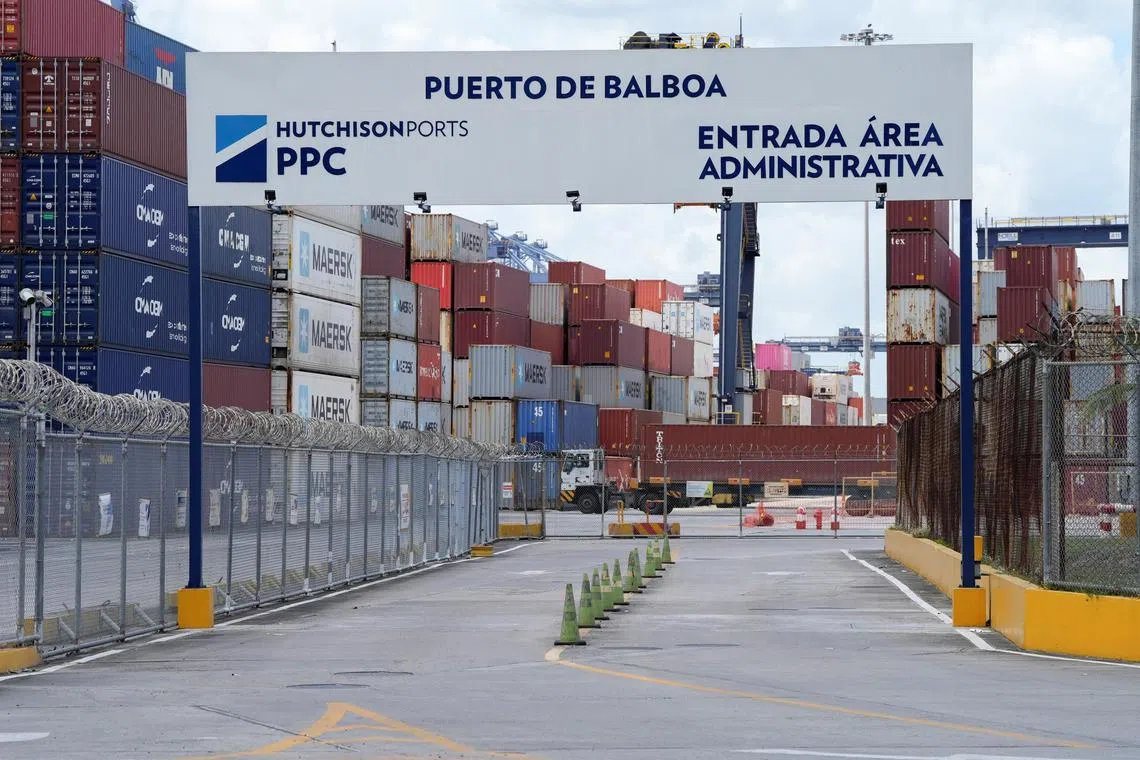
Panama’s Supreme Court ruled in January 2026 that the concession held by CK Hutchison’s Panama Ports Company for the Balboa and Cristóbal terminals was unconstitutional. The ruling came after months of U.S. pressure. Trump had threatened to “take back” the Panama Canal and accused China of controlling the waterway. The pressure fell on CK Hutchison, the Hong Kong-based company operating terminals at both ends of the canal.
CK Hutchison was already under pressure to sell. In March 2025, the company announced a deal to sell its controlling stake in Panama Ports Company and most of its non-China global ports business to a consortium led by BlackRock, through its Global Infrastructure Partners unit, and MSC’s Terminal Investment Limited. The deal would have handed the two canal terminals to U.S.-aligned financial capital.
Panama’s courts and government later blocked the transfer of the canal terminals. But the fight did not end there. Panama granted temporary operating licenses to Maersk and MSC, while the wider CK Hutchison ports deal continued through a BlackRock-MSC structure. The form changed; the pressure to push CK Hutchison out of the canal terminals did not.
Roughly 5-6% of world maritime trade passes through the canal. “Free trade” has always meant Washington’s freedom to decide who owns the chokepoints.
Washington cannot clear Hormuz. In Panama, it is still trying to pry the canal’s entry ports away from Chinese-linked control and into U.S.-aligned hands.
What is replacing the old order
Chinese state-owned entities invested nearly $24 billion in 363 seaport projects across 90 countries between 2000 and 2025, according to AidData’s March 2026 report, Anchoring Global Ambitions. UNCTAD reported that China’s commercially owned fleet reached about 10,440 vessels in 2025 by beneficial ownership — meaning ships ultimately owned or controlled by Chinese interests, whatever flag they fly. The U.S. merchant fleet is around 1,702 ships. More than half the value of that U.S.-owned fleet — $60 billion of $116 billion — is cruise ships, most of which are flagged to Panama, the Bahamas and Liberia to escape U.S. taxes and labor laws.
The U.S. merchant fleet did not just shrink. The U.S. ruling class let it die. Building and crewing cargo ships under U.S. flag stopped being profitable enough for finance capital, which moved into shipping the way it moved into housing and pharmaceuticals: extracting value, cutting costs, exiting the productive base. The same logic that produced BlackRock as the buyer at the Panama terminals produced the hollow U.S. fleet. U.S. capitalism hollows out its own productive base, then sends finance capital to buy control over what other countries built.
China is not doing the same thing in reverse. Building ports across 90 countries on multi-decade timelines is not the normal work of private capital looking for fast returns. It requires state direction, state banks and state-owned companies able to plan beyond the next quarter.
That capacity comes from China’s revolution. The 1949 revolution overthrew imperialism, the landlord class and Chinese capitalism and established a workers’ state. The market reforms that began in 1978 introduced capitalist elements, but they did not privatize the state-owned banks, the commanding state-owned enterprises in finance, energy, heavy industry and transport, or state control over land. That is why China can direct billions into ports, rail and shipping while U.S. capitalism pours comparable sums into stock buybacks, mergers and financial takeovers.
The two systems are organized on opposing class principles.
Iran’s oil has kept moving because the route no longer depends on a single chokepoint. Some crude moves overland to loading points east of Hormuz, including a terminal handling roughly 350,000 barrels a day. Other cargoes move through shadow-fleet methods: ship-to-ship transfers, relabeling and intermediaries that make the oil harder to seize or trace. Chinese buyers then settle much of the trade in yuan, outside the dollar channels Washington polices.
What Western analysts called improvised sanctions evasion in 2022 has become permanent infrastructure.
Iran, China and other sanctioned countries built these oil routes, shipping methods and payment channels because Washington used the old system as a weapon. They had to find ways around U.S. control of sea lanes, dollar payments, insurance and sanctions. Washington calls that instability. What it is losing is the power to decide which countries trade, which ships move and which payments clear.
The danger comes from Washington’s attempt to preserve the old order by force — in the Strait of Hormuz, the Red Sea and the Black Sea.
The cost is being passed through the prices of gasoline, jet fuel, fertilizer, helium and aluminum — the inputs that keep daily life moving. The International Energy Agency’s Fatih Birol has called the current disruption the greatest global energy security threat in history. The Asian Development Bank warns that the crisis will drag down production, jobs and living standards across developing Asia.
U.S. naval power and dollar dominance have always worked together: one guarded the sea lanes, the other controlled payments, insurance, credit and sanctions. Now both are being challenged at once.
Trump’s shoot-and-kill order and the Panama ports fight come from the same crisis. Washington is used to giving orders and expecting ships, banks and governments to fall in line. Now it threatens crews in Hormuz, commits piracy against ships it cannot control and forces port deals in Panama — destroying what it cannot command and seizing what it still can.
Join the Struggle-La Lucha Telegram channel