
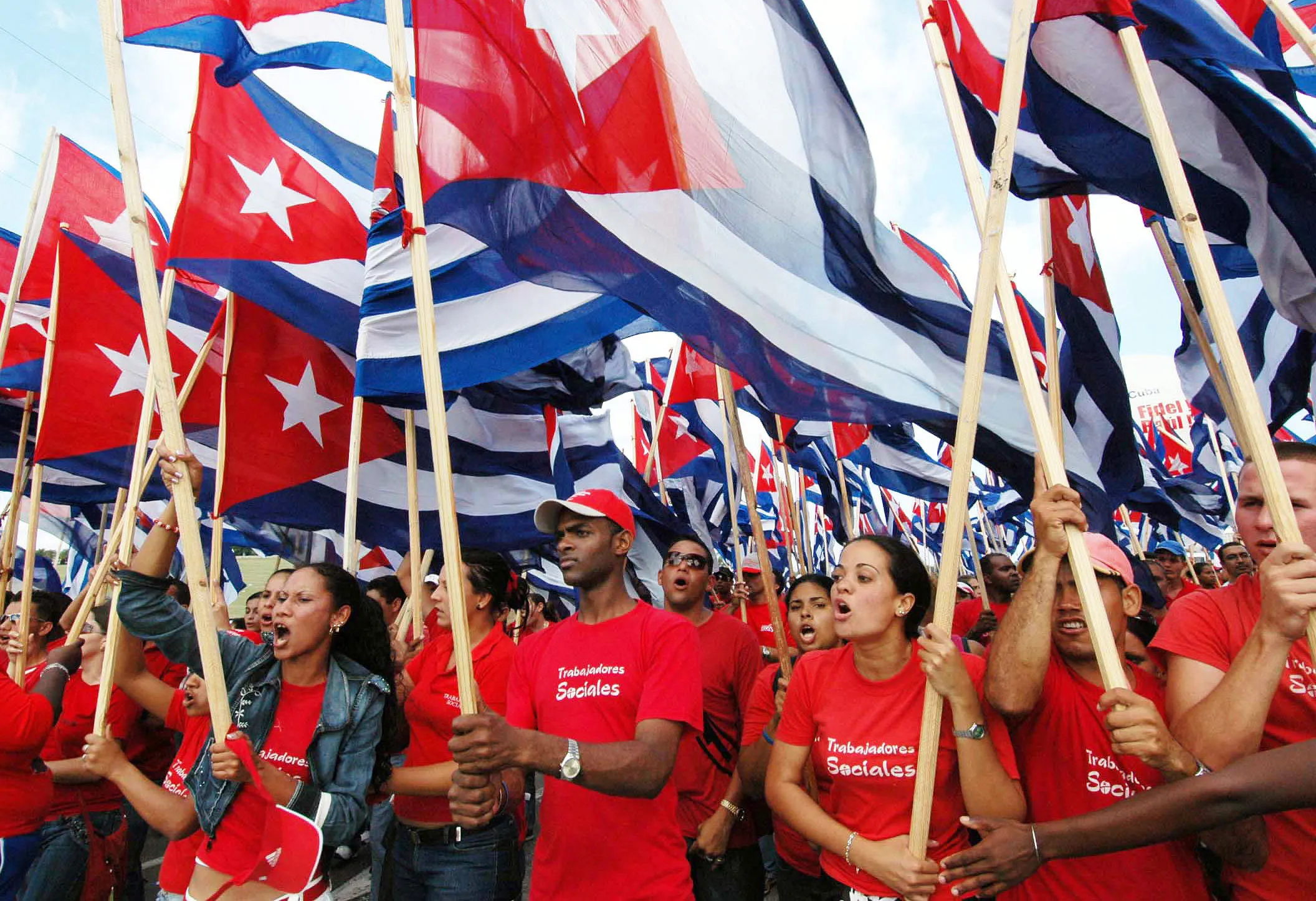
On April 16, the 65th anniversary of Fidel Castro’s declaration that the Cuban Revolution was socialist, Miguel Díaz-Canel stood at the same Havana corner where Fidel had spoken on the eve of the 1961 U.S.-backed invasion at Playa Girón. “Cuba is not a failed state. Cuba is a besieged state,” Díaz-Canel told the crowd. The country, he said, had to prepare once more for grave threats, including military aggression.
He was responding to an escalating threat. Three days earlier, Trump had told reporters at the White House that the U.S. “may stop by Cuba” after concluding the war in Iran. On April 15, USA Today reported — citing two sources familiar with White House directives — that the Pentagon was accelerating contingency planning for a possible military operation in Cuba. Asked to comment, the department said it plans for a range of contingencies and remains prepared to carry out the president’s orders.
Eleven days earlier, on April 5, Havana’s electric grid generated 1,278 megawatts at peak demand. Demand was 3,000 — a routine shortfall of more than 1,700 megawatts. March had already seen three full national collapses, the longest lasting 29 hours and 29 minutes.
On April 12, the Central de Trabajadores de Cuba (CTC, the Cuban Workers’ Federation), together with its affiliated unions and the National Association of Innovators and Rationalizers, issued its call for May Day 2026. The slogan was La Patria se defiende — the Homeland is defended. The call put the latest escalation in plain terms. Trump’s Jan. 29 executive order, it said, added an “energy siege” (cerco energético) to the commercial, economic and financial blockade imposed on Cuba for 65 years.
What is happening to Cuba is often reported as three separate stories: Venezuela, Ukraine and Iran. Each has narrowed Cuba’s access to fuel. Together, they have deepened the fuel crisis bearing down on Cuba.
The executive order
On Jan. 29, Trump signed Executive Order 14380, declaring a national emergency and authorizing tariffs on any country that directly or indirectly supplies oil to Cuba. The order took effect the next day. It threatened third countries with punitive tariffs and broader economic retaliation for trading with the island.
Treasury Secretary Scott Bessent had already called the December 2025 collapse of the Cuban peso on the unofficial currency market the “grand culmination” of the maximum-pressure strategy he inherited. That strategy did not begin with Trump. Biden left most post-2019 sanctions in place. What changed on Jan. 29 was the method. Washington added secondary tariffs aimed at cutting third countries out of trade with Cuba. Mexico’s state-owned Pemex halted shipments soon after.
The United Nations Human Rights Office has called the fuel blockade a serious violation of international law. U.N. officials say it is worsening a humanitarian emergency. On April 6, U.N. Resident Coordinator Francisco Pichon said conditions had worsened since late March and that needs remained acute across the eight provinces targeted for emergency assistance — affecting 2 million people, including nearly 300,000 elderly Cubans living alone.
That view is not isolated. Since 1992, the U.N. General Assembly has voted every year to condemn the U.S. blockade of Cuba. The 2025 vote was the 33rd in a row. In 2024, only the United States and Israel voted against the resolution. In 2025, Washington pressured five more governments — Argentina, Hungary, North Macedonia, Paraguay and Ukraine — into joining them.
The first war: Venezuela
The Venezuelan front did not begin with Trump’s second inauguration. Washington had already prepared the ground in the final months of the Biden administration. The decisive turn came in December 2025, when the U.S. began direct action against Venezuelan oil shipping. Washington seized a Venezuelan tanker on Dec. 10, then on Dec. 16, Trump ordered a blockade of sanctioned tankers entering or leaving the country. Venezuelan shipments to Cuba stopped that month, weeks before the Jan. 3 invasion in which President Nicolás Maduro and Cilia Flores were kidnapped.
This is domination through force, siege and financial strangulation. Trump and senior officials threatened Venezuela with the kind of punishment they praised in Israel’s war on Gaza: bombardment, siege and relentless pressure on an entire population. That threat hung over every move Caracas made. Washington then deepened the squeeze through control over oil, payments, insurance and contracts. The government still stands. Maduro remains Venezuela’s president, and the Bolivarian Revolution has not been overthrown. But Washington has made it harder for Caracas to sell oil, move money and keep production running.
Washington, acting through the Treasury’s Office of Foreign Assets Control (OFAC), now decides what can be exported, whether payments can clear, whether ships can be insured, and whether Venezuela’s state oil company, PDVSA, can get the imports it needs to move heavy crude.
In his March 4 State of the Union address, Trump boasted that the U.S. had already taken more than 80 million barrels from Venezuela. Reuters reported on Feb. 18 that Venezuela’s oil ministry had canceled 19 private oil and gas contracts, now subject to OFAC licensing review. The effect was to put more of Venezuela’s economy under U.S. licensing control.
For Cuba, the effect was immediate. The island’s main outside source of fuel was gone — the oil relationship the electric grid had relied on since Hugo Chávez’s presidency.
The second war: Ukraine
Russia is Cuba’s remaining major fuel supplier. It is also a country under heavy sanctions, with tanker capacity operating through a shadow fleet exposed to secondary enforcement and a wartime economy under strain. That Moscow has continued to send oil to Cuba under those conditions is central to the story, not incidental to it.
On March 31, the sanctioned Russian tanker Anatoly Kolodkin entered Matanzas carrying roughly 730,000 barrels of crude, Cuba’s first oil tanker arrival in three months. Washington said such deliveries would be handled case by case. The arrival mattered, but it did not end the crisis.
A second Russian tanker is now headed for Cuba. But the significance is larger than one shipment. After Russian Foreign Minister Sergey Lavrov’s April 14-15 meetings in Beijing, Moscow said Russia and China were coordinating more closely on Cuba, Venezuela and the wider war. Lavrov said Russia had already sent 100,000 metric tons of oil to Cuba, expected that support to continue, and expected China to continue participating as well.
None of this ends Cuba’s immediate power crisis. A 730,000-barrel shipment, even fully processed, covers only about nine or 10 days of national diesel demand. But the squeeze is having another effect. It is pushing Russia, China and Cuba toward the kind of open political, economic and energy coordination the blockade was meant to stop.
The third war: Iran
The U.S. air war against Iran, which began Feb. 28, has sharply disrupted shipping and oil flows through the Gulf. Insurers have pulled back, shipping firms have avoided the route, and commercial traffic through the Strait of Hormuz has at times collapsed. Brent crude was over $100 a barrel on April 22.
The International Energy Agency has called it the largest oil supply disruption since the 1970s. Asian refiners, which rely heavily on Gulf crude, are rationing. European fuel prices have risen.
The shock is rippling outward through fuel markets. Lufthansa said on April 21 that jet fuel prices had doubled since the war began and that it would cut 20,000 flights through October to save fuel.
For Cuba, the pressure works indirectly, but the result is decisive. In a tight oil market, every supplier with spare capacity has buyers lined up at premium prices. None has a commercial reason to defy a U.S. secondary-tariff regime to move a cargo to Cuba. The Iran war does not target Cuba directly. It makes every other option more expensive, scarcer or politically harder to reach.
What the CTC called for
The CTC’s April 12 May Day call was not the usual holiday text. It placed the Jan. 29 executive order at the center. It described “a real military threat” — una amenaza militar real — and exhorted workers to defend the country “from every trench of combat”: fields, factories, classrooms, thermoelectric plants, hospitals, cultural and sports venues. It invoked Antonio Maceo at Baraguá, who in 1878 refused a peace without independence. It invoked José Martí at Dos Ríos. And, in the year of Fidel Castro’s centenary, it invoked his 2000 address on what defines a revolutionary process.
A labor federation speaking for a population living through 18-hour blackouts is telling workers that May Day is part of the country’s defense. The call does not separate civilian life from national defense. It treats the electric system, the harvest and the classroom as fronts in a war already underway.
The CTC’s language is not exaggeration. It matches the purpose Washington has laid out openly.
The goal of the Cuba operation was stated openly. Rubio told the Senate on Jan. 28 that the administration sought regime change. On March 16, Trump said Cuba was weak enough to “take.”
The energy siege is not aimed at a concession. It is aimed at putting a government in place that will reopen Cuba to foreign corporations and private profit. That is already happening in Venezuela, where OFAC licensing is positioning outside companies for access to the oil sector. The same interests will next look to Cuba’s nickel mines at Moa and to offshore oil and gas fields in Cuba’s territorial waters.
What Washington built against Caracas is now aimed at Havana.
Two May Days
A million workers marched in Havana on May Day 2025. This year’s turnout is likely to be smaller — the blackouts, the transport collapse, and the fuel rationing are all real limits on what the CTC can stage. Marches began on April 20 in communities and people’s councils, per the organizing commission’s announcement, and culminate on May 1 in municipal and provincial capitals. A May 2 international solidarity event is scheduled in Havana.
On the same day, in the United States, the May Day Strong coalition is calling the largest labor-backed mobilization in a generation. Its demands are domestic: tax the rich, no ICE, no war, hands off the vote. Its organizers have repeatedly named the Iran war, the immigration raids, and the billionaire class as a single structural problem.
The kidnapping of Maduro and Flores, the energy siege on Cuba and the war on Iran are parts of one imperialist drive, carried out on different fronts. In the United States, May Day Strong is naming war, repression and billionaire rule. In Cuba, the CTC is telling workers the blockade is a war already underway. They are describing the same enemy.
Join the Struggle-La Lucha Telegram channel