
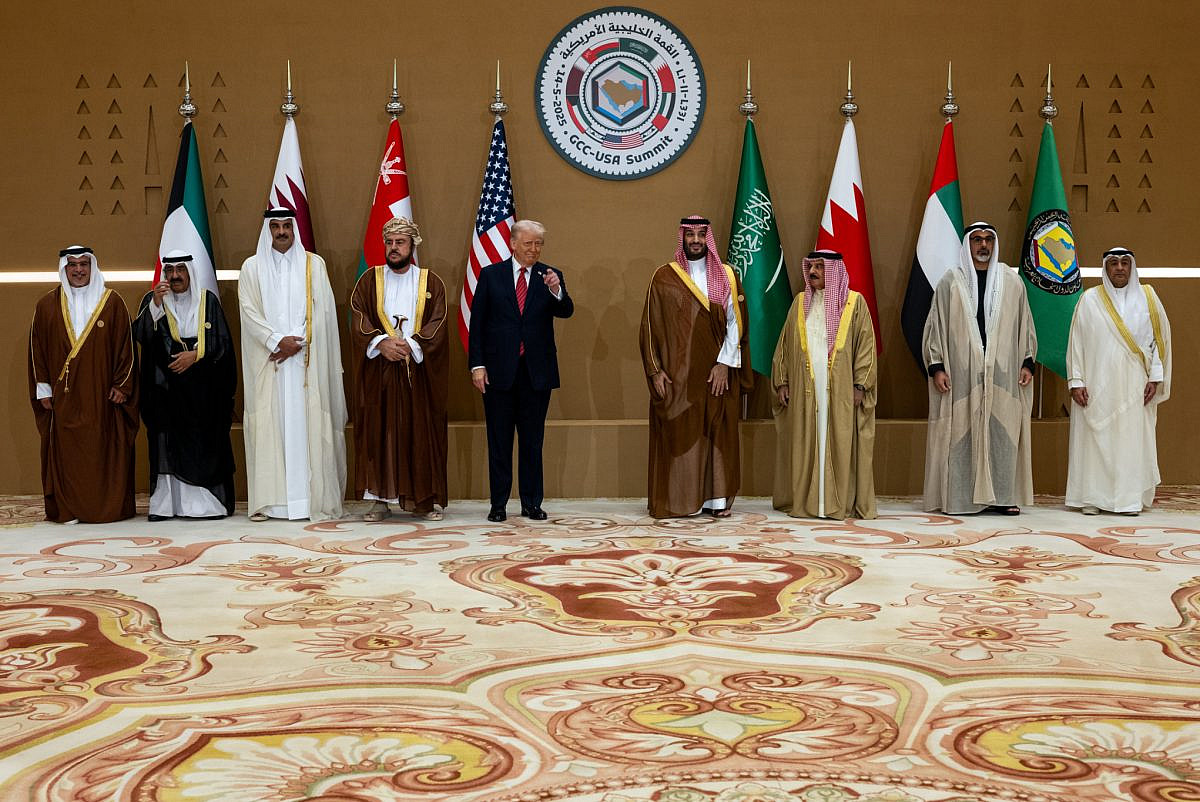
The United Arab Emirates has asked Washington for a financial lifeline — and threatened to start selling oil in Chinese yuan if it does not get one.
That is a contradiction of Trump’s war on Iran.
According to the Wall Street Journal, UAE Central Bank Governor Khaled Mohamed Balama raised the idea of a currency-swap line with Treasury Secretary Scott Bessent and Federal Reserve officials during meetings in Washington the week of April 14. Such a line would give the UAE access to dollars from the Fed in exchange for dirhams, a backstop usually reserved for Washington’s closest allies. Emirati officials also warned that if the UAE runs short of dollars, it may have to use yuan or other currencies for oil sales and other transactions.
The UAE is not a poor country in need of rescue. Abu Dhabi’s sovereign wealth funds hold more than $1 trillion in assets. It is one of the Gulf client states built into the U.S.-dominated dollar order. Its currency is pegged to the dollar. Its oil is sold in dollars. It hosts U.S. bases and recycles petrodollar wealth back into U.S. Treasury debt, Wall Street investments and — increasingly — AI data center infrastructure for Amazon, Microsoft, Meta and Google built on cheap Gulf energy. In return, Washington protects the monarchy and the system that keeps it in power.
The dollar order
That arrangement underpins U.S. imperialist power. Since the 1970s, world oil trade has been organized around the dollar. Countries that need oil need dollars to buy it. That constant demand helps Washington run huge deficits, finance war and borrow on terms no other country can match.
Iran has stood partly outside that order since the 1979 revolution overthrew the U.S.-backed Shah, installed after the 1953 CIA coup, and removed the country from direct imperialist control. Under decades of sanctions, Iran built alternative trade and payment channels, including oil sales to China in yuan. Crushing that independence would have strengthened the dollar system. Instead, Trump’s war is doing more damage to the dollar order than Iran ever did.
The clearest example is the Strait of Hormuz, where about one-fifth of the world’s oil supply passes. Iran reimposed military control over the Strait on April 19 after the U.S. seized an Iranian cargo ship, and the Islamic Revolutionary Guard Corps fired on two vessels trying to cross. International Energy Agency head Fatih Birol said on April 18 that no new oil or gas tankers were loaded for Asian markets in March and that recovery of West Asian energy output could take about two years. The war is not defending stable energy flows. It is choking them.
Now the pressure is hitting the very Gulf states Washington counted on to anchor the petrodollar system.
The UAE is not trying to break from the dollar. It is warning that dependence on the dollar has become dangerous under conditions Washington itself created. When even a core U.S. client state starts raising the possibility of oil sales in Chinese yuan — the currency of the developing socialist country Washington has designated its primary enemy — the system is starting to crack.
Access without influence
Qatar has learned the same lesson. It hosts Al Udeid, the largest U.S. military base in West Asia and the forward headquarters of U.S. Central Command. The Qatari government donated a Boeing 747 to Trump. A Qatari state-owned real estate firm signed a deal with the Trump Organization to build a Trump-branded golf course. When Trump visited in May 2025, the White House announced an agreement “to generate an economic exchange worth at least $1.2 trillion.” Qatar housed the base, gave away the plane, built the golf course and signed the trillion-dollar pledge. None of it bought a seat at the table when Trump launched a war on its doorstep.
As Qatari analyst Rashid Al-Mohanadi said, the Gulf states were thrown into “strategic shock.” They assumed a war of this scale would at least be discussed with them. It was not. The relationship gave them access to Washington, not influence over it. It is a relationship of dependence and subordination.
Wall Street’s war dividend
The financial costs of the war continue to mount. The American Enterprise Institute estimated in early April that the U.S. had spent between $25 billion and $35 billion on the conflict. U.S. Energy Secretary Chris Wright acknowledged on April 20 that gas prices might not return below $3 per gallon until 2027.
Wall Street has been celebrating anyway. Stocks surged and oil prices dropped during the week of April 14 on optimism about ceasefire talks — talks that Iran announced on April 20 it would not attend. The rally was a bet that the petrodollar arrangement would hold and that energy flows would resume on the old terms. The war itself points in the opposite direction.
Some on Wall Street are not just wrong about the war. They are profiting from it. On March 23, traders placed $580 million in bets on oil futures 15 minutes before Trump posted on social media that the U.S. was having “productive” talks with Iran, the Financial Times reported. Trump’s post triggered a sell-off that sent oil prices plunging. On April 7, traders spent $950 million betting oil prices would fall, hours before the ceasefire was announced. That is more than $1.5 billion in trades timed to presidential statements about a war that has killed thousands. UN and WHO data confirm the destruction of hundreds of schools, hospitals and residential complexes.
The energy industry itself is not so confident. Gerry Morton, oil and gas co-chair at Baker Botts — one of the oldest and most connected energy law firms in the United States — told the Washington Post on April 18 that people closest to the industry recognize how long recovery will take, if it happens at all. People who work in energy production can see the damage. Investors trading oil futures from a distance are betting on restoration.
That is the broader contradiction. Trump’s war on Iran was supposed to reinforce dollar rule in the Gulf. Instead it is exposing how fragile that rule really is. The dollar system was built on stability in the Gulf and steady energy flows. Trump’s war has thrown both into disorder. The Gulf monarchies were meant to stay locked inside dollar dependence — buying Treasury debt, hosting U.S. military bases, powering U.S. tech infrastructure on cheap Gulf energy. Now even they are raising the yuan. Finance still bets on a return to normal. But no cargo seizure or U.S. aircraft carrier deployment can restore a system the war itself is helping break apart.
Join the Struggle-La Lucha Telegram channel