
The ceasefire expires around April 22. The U.S. military buildup has not stopped. Every claim Donald Trump made on April 18 about a deal with Iran was false — and Iran said so publicly, in real time. Then Trump said it himself: “Unfortunately we’ll have to start dropping bombs again.” The pattern is now unmistakable. Washington is constructing a pretext for a massive new air assault on Iran, the fourth major escalation since Operation Epic Fury began Feb. 28.
The script
Trump posted a barrage of claims on Truth Social on April 18. He said the Strait of Hormuz was “completely open and ready for business.” He said Iran had agreed to end its nuclear enrichment program “forever.” He said the war was “very close to over.” He said Iran would hand over its stockpile of enriched uranium, and that U.S. excavators would collect it.
None of this was true.
Iran’s Foreign Ministry spokesperson Esmaeil Baqaei said the country’s enriched uranium “is not going to be transferred anywhere.” He described Trump’s claims as “a baseless statement of the enemy.” Iran’s enriched uranium, Baqaei said, is “as sacred as Iranian soil.”
The Strait of Hormuz was not fully reopened. Iran’s Foreign Minister Abbas Araghchi said commercial vessels could transit for the remaining days of the Lebanon ceasefire — a 3-day window, not a permanent arrangement. Iran laid out three strict conditions: no military vessels, no cargo linked to hostile countries, and all ships must follow routes designated and controlled by the Islamic Revolutionary Guard Corps. That is not what “completely open” means by any ordinary definition.
Trump acknowledged, in the same burst of posts, that the U.S. naval blockade of Iranian ports would remain in full force “until such time as our transaction with Iran is 100% complete.” There is no transaction. Iran has not agreed to one. The blockade — the third unauthorized war action since Feb. 28 — continues.
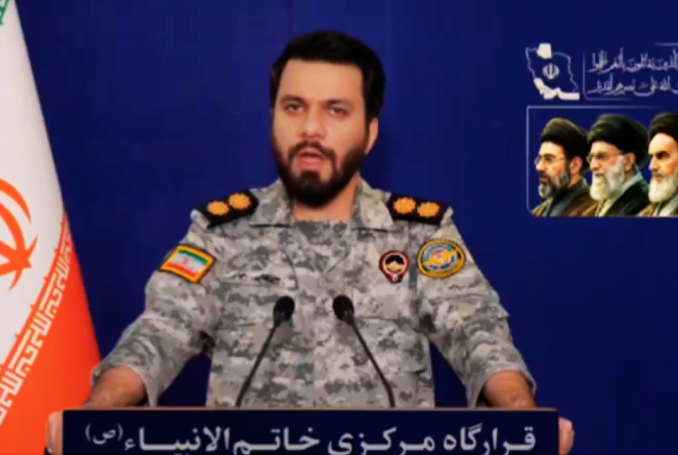
Within hours, Iran reversed even the limited opening it had offered. The spokesperson for Iran’s Khatam al-Anbiya Central Headquarters announced that Tehran was re-tightening control over the Strait, returning it to its previous operational state. Iran had allowed limited commercial passage as a gesture of good faith during negotiations, the spokesperson said, but reversed course after accusing Washington of “piracy” as U.S. forces continued stopping and turning back vessels under the blockade. Maritime access will remain restricted until the U.S. guarantees free movement of vessels to and from Iran.
Iranian Parliament Speaker Mohammad Bagher Qalibaf was blunt. Trump’s claims were false. “They did not win the war with these lies, and they will certainly not get anywhere in negotiations either,” Qalibaf said. Control over the Strait of Hormuz is determined “on the ground, not on social media.” Transit will occur only under Iranian conditions and authorization.
Trump, speaking to reporters aboard Air Force One on April 18, then dropped the pretense. He warned that the ceasefire might not be extended beyond the following week and that the blockade would remain in place. “Maybe I won’t extend it,” he said. “So, you have a blockade, and unfortunately we’ll have to start dropping bombs again.”
In a single day, the sequence was laid bare: Washington announced a breakthrough that did not exist, Iran said so publicly, and Trump answered with a threat to resume bombing.
The pattern
This is the same sequence Washington ran with the Islamabad talks.
A temporary ceasefire was brokered on April 8. The U.S. entered Pakistan-brokered negotiations in Islamabad days later. Reports indicated that Trump envoys Jared Kushner and Steve Witkoff walked out after 21 hours. The collapse was not presented as a U.S. walkout. It was framed as a failure of diplomacy — as if both sides had simply failed to agree.
The blockade followed days later.
Now the cycle is repeating at higher volume. Trump announces sweeping breakthroughs that Iran immediately denies. He insists on conditions — surrendering enriched uranium, ending all nuclear work — that no sovereign country would accept. When the fabricated progress fails to materialize, Washington will have its justification: Iran refused the deal. The bombs follow.
Professor Mohammad Marandi of Tehran University identified the logic at work. “I believe Trump is probably saying all this nonsense about agreements with Iran so that he can later claim, ‘Iran didn’t keep its promises’ — promises Iran never made,” Marandi wrote on April 18. “The chances of renewed murderous aggression from Trump and Netanyahu are high.”
U.S. military aircraft have continued flowing into the region throughout the ceasefire period. The buildup has not paused.
The market play
Trump’s blitz of false claims was not only aimed at building a case for war. It was aimed at Wall Street.
Stocks surged on April 18. Oil futures dropped. Investors took Trump’s claims about the Strait and the nuclear deal at face value. The stock market soared on the expectation that the war was winding down.
It is not winding down.
Paper oil prices fell, but actual barrel prices — the cost of physical crude — remained elevated. This gap has been a consistent feature of the war. Speculators trade on Trump’s words. The supply chain trades on material reality. Working people pay the real price at the pump and in the cost of goods that move by sea.
The timing of Trump’s posts is itself revealing. He described working with Iran “at a leisurely pace” — language directed at portfolio managers, not at Tehran. The effect of the fake diplomacy is to steady financial markets while the Pentagon positions for the next round of strikes.
This is not a president losing control of the narrative. It is a president using public claims to move the markets. The same administration that launched Operation Epic Fury without congressional authorization, expanded it with the blockade, and is now preparing a fourth escalation, is simultaneously manipulating the markets that are supposed to register the cost of war.
The war economy takes shape
While Trump claims the war is nearly over, the Pentagon is building a wartime industrial base.
The Department of War has opened discussions with Ford and General Motors to convert automotive production capacity into military output. The administration frames this as a revival of the World War II “Arsenal of Democracy.” The scale tells the real story. The proposed fiscal year 2027 defense budget is $1.5 trillion — a 44% increase over current levels.
The need is driven by depletion. In the first 40 days of the Iran war alone, the U.S. burned through Tomahawk cruise missiles and Patriot interceptors at a rate that will take at least five years to replenish. Tomahawks cost roughly $2 million per unit. The burn rate is outstripping both the budget and the production capacity of existing defense contractors.
Retired Army Major General John Ferrari, a fellow at the American Enterprise Institute, put it plainly. “We are on borrowed time. The Russians, the Chinese, the Iranians, everybody knows that we don’t have enough munitions.”
The Pentagon wants the auto factories because the traditional defense industrial base cannot produce at the volume this war demands. Defense Secretary Pete Hegseth has called the existing contractors “stagnant.” The administration is seeking off-the-shelf commercial components to bypass the high costs of specialized weapons systems. Ford is operating at 73% capacity. General Motors sits at 79.5%. The Pentagon sees available factory space.
The technical barriers are real. In 1942, cars and bombers shared the same engine base, so factories could shift quickly. That is not the case today. An F-150 assembly line cannot be converted into a precision-guided missile line. “You’re not going to make F-150s next to planes and tanks,” said Sam Fiorani of AutoForecast Solutions. The F-150 is Ford’s full-size pickup truck, the best-selling vehicle in the U.S. for over four decades.
The political friction is sharper. UAW President Shawn Fain called the production push a “foolish agenda” with no strategy and no exit plan. Secretary of State Marco Rubio has conceded there is “no plan to bring it to an end.”
Working people face the cost from both ends. The Strait of Hormuz disruption drives up energy and shipping costs globally. The diversion of factory capacity, materials and labor into weapons production will push car prices higher. The end of the federal EV tax credit compounds the squeeze. Autoworkers are being drafted into a war economy that no one voted for, to sustain a war that Congress never authorized, with no timeline for it to end.
None of this is consistent with a war that is “very close to over.”
Israel’s spoiler role
The ceasefire that is supposed to hold until April 22 was already in trouble on its first day.
Large-scale detonations of Lebanese infrastructure were reported across southern Lebanon within hours of the truce taking effect. Displaced civilians who attempted to return home found their villages destroyed or still under Israeli military occupation. Sen. Lindsey Graham immediately demanded Hezbollah disarmament as a condition for any “real” peace — a demand that has nothing to do with the terms of the ceasefire and everything to do with ensuring it collapses.
This matters directly for the Strait of Hormuz because Iran tied commercial transit to the Lebanon ceasefire. Iran conditioned the limited reopening of commercial transit on the Lebanon ceasefire holding. The Tasnim News Agency reported that a source close to the negotiations warned explicitly: If the blockade continues or the ceasefire fails, Iran will shut the Strait again. That warning has already been carried out. Iran cited U.S. “piracy” — the blockade itself — as the trigger for re-tightening control. Israel’s violations of the ceasefire give Washington an additional mechanism to ensure the framework collapses entirely.
What comes next
The ceasefire expires around April 22. Trump has already said he may not extend it. An administration this attuned to market timing is unlikely to launch strikes early in a trading week. A Friday or weekend start would allow the initial wave of bombing to dominate headlines before markets reopen and before the results are known.
The war on Iran has followed a consistent logic since Feb. 28. Each phase — the initial bombing campaign, the expansion of targets, the blockade — has been preceded by a round of false diplomacy and followed by escalation. The current round of fake breakthroughs is louder and more elaborate than any before it. It collapsed within hours. Iran re-tightened the Strait. Trump threatened to resume bombing.
As Qalibaf said, wars are decided on the ground, not on social media. The ground is being prepared for the next round.
Join the Struggle-La Lucha Telegram channel