
On April 7, U.S. bombs hit eight major rail sections and bridges across Iran, including targets in Tehran, Karaj, Tabriz, Kashan and Qom. Iran halted service from Mashhad and Khuzestan.
The attacks followed weeks of strikes on civilian infrastructure. In late March, U.S. bombs destroyed part of the B1 bridge west of Tehran, a major link between the capital and its western suburbs. They hit petrochemical plants at Asaluyeh and Marvdasht, Kharg Island oil terminals, power grids and Sharif University of Technology. On the war’s opening day, Feb. 28, a U.S. Tomahawk missile struck the Shajareh Tayyebeh girls’ elementary school in Minab, killing at least 170 people, most of them girls between 7 and 12 years old. Amnesty International, Human Rights Watch and Al Jazeera investigations concluded the strike was deliberate. By early March, the World Health Organization had verified 13 attacks on health facilities in Iran. Gandhi Hospital in Tehran had its IVF department destroyed. The Pasteur Institute was knocked out of service. Iranian officials reported 31 major hospitals damaged, 12 of them no longer functioning.
On April 6, Trump told reporters that every bridge in Iran would be “decimated” and every power plant left “burning, exploding and never to be used again.” On April 7, he declared that “a whole civilization will die tonight.”
Iranians answered. Across the country, people formed human chains at power plants and on bridges. Workers, students, athletes and musicians stood outside the Tabriz Thermal Power Plant, the Bisotun plant in Kermanshah, power stations in Bushehr and Kazeroon, and the Damavand plant that supplies Tehran. In Dezful, students lined the 1,700-year-old Sassanid bridge. In Ahvaz, crowds linked arms on the White Bridge. They carried Iranian flags and placards reading, “Infrastructure is not a battlefield.”
The targets were not random. The strikes hit rail lines, bridges, ports, hospitals, schools, power plants and fuel systems across Iran. The rail network under attack carries freight between China, Central Asia and Europe through Iranian territory. It bypasses U.S.-controlled sea lanes. It helps make Iran a transit hub instead of an isolated country under sanctions. That is what the bombing is hitting.
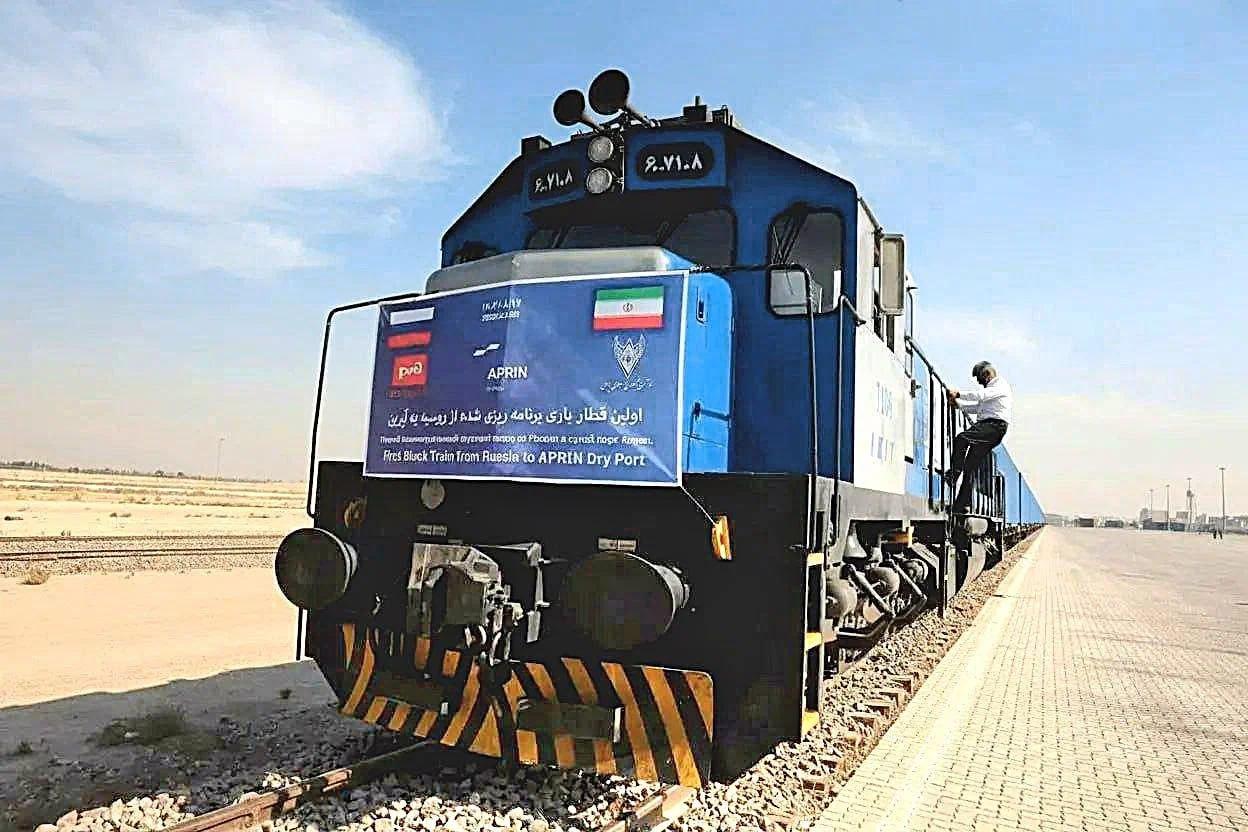
On May 25, 2025, the first freight train from Xi’an, China, arrived at the Aprin dry port near Tehran. The route cut China-to-Iran transit time from 30 to 40 days by sea to about 15 days by land, bypassing the maritime chokepoints the war has now thrown into crisis. Trade through Iran is growing fast, with container volumes surging 260% in the first half of 2025.
Before 2022, the Northern Corridor through Russia and Belarus carried more than 86% of overland trade between East Asia and Europe. The Ukraine war shut that route down. Sanctions barred Russian freight operators from Europe. Overland shipments between China and the European Union fell 40%. Then, on Sept. 26, 2022, underwater explosions tore apart three of the four Nord Stream gas pipelines linking Russia to Germany.
Nord Stream was a deliberate target. The blasts severed the energy link between Russia and European industry, replacing cheaper pipeline gas with far more expensive U.S. liquefied natural gas. Trade had not broken that link. Sabotage did.
The Middle Corridor — the trans-Caspian route through Kazakhstan, Azerbaijan, Georgia and Turkey — absorbed some of the displaced trade. Cargo volumes along it rose to 4.1 million tons in the first 11 months of 2024, up 63% from the year before. But ships still have to cross the Caspian. Rail gauges change at multiple borders. Six countries have to coordinate customs and scheduling. Even at full capacity, the Middle Corridor carries only a fraction of what the Northern Corridor carried before the war.
The Southern Corridor through Iran is the real alternative. China is funding electrification and freight terminals, while Iran is building track and expanding capacity. On July 15, 2025, Iran and China signed a deal to electrify 1,000 kilometers of the Razi-Sarakhs line, a key east-west link. India is connecting its sea routes to Iran’s inland rail network through port investments at Chabahar and Bandar Abbas. China’s role is not ad hoc. It sits inside the long-term Belt and Road buildout formalized in the March 2021 China-Iran cooperation agreement.
In May 2025, rail officials from Iran, China, Kazakhstan, Uzbekistan, Turkmenistan and Turkey met in Tehran to plan a transcontinental network. They met again in Beijing in August. The Aprin freight link, the Razi-Sarakhs electrification and new corridors connect China, Central Asia, Iran, Iraq, Syria, Turkey and Europe by land without passing under a U.S. carrier group.
Marx wrote in 1853 that railways would become “the forerunner of modern industry” in India. The British built them to extract cotton and raw materials at lower cost. But Marx argued that once a country with iron and coal had railways, it could not be kept from building industry around them. The rails would begin to break the isolation that held development back. They would lay down what he called the material premises for progress — and for independence. But Marx also wrote that the people of India would only reap the fruits of that development when they had grown strong enough to throw off the English yoke altogether. The railroads China and Iran are building today serve a similar function, with one major difference. They are not a byproduct of imperialist extraction. They are being built deliberately to move trade outside imperialist control. That is why they are being bombed.
Washington is not building a cheaper route. It is not building a faster one. Rail cuts time and cost. Russian pipeline gas was cheaper than U.S. LNG. When U.S. imperialism cannot stop trade through competition, it uses force. The Pentagon hits the infrastructure. The Treasury freezes assets, blocks payments and shuts down the banks and insurance that keep the trade moving. The aim is the same: to break the routes that move goods, energy and payments outside U.S. control.
The rail lines will be rebuilt. Iranian crews began repairing damaged bridges within days of the April 8 ceasefire. Service on the Tabriz-Tehran and Tabriz-Mashhad routes resumed April 13. The Xi’an-Aprin route is expected to resume within weeks. The Razi-Sarakhs electrification continues.
Every bomb on an Iranian rail bridge pushes China, Iran and India to build routes less exposed to U.S. force.
The United States is bombing the railroads of a world it no longer controls. The railroads will be built anyway.
Join the Struggle-La Lucha Telegram channel