
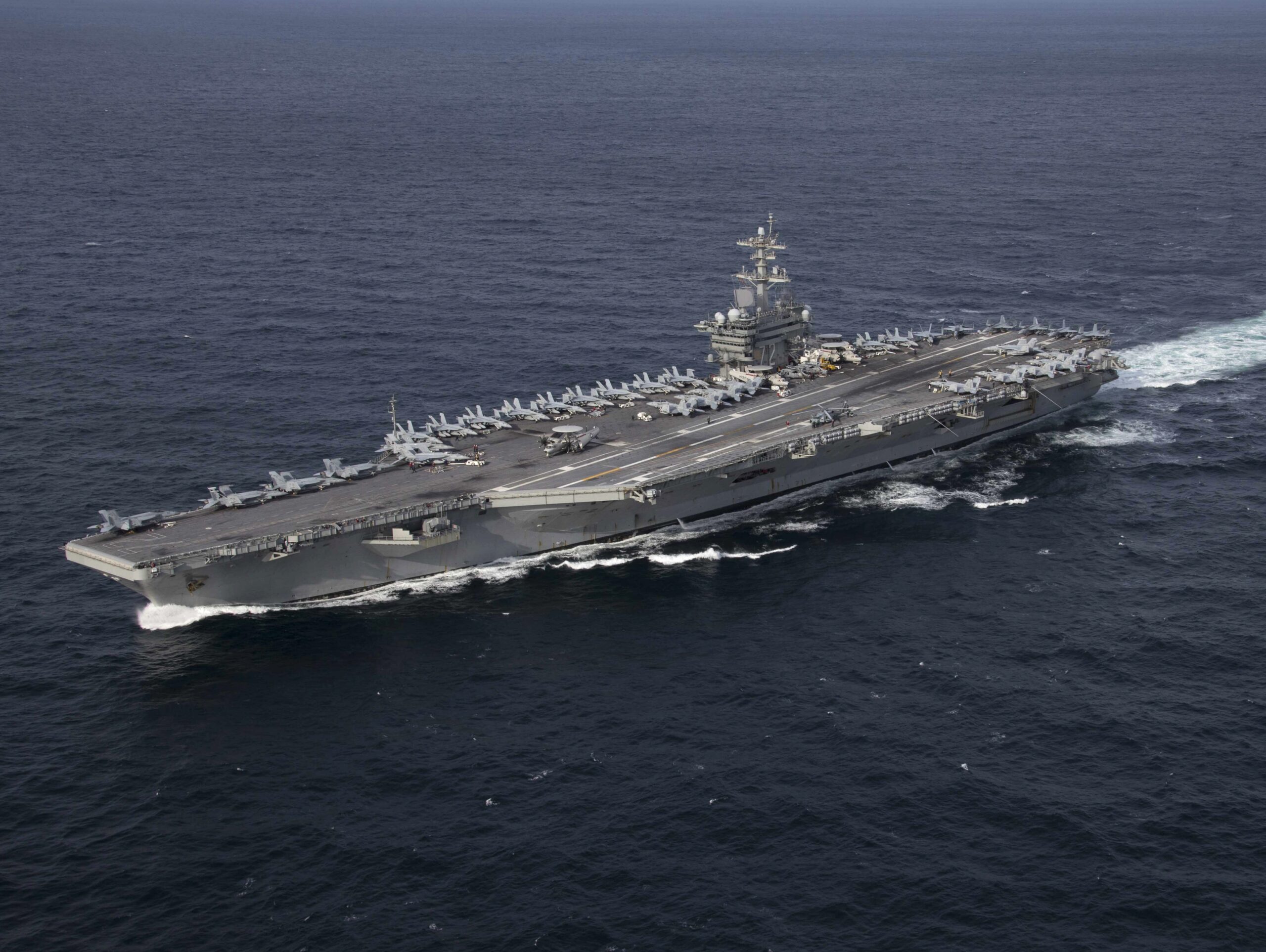
When the U.S. delegation walked out of the Islamabad talks on April 12 without an agreement, Washington moved at once to escalate. Trump announced that U.S. naval forces would impose a blockade on Iranian ports, cutting off maritime traffic in and out of the country. U.S. Central Command said the operation would begin at 10 a.m. Eastern time on April 13.
But this did not begin with Washington. After six weeks of war, Iran had already asserted control over the Strait of Hormuz — its own territorial waters — restricting passage under regulated conditions and sharply reducing shipping through the waterway. That move came in response to an illegal U.S. war and a sustained bombing campaign that has killed civilians and destroyed hundreds of schools, hospitals and key industries.
The U.S. blockade is the same war in another form. Washington could not break Iran through bombing or impose terms at the negotiating table. Now it is trying to choke off Iran’s oil exports — the country’s main link to the world market — in an effort to force what it could not win militarily.
This is the third major war action Trump has taken against Iran since Operation Epic Fury began on Feb. 28. He has done it without congressional authorization, without public debate and without even attempting to secure broad political consent. Congress has not been asked to authorize a single step. The war is moving ahead anyway.
Democratic leaders are not calling for the war to end. Their criticism is about how Trump is running it, not whether it should continue.
The economic shock began before the U.S. blockade of Iranian ports even started, because shipping through Hormuz had already been disrupted by war and by Iran’s control over passage. Brent crude, which had dropped to $92 when the two-week ceasefire was announced, climbed above $102 a barrel on April 13, while West Texas Intermediate rose above $104. Tankers began steering away from the strait before the operation’s start time.
The disruption is already spreading beyond oil. Analysts report shortfalls in helium, liquefied natural gas and industrial feedstocks. An imperialist assault on a strategic energy-producing country does not stay contained within oil markets. It spreads through the entire system of trade and production.
Iran restricted passage through the strait itself, in its own waters. Washington is blockading Iranian ports to stop its oil from reaching the world market.
The geography of the Strait of Hormuz sets hard limits. At its narrowest point, the strait is about 21 miles wide. Coastal waters extend 12 nautical miles from shore, meaning the shipping lanes run through Iranian and Omani territorial waters, not open ocean. Ships move through a confined corridor under constant surveillance and within range of coastal defenses. This is not a space the U.S. controls.
Tankers are already steering away from the strait. Shipping is reacting to danger, not to what Washington says on paper. More than 15 U.S. warships have been deployed for the operation, including an aircraft carrier, destroyers and an amphibious assault ship. Some are equipped for boarding operations. Others are positioned to stop and redirect commercial traffic.
In practice, stopping ships is not simple. Crews can refuse orders, resist boarding or lock down control systems. Each step of enforcement — from warning to boarding to seizure — raises the risk of direct confrontation. The blockade cannot be enforced without escalation.
For decades, Washington has claimed to defend “freedom of navigation.” In practice, it uses sanctions and military force to decide who can sell oil, who can buy it and how it is shipped. U.S. sanctions restrict which countries and companies can receive targeted oil, while measures like the full blockade of oil shipments to Cuba show how that control is enforced in practice. The blockade makes that reality explicit. It is an attempt to control energy flows at their source by force.
In March, after coming under missile attack, the USS Abraham Lincoln carrier strike group retreated to roughly 1,000 kilometers (620 miles) from Iran’s coast. That is not a position from which to enforce a blockade.
On April 13, the Islamic Revolutionary Guard Corps said U.S. military vessels approaching the strait would be treated as a ceasefire violation and would bring a forceful response, while civilian shipping would continue under regulated conditions.
That distinction matters. Iran is not attempting to shut down all traffic. It is asserting control over its own waters under conditions of war.
The two-week ceasefire announced April 7 technically remains in place through April 21, and further contacts had been under discussion. The U.S. blockade now puts those talks on the verge of collapse. Iranian Foreign Minister Araghchi said the two sides had been close to a memorandum of understanding before the U.S. walked out.
After 21 hours without an agreement, the U.S. delegation walked out. Talks over a war of this scale do not end in a single day unless the U.S. is there to impose terms, not to negotiate.
Washington pointed to the nuclear issue as the reason the talks failed. But the talks turned on Hormuz, Lebanon and whether Iran would accept U.S. terms — the same questions now driving the blockade.
Washington launched this war seeking regime change. It failed. Iran held together, strengthened its defenses and asserted control over the Strait of Hormuz in response to an attack on its existence. Only then did Washington shift to demanding that the strait be reopened on U.S. terms.
The U.S. blockade of Iranian ports is its answer to that refusal.
It is an attempt to use siege — cutting off oil exports and threatening economic collapse — to force what war and negotiations could not deliver.
But that pressure does not fall on Iran alone. China, India and Pakistan depend on Iranian energy flows. Blocking those exports means confronting the countries that rely on them. Washington cannot escalate against Iran without widening the conflict.
Washington presents each escalation in this imperialist war as limited and controlled. In reality, the costs are rising and the risks are widening. The blockade does not resolve the problem Washington has run up against. It deepens it.
There is no reason to expect it to succeed where war and negotiations have already failed.
Join the Struggle-La Lucha Telegram channel