
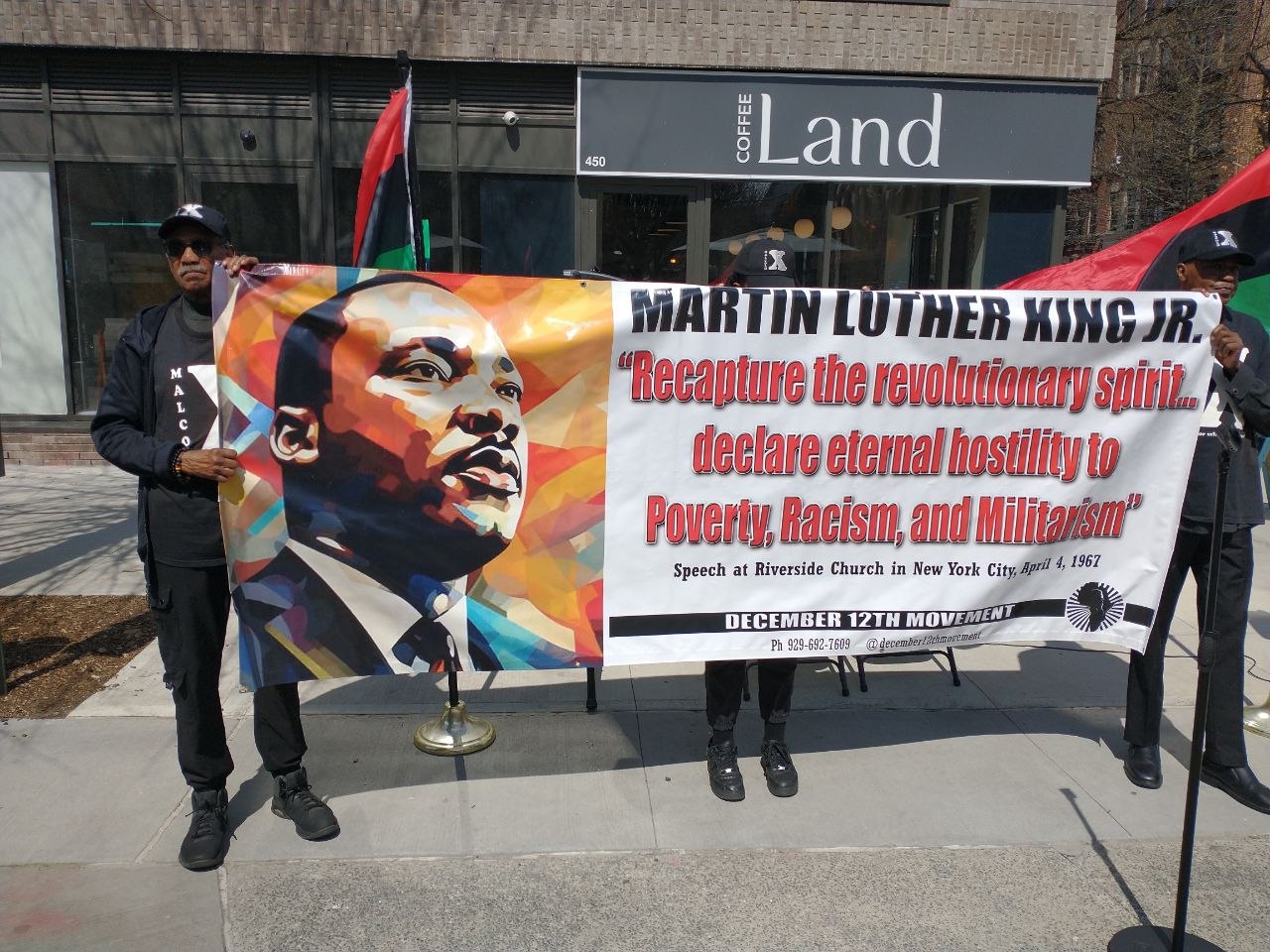
Fifty-eight years ago the Rev. Dr. Martin Luther King Jr. was assassinated in Memphis on April 4, 1968. Exactly one year earlier the Black leader had denounced the U.S. government as the “greatest purveyor of violence in the world today,” in his “Beyond Vietnam” speech.
The April 4, 1967 talk delivered in New York City’s Riverside Church attacking the dirty war against Vietnam and Laos — and later, Cambodia — became a death warrant for King. FBI Director J. Edgar Hoover had been threatening the freedom fighter for years.
The military-industrial complex had Dr. King and his family in its sights even longer. The U.S. Army investigated Dr. King’s grandfather for giving a “subversive” sermon attacking lynching.
Dr. King’s family doesn’t believe the official story that James Earl Ray was the sole assassin in Memphis. This was the same “lone gunman” type tale peddled by the Warren Commission to explain President Kennedy’s assassination. King’s murder was conducted by a more united ruling class determined to crush the Black liberation struggle.
Hoover’s FBI had been snooping on Dr. King since December 1955, when the Montgomery, Alabama, bus boycott began. In 1964, Hoover called Dr. King “the most notorious liar in the country.”
While King was in Memphis supporting striking sanitation workers, he was attacked by West Virginia Senator Robert Byrd as “a self‐seeking rabble-rouser.” The former Ku Klux Klan member would later be selected by his fellow Senate Democrats as their Majority Leader.
The corporate media also helped kill Dr. King. The Memphis Commercial Appeal attacked him for staying in a downtown hotel. This led to King moving to the Lorraine Motel, where he was more vulnerable and was killed. According to “Code Name Zorro,” by Dick Gregory and Mark Lane, there were two Black firefighters assigned to the firehouse behind the Lorraine Motel. They were suddenly transferred without explanation shortly before the assassination, thus getting rid of two possible witnesses.
Brooklyn remembers Dr. King
On April 4, a hundred people came to Brooklyn’s Jitu Weusi Plaza to commemorate Dr. King’s life of struggle. The December 12th Movement organized the rally, which began with Dr. King’s powerful “Beyond Vietnam” speech being played.
It took a struggle to get the plaza named after Jitu Weusi, who was a Black educator and activist. In 1968 — the same year that Dr. King was killed — Jitu Weusi fought for community control of the schools in New York City.
Activists who denounce the genocide in Gaza are often slandered as being “anti-Jewish.” Jitu Weusi was similarly attacked because he opposed the racist misleader of the teachers’ union, Albert Shanker, who fought Black and Latine communities controlling their schools.
Christian of the December 12th Movement chaired the rally. Omowale Clay, chair of the December 12th Movement, denounced Trump and the war against Iran.
Dr. James McIntosh of the Committee to Eliminate Media Offensive to African People (CEMOTAP) spoke. So did Raymond Dugue, the First Assistant President General of the Universal Negro Improvement Association (UNIA), which was founded by the Honorable Marcus Garvey.
People marched down Harriet Ross Tubman Avenue (Fulton Street), through the heart of the Bedford-Stuyvesant community. Many drivers honked their horns in support. Marchers chanted “The people united will never be defeated!” People on sidewalks waved and were urged to join the march. Several young people did. The march ended at Utica Avenue where a brief rally was held. Omowale Clay demanded the plaza and subway station there be named after Malcolm X.
Join the Struggle-La Lucha Telegram channel