
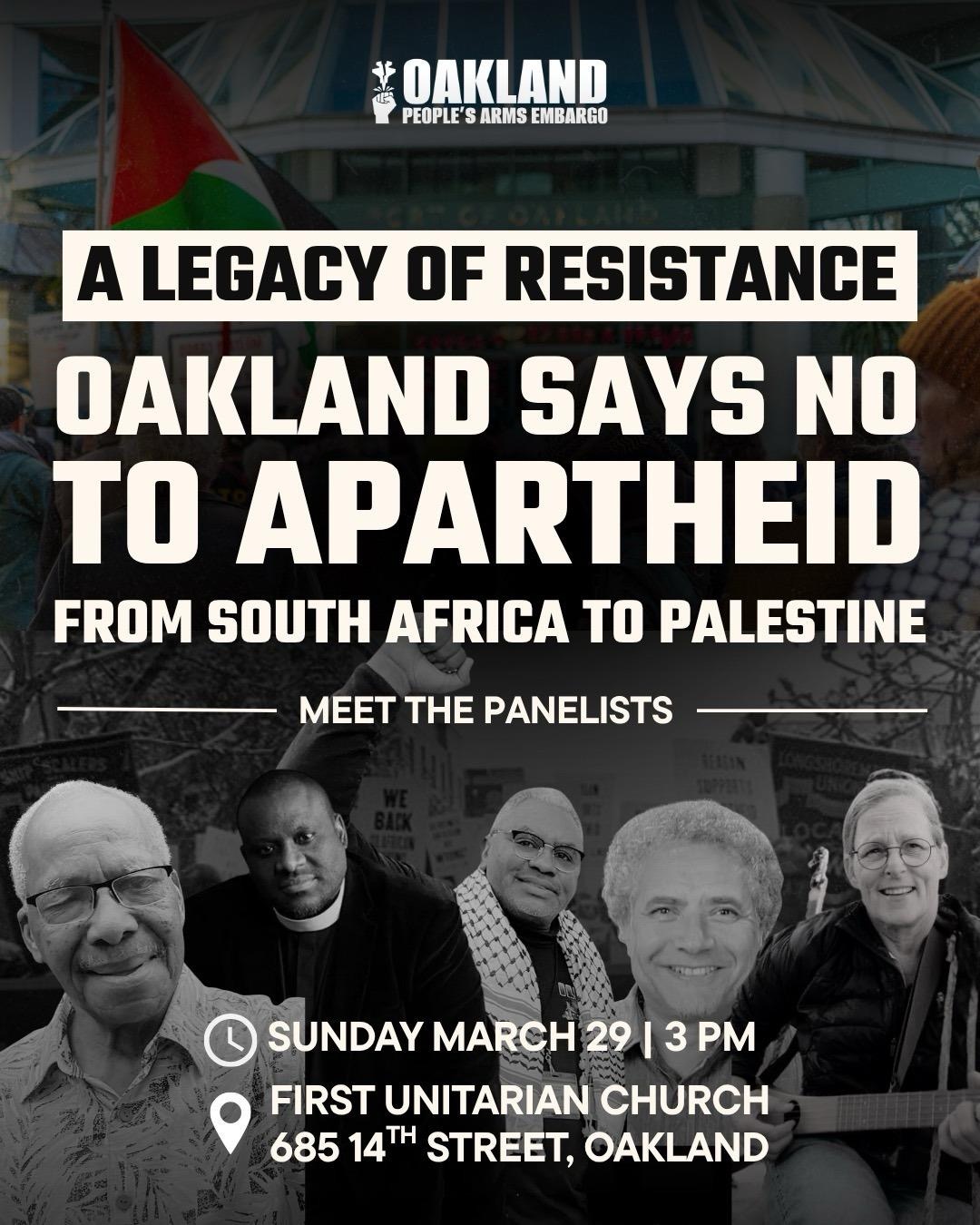
The following are lightly edited remarks by Clarence Thomas, a retired executive board member of ILWU Local 10 and former Black Panther Party member. Speaking at a March 29 panel, “Oakland Says No to Apartheid: From South Africa to Palestine!,” he traced ILWU Local 10’s role in the anti-apartheid struggle and its connection to solidarity with Palestine today.
It is so critical to document our history rather than have someone else revise it, or, worse, have it erased completely!
Amilcar Cabral, the Bissau-Guinean and Cape Verdean revolutionary, said: “Tell no lies, claim no easy victories.” It is a call to honesty, urging activists to avoid hiding difficulties, mistakes or failures and never exaggerate accomplishments. That’s what I plan to do this evening by first stating that I came onto the waterfront less than six months after the last historic 11-day boycott of South African cargo on the Nedlloyd Kimberly at Pier 80 in San Francisco in 1984.
I have been mentored by men like Leo Robinson, who led that struggle, and I have written about its history. I have been part of many ILWU Local 10 rank-and-file Palestinian solidarity actions since 2010, such as the Oakland People’s Arms Embargo, Block the Boat and Labor for Palestine.
Support for Oakland People’s Arms Embargo
I would like to say how important it is to be supportive of the Oakland People’s Arms Embargo, because it is consistent with our history.
When I say that, I’m going back to 1946, when there was a general strike in the city of Oakland initiated by a very diverse group of retail workers.
Fast forward to the 1960s with the formation of the Black Panther Party, and then on to the 1980s and 1990s with the emergence of community and labor activism around the anti-apartheid struggle. Now in the 21st century, the leadership has been shown by the ILWU at the Port of Oakland.
I mention all of this to briefly talk about the importance of knowing our history and understanding how we have taken positions that have been very progressive — positions that have sometimes been out of step with the mainstream. But we’ve managed to be in the vanguard and bring those positions into the mainstream.
One such issue is the anti-apartheid struggle. Initially, it was not supported by a broad base of people in the United States. But we know that changed from when Nelson Mandela visited the Oakland Coliseum in 1990 where, before 60,000 people, he acknowledged ILWU Local 10 for refusing to unload South African cargo for 11 days in 1984. What he did not mention was that this took place while he was in prison on Robben Island.
If you know anything about shipping, it drives capitalism. It was the first major manifestation of capitalism in the world. The world depends on the movement of goods, and longshore workers are responsible for the loading and unloading of cargo. We are critical to the world economy. When longshore workers don’t work, we disrupt the supply chain — and in so doing, we make a very serious contribution to the anti-apartheid struggle.
But let’s talk about 2014, with the Block the Boat action. A Palestinian youth organization, the Arab Resource and Organizing Center, and other Palestinian activists, along with labor and community social justice activists, came to the Port of Oakland to blockade an Israeli Zim line ship. It was only supposed to last for one day. It wound up taking place for four whole days. And from 2014 to now, the Zim shipping line has not come back to the Port of Oakland.
This is why it is so important for us to support these struggles, and why it is so critical for people in the Bay Area to continue that legacy.
Other distinguished panelists included: Nesbit Crutchfield, former chairperson of the Bay Area Free South Africa Movement; Pastor Michael McBride, of The Way Christian Center in West Berkeley; David Canham, executive director of SEIU 1021 and former anti-apartheid organizer in South Africa; and Andrea Prichett, educator & former leader of UC Berkeley Campaign Against Apartheid. The panel concluded with a performance by Vukani Mawethu Choir!
Clarence Thomas has written and edited books on political activism in Oakland. They are available at MillionWorkersmarch.com.
Join the Struggle-La Lucha Telegram channel