
The labor movement that helped drive the Jan. 23 anti-ICE Minnesota General Strike is now lending its muscle to support the meatpackers’ strike by members of United Food and Commercial Workers Local 7 in Greeley, Colorado. Other UFCW locals are also backing the strike, including Local 663 in Minnesota and Local 431 in Iowa.
Solidarity is spreading to help the Greeley workers. The meatpacking industry deliberately recruits workers from Haiti, Somalia, Eritrea, Burma and Latin America. Their vulnerability to ICE — compounded by corporate collusion with immigration enforcement — lets the bosses squeeze maximum profit from a workforce too exposed to fight back. The striking workers in Greeley come from 57 different countries. When UFCW Local 7 held its strike authorization vote, several ICE officers were stationed outside the plant. Workers voted 99% to authorize the strike anyway.
Beginning in the 1980s, the meatpacking bosses moved to break UFCW’s strength by recruiting immigrant labor and shifting plants to isolated rural areas with weaker union power. Four giant companies — JBS, Tyson, Cargill, and National Beef — control 85% of U.S. beef processing. After World War II, as many as 90% of meatpacking workers were unionized. By 2019, that figure had fallen to 15% as the result of a decades-long union-busting strategy.
On March 16, about 3,800 members of UFCW Local 7 in Greeley walked off the job. What began as a two-week unfair labor practice strike is now entering its fourth week. It is the longest major meatpacking strike in the United States in four decades.
An unfair labor practice strike
The Greeley workers are currently protected under federal labor law covering unfair labor practice strikes. They cannot legally be permanently replaced, unlike workers striking only over economic demands — a distinction that helped the bosses crush the Hormel P-9 strike in 1985-86, the last major meatpacking walkout before this one.
UFCW Local 7’s contract at the JBS Swift Beef plant in Greeley expired last July. Instead of bargaining with the workers, JBS demanded that the union accept terms negotiated elsewhere by other unions at other JBS facilities. Under labor law, forcing a union to accept terms negotiated by outside parties violates the duty to bargain in good faith.
Negotiating for survival
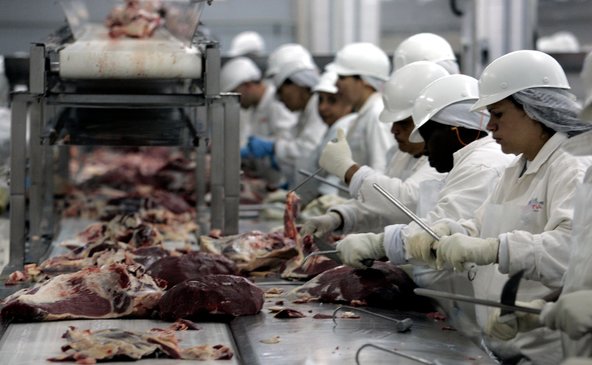
Meatpackers work in dangerous conditions, handling lethal tools on high-speed conveyor lines. They face speedup and a reduced workforce. One worker said JBS is squeezing more production out of a workforce that is taking home less pay.
According to UFCW Local 7 President Kim Cordova, JBS deducts the cost of replacing worn and damaged equipment directly from workers’ paychecks without their consent. Some workers, unable to absorb the deduction, continue working with damaged equipment. “One wrong move can take your life away,” Teshale Dadi, who works on the chuck line, told Labor Notes.
The night shift in Greeley is largely Haitian. Haitian workers have filed a class action lawsuit. They charge that JBS management forces them to work at dangerously high line speeds. The lawsuit also includes allegations of human trafficking — specifically, that JBS circulated videos promising jobs and housing to non-English speakers in Haiti. The recruits were then charged weekly fees for overcrowded, unsanitary motel rooms, while those costs were deducted from their wages.
Now the Trump administration is trying to end Temporary Protected Status for Haitian nationals. TPS is how many of these workers maintain legal authorization to work. The USDA is now considering a proposal to eliminate federal line-speed limits entirely — the same speedup drive at the center of this strike and the Haitian workers’ class action lawsuit.
In the past year alone, JBS has paid more than $100 million in settlements, legal fees and fines, according to organizer Caitlyn Clark of Essential Workers for Democracy. The Department of Labor found that cleaning contractors at the Greeley facility were using child labor. JBS paid part of a $200 million industry settlement over collusion with other meatpackers to suppress wages. The company was also forced to settle a suit over discrimination against Muslim workers in Greeley.
In January 2025, JBS made a $5 million donation to Donald Trump’s inauguration committee, the largest single donation the committee received.
The courageous energy of the immigrant meatpacking workers may be the spark that fuels the national general strike on May 1. A victory for UFCW Local 7 would be a victory for all.
UFCW Local 7 has a strike fund. Solidarity contributions can be made at ufcw7.org.
Join the Struggle-La Lucha Telegram channel