
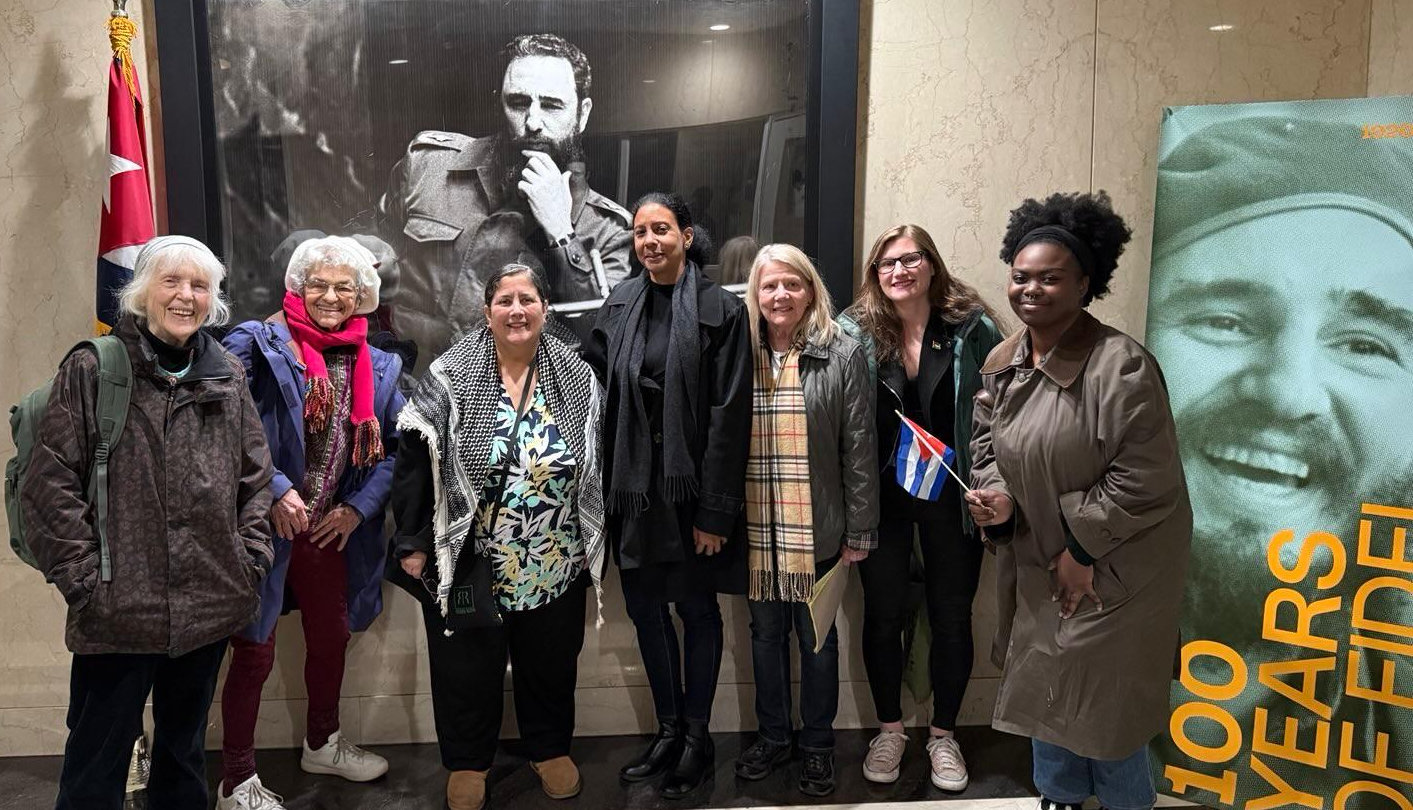
The following is a talk given by Maybel González Marín, an organizer from Cuba, on International Working Women’s Day (IWWD), March 8, 2026. The event was hosted by Women United Against Genocide, and the talk was translated by a member of that organization.
Maybel is the Coordinator of the Regional Office for the Americas and the Caribbean of the Women’s International Democratic Federation (Federación Democrática Internacional de Mujeres, or FDIM, in Spanish) and a member of the National Committee of the Federation of Cuban Women.
Good afternoon to everyone present. Today, I come to speak to you about a story of resistance, but also a story of unnecessary suffering. I am speaking about the economic, commercial, and financial blockade imposed by the United States government against the Cuban people.
This is not a new issue. We have endured this genocidal policy for more than six decades. According to reports submitted by Cuba to the United Nations, the quantifiable damage accumulated during more than 60 years of the blockade amounts to the staggering figure of more than $164 billion, taking into account the depreciation of the dollar against gold. In terms of current prices, the damage exceeds $1 trillion. It is an invisible wall, but more cruel than any physical border.
Let me focus on the humanitarian impact, on the invisible victims of this policy: our women, girls, and boys. In the health sector, the blockade is a silent killer. During these six decades, the inability to acquire medicines, medical equipment, raw materials, and technology in the U.S. market, or through subsidiary companies, has caused incalculable suffering. Studies by the Cuban Ministry of Public Health estimate that the blockade has caused losses of more than $3 billion in the health sector in recent years.
But behind every figure is a face. Thousands of complex surgeries have been postponed due to a lack of instruments. During the pandemic, the blockade prevented the purchase of ventilators and protective equipment, driving up costs and delaying the response.
For women, the impact is twofold. The lack of basic supplies for childbirth, the shortage of cancer medications for breast and cervical cancer, and the difficulties in obtaining contraceptives and fertility treatments are constant. According to data from the Federation of Cuban Women, the blockade has increased the cost of breast implants and medications for autoimmune diseases, which disproportionately affect women, by between 30% and 50%.
For children, the blockade is especially cruel. Cuba has had to search in distant and expensive markets for soy milk and nutritional supplements for children with kidney and metabolic diseases. It is estimated that the additional cost of specialized infant nutrition exceeds 40% annually. There are children who have waited months for cardiovascular surgery due to delays in the importation of catheters and heart valves, which are subject to licenses from the U.S. Treasury Department. That is the true face of the blockade: a war against the most vulnerable.
But let’s not be fooled, the blockade is not static. Each U.S. administration has competed to tighten it. And today, that cruelty has a name and a date: President Trump’s executive order, issued on Jan. 29, 2026, which imposes a total energy blockade against the island. This executive order has intensified the siege in an unprecedented way. Initial estimates from the Ministry of Economy and Planning indicate that in the first quarter of 2026 alone, the direct impact of this measure amounts to more than $500 million in losses.
But the greatest damage is indirect. With this order, the United States government has specifically prohibited the arrival of oil and petroleum product shipments from any country, under threat of sanctions against shipping companies. This has led to a drop of more than 60% in fuel availability on the island compared to the same period last year.
What does this mean in practice? It means that thermoelectric power generation has been drastically reduced. In February 2026, the electricity generation deficit reached peaks of more than 1,200 megawatts per day, causing blackouts of up to 12 to 14 hours across much of the country. For the health sector, this is devastating.
Interruptions in the operation of more than 200 hospitals and polyclinics that depend on generators, whose fuel is now being rationed, have been reported. Forty percent of the country’s ambulances have had their operational capacity reduced. For pregnant women and children, this means health centers without electricity for deliveries, without refrigeration for vaccines and medications, and without oxygen for critically ill patients. It is collective punishment, a flagrant violation of International Humanitarian Law.
Faced with this situation, many might ask: How is Cuba resisting? I tell you: We are resisting with creativity, with the heroic efforts of our people, with the development of our own science, as we saw with our vaccines, and with international solidarity. But creativity doesn’t put food on the table. Solidarity provides relief, but it doesn’t compensate for the damage. This energy blockade is not just another thorn in our side; it’s a club trying to break our legs. The objective is clear: to create a scenario of ungovernability through popular discontent, artificially generated by the lack of the most basic resources. Every blackout in a maternity hospital, every operating room in darkness, every child who doesn’t receive timely treatment, has a target and a culprit: the United States government.
Comrades, the executive order of Jan. 29 is not an isolated measure against a government; it is an act of war in peacetime against an entire people. Cuba is not a threat. Cuba is an example of dignity.
Today, I raise my voice to denounce this crime and to issue a call to action. To the international community: demand an end to this policy. The overwhelming annual vote at the UN against the blockade is the voice of the world’s conscience, which Washington insists on ignoring. To social movements: intensify the campaign of denunciation. The blockade is a silent war. The energy blockade is a final attempt at strangulation. But as long as there is one Cuban with dignity, we will win this war.
Let us raise our voices for the end of the blockade. For the sovereignty of Cuba. Long live a free Cuba! Thank you very much.
Join the Struggle-La Lucha Telegram channel