
An interview with Ana Hurtado by Oriol Sabata
March 22, 2026
Cuba is currently facing a serious situation as a result of the intensification of the criminal U.S. blockade. What is the atmosphere like on the island, what mood do you sense among the people, and what has been the reaction of the government and the people to this new imperialist onslaught?
In Cuba this week, the crisis has intensified—one that, in my view, has been ongoing for one or two years now. I have been living on the island for three years, and for the past two or two and a half years, I have observed how power outages occur daily or nearly daily, even in Havana, where they are less frequent than in the rest of the provinces, which gives a real sense of the severity of the energy problem.
Although the United States has been actively pursuing a policy to destabilize the Cuban people since the early 1960s—beginning with Lester Mallory’s memorandum, which proposed creating material shortages to provoke the people into rebelling against their government—the truth is that this crisis has intensified with each successive administration. During Trump’s first term, hundreds of measures were imposed, even during the COVID-19 pandemic; the Cuban people were denied access to oxygen; measures that were not subsequently reversed and that today have led to an energy blockade with direct consequences on daily life.
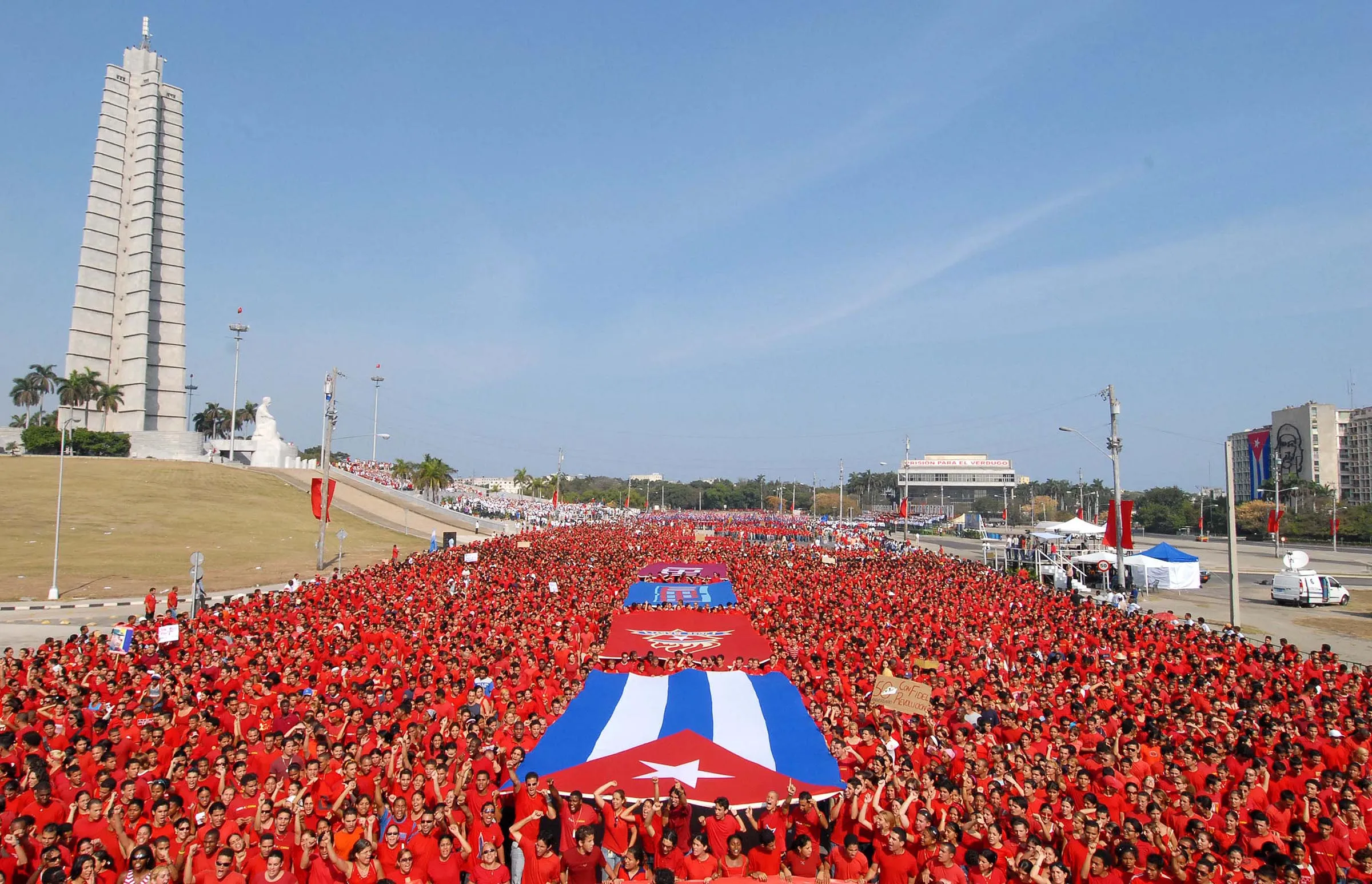
This country has been operating under a wartime economy for years and has developed enormous resilience. People are tired, but they maintain a strong spirit of resistance. We must not forget that within this island, a very high percentage of the population supports the revolution and its political model, in a country that has elected its parliament with a turnout exceeding 70% of the registered electorate.
At the same time, the government is focusing its efforts on guaranteeing the basic resources needed to sustain daily life in a context of scarcity, ensuring essential services and prioritizing the fundamental needs of the population.
On February 25, a boat from Florida carrying 10 armed individuals was intercepted by Border Guard troops. It later emerged that they were planning an armed infiltration in Villa Clara. Can we say that Cuba is facing a multidimensional war that goes beyond the economic sphere?
The U.S. blockade of Cuba is not only comprehensive but also multifaceted. Few peoples in the world have faced a war on all fronts as is the case with Cuba.
The Cuban people have faced a constant ideological war, aimed at dismantling their values, their history and their culture. They have faced a military war through armed invasions, as well as terrorism, with thousands of fatalities and many others maimed. Cuba has also suffered bacteriological attacks, with the introduction of diseases that severely affected the population, and a biological war directed against its staple crops.
Likewise, it has been the victim of terrorist acts such as the bombing of an airplane; the first terrorist acts against civil aviation in the world were perpetrated by anti-Cuban terrorists.
We cannot forget, to highlight just a few, the nefarious figures of Posada Carriles, Orlando Bosch and Félix Rodríguez—who was the one who cut off Che’s hands after his death—with the attack on the Barbados plane, the attempted attack in the university auditorium in Panama, and the assassination attempts against leader Fidel Castro throughout his political career.
These are obsolete figures who want to continue this indecent struggle.
In summary, Cuba has been facing an unconventional war for 67 years.
Cuba has been undergoing a long process of resistance since the 1960s, when, following the triumph of the Cuban Revolution, the U.S. established the criminal blockade with devastating consequences both economically and socially that affect the people’s daily lives. Could you give us some concrete everyday examples so our readers can understand its magnitude?
The blockade, as we said, is comprehensive in nature, and we cannot say that it affects only certain sectors; the fact is that there is no area of life that escapes this blockade.
Let me give an example: at this moment, more than 80% of the Cuban population has lived under the blockade. It must be kept in mind that, currently, with the war the United States has waged against the world—simply by imposing tariffs on economies—they have managed to force governments to bow to their interests. In Cuba’s case, it is not merely that tariffs are imposed, but that the country is deprived of direct trade with a partner that, geographically speaking—as is the case with the United States—is in the same region and very close by.
Now, the impacts. They are felt in daily life. These are, I would say, the factors that definitively make life harder for Cubans. Water supply, electricity, communications and food—all of this affects every aspect of the nation’s activities.
Added to this is the transportation situation, not only due to fuel but also spare parts. The same applies to electricity generation.
Furthermore, the United States, with its blockade against Cuba, exerts enormous pressure on third countries and on companies.
It should also be mentioned that any product containing more than 10% of U.S.-origin components cannot be sold in Cuba due to the blockade regulations.
Added to this is the financial witch hunt, where the United States constantly monitors all banking transactions—as if Cuba were truly a country that sponsors terrorism.
Yet all Cuba has ever done is fight against terrorism and piracy. It has waged an open and total war against drug trafficking. In Cuba, there is zero tolerance for narcotics and drugs.
Therefore, a key point is that the inclusion of Cuba on the list of state sponsors of terrorism is cynical and utterly sickening.
It must be emphasized that Cuba has a consistent commitment to internationalism and to helping peoples. There is no country that has not been touched by Cuban doctors and teachers. Operation Miracle in Venezuela, literacy campaigns in various countries and the medical missions during the COVID-19 pandemic in a Europe incapable of saving its own people.
This internationalist, solidarity-based effort is known throughout the world.
On March 13, President Díaz-Canel reported that talks have been established with Washington. How much trust can be placed in an administration like Trump’s, given the recent attacks on Venezuela and Iran while both governments were engaged in active negotiations?
The point is not about trust, but about will. Cuba has always had the will to negotiate any existing differences and to sit down for dialogue in any setting where such differences arise. In the specific case of relations with the United States, there are hegemonic interests that are not circumstantial but have persisted for over 200 years.
This administration is characterized precisely by its disruptive behavior on the international stage and, above all, by its unreliability. In that sense, the issue has never been framed in terms of trust in the ongoing talks, but rather in terms of principles.
The aim is to reaffirm those principles in any process of dialogue or negotiation, while being clear that there are issues that are not at stake and cannot be.
Sovereignty is not at stake, self-determination is not at stake, the dignity of the Cuban people is not at stake. That is the point.
What role does internationalist solidarity play in these difficult times Cuba is facing?
Internationalist solidarity is more essential than ever for Cuba today. In a globalized, dehumanized world permeated by a capitalism that has penetrated every sphere, it is solidarity—the compassion of peoples—that must sustain and accompany the Cuban people.
Ultimately, it is nothing more than giving back, in part, everything that Cuba has given to the world over the decades. These days, solidarity flotillas from different parts of the globe are arriving on the island—friends of this people who, by their presence, help bring to light the magnitude of a conflict that has now spanned nearly seven decades.
But this is not merely a matter of material or one-off solidarity. This internationalist solidarity must also serve to promote Cuba’s cause, the defense of its sovereignty and its revolutionary process, and to challenge the hegemonic narrative that imperialism has constructed on a global scale.
What recommendations would you give our readers to confront the media and psychological war being waged against Cuba by the mainstream media?
I would recommend that readers always get their information from official Cuban media and left-wing media that do not reproduce the hegemonic narrative of the mainstream media that props up the capitalist economy.
Today, the media war and psychological warfare are even more decisive than military warfare or so-called surgical strikes, because they are what penetrate the collective imagination of the people, reaching workers in France, Italy, Spain or Japan.
At this point, the responsibility does not fall solely on the media, but also on ourselves, who have internet channels—such as social media—to help spread the truth and fight against disinformation.
It is essential to maintain a critical mindset toward the major Western media and seek information from alternative media with a critical and humanistic perspective, while also helping to spread it.
Today, there are tools such as artificial intelligence that can distort any kind of reality. We live in times when, with artificial intelligence, social media and the post-truth era, it is difficult to distinguish which news is false and which is true.
Therefore, this must be an essential struggle and a moral duty for every person aware of the harm that U.S. imperialism and Zionism inflict on peoples.
International public opinion is often bombarded with the idea that socialism is a failure and does not work. However, since the Revolution triumphed in Cuba, it has never been allowed to develop with even a modicum of peace and stability. What fear lies behind this constant harassment and boycott?
If one attempts to define Cuba as a “failed state,” as they call it, one must ask how a failed state can survive for 67 years under an unceasing blockade by the United States and under multiple forms of aggression such as those we have explained.
If it is a failed state, how can it sustain itself over time? And furthermore, why isn’t the blockade lifted? What would happen if those measures were lifted? What would happen if it were allowed to develop without those restrictions?
It was demonstrated during the Obama administration that, without renouncing its intentions to dismantle the country’s sociopolitical system, an economic opening occurred through executive decisions that partially eased the blockade, and in that context, multiple sectors of the Cuban economy showed favorable indicators.
So, if it is truly a failed state, why maintain and reinforce the blockade measures? Why sustain an extraterritorial blockade? Why prevent other countries from trading with Cuba or supplying it with fuel? Why is all of that necessary?
Who defines a failed state when there are countries facing political, economic and social crises—or even natural disasters—with far more severe consequences? Cuba repeatedly faces large-scale natural phenomena, such as hurricanes, with minimal human and material losses.
However, in other regions of the world, including Europe, the Americas and even the United States itself, natural disasters occur with devastating consequences, and no one automatically labels those countries as failed states.
So why is this label insisted upon for a country that places human beings at the center of its governance? These are obvious inconsistencies, difficult to sustain.
It is claimed that socialism is not progressing, yet this claim coexists with the constant need to impose suffocating measures on it. This contradiction, in and of itself, reveals the root of the problem.
Source: Cuba en Resumen
Join the Struggle-La Lucha Telegram channel