
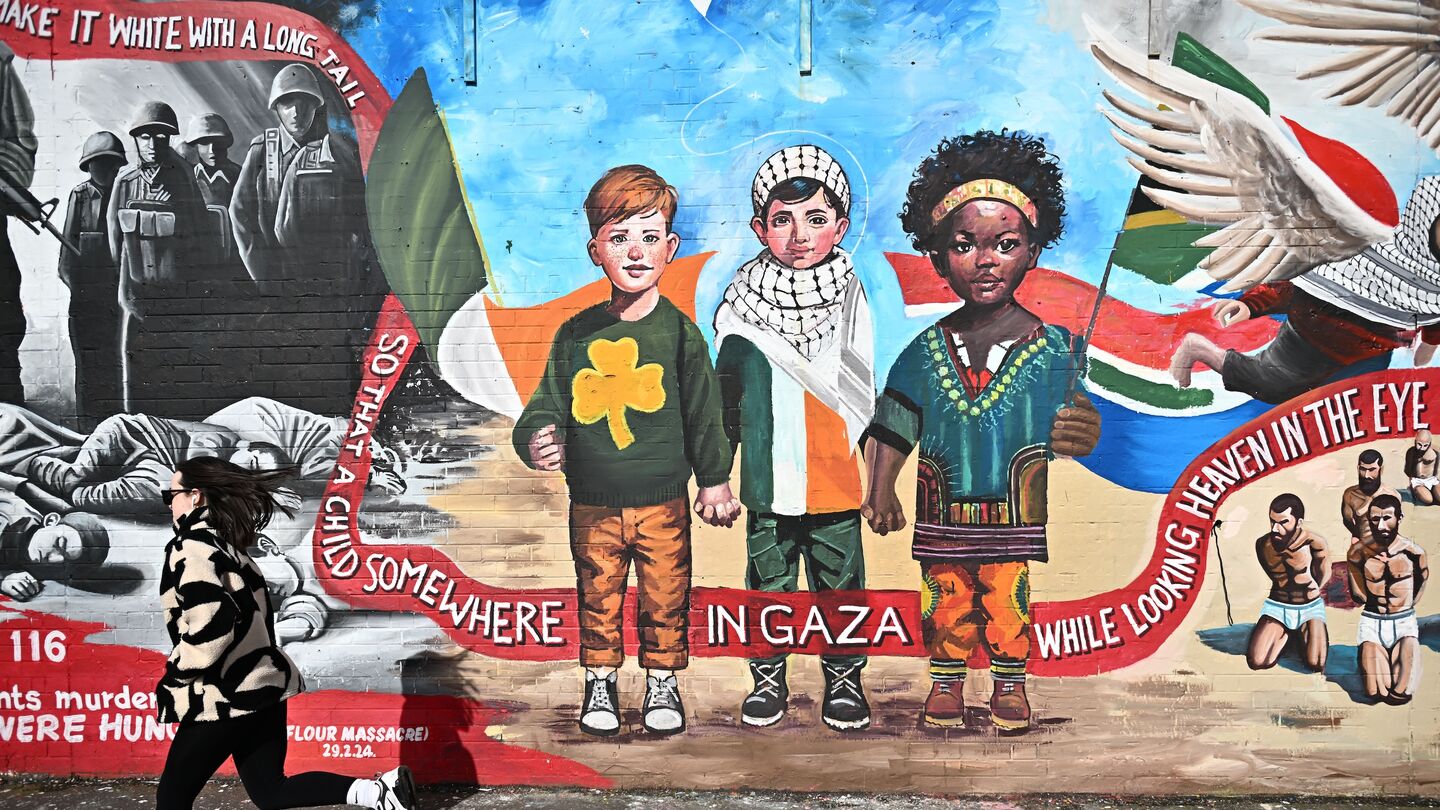
The following talk was given at the “Teach-In: Stop the War on Iran” event held at the Harriet Tubman Solidarity Center in Baltimore, Maryland, on March 18, 2026, to commemorate St. Patrick’s Day.
I’m Penny with the Struggle for Socialism Party and Women in Struggle. Because yesterday was St. Patrick’s Day, I’m going to begin our event tonight by speaking about Irish resistance against imperialism and colonialism. I’m going to try to keep it brief, because I could talk for hours about the over 800 years of Irish resistance. That is a fight that continues to this day because the six counties in the north of Ireland are still occupied by Britain. After a brief background, I’m going to connect the fight in Ireland to the fight against imperialism across the world, because all of our struggles are connected.
In the 12th century, the Anglo-Norman invasion began the oppression of the Irish at the hands of the English. Violent displacement and ethnic cleansing against the primarily Catholic Irish by the predominantly Protestant English continued for centuries through conquests and English rule. Throughout this time, the Irish rebelled and fought for self-rule, for the return of their lands, and to end sectarian discrimination.
One of these rebellions – the Rebellion of 1798 – sticks in my heart, because it occurred in County Wexford, where my family lived, when my family was still there before they left Ireland as part of the Irish diaspora that occurred because of the Great Hunger.
Speaking of the Great Hunger, it was a man-made famine by the British that occurred from the late 1840s to 1850s. We’re taught here in the United States that it was a potato blight that caused the famine. What really caused the famine was absentee landlordism and a forced single-crop dependence. The food produced in Ireland was not kept in Ireland to feed the Irish people; it was exported to England by the English ruling class. The Irish people starved, lived in poverty, and were evicted.
This disproportionately affected areas in Ireland where Irish was the predominant language, decimating the language. Over one million people died from the famine, and over two million Irish people left Ireland and spread out across the world.
Now that we have a little bit of background, I’m going to talk about some modern Irish republicanism, the fight for Irish independence, and connecting the Irish struggle to struggles across the globe.
[Editor’s note: Irish republicanism is the movement to establish an independent Irish state and has nothing to do with the U.S. Republican Party or right-wing politics.]
To start off, I want to talk about James Connolly. James Connolly was an Irish republican, a socialist, and a trade union leader. He founded the Irish Citizen Army, was a signatory of the Proclamation of the Irish Republic, and a leader of the Easter Rising, which fought to proclaim Ireland’s independence from Britain. He was wounded during the Easter Rising and still commanded his troops from a stretcher. I say “troops” and not “men,” because there were women’s units that fought in the Easter Rising. At the end of the Easter Rising, James Connolly was executed by the English.
I want to connect James Connolly and his work to two modern-day items. One is the fight against discrimination, not just the discrimination against Irish people, but the discrimination against all oppressed peoples. He was a founding leader and organizer of the first interracial labor union in the United States. It was called the Industrial Workers of the World, and it was the only union that welcomed Black, Asian, and immigrant workers. The union stated that all workers, regardless of color or creed, were able to join.
The other item that I want to connect James Connolly to is the struggle for socialism. He was a socialist. He fought for socialism and knew it was the only way forward. I’m going to read for you all my favorite quote from James Connolly:
“If you remove the English Army tomorrow and hoist the green flag over Dublin Castle, unless you set about the organization of the Socialist Republic your efforts will be in vain. England will still rule you. She would rule you through her capitalists, through her landlords, through her financiers, through the whole array of commercial and individualist institutions she has planted in this country and watered with the tears of our mothers and the blood of our martyrs.”
To keep this brief, I’m going to jump ahead to connecting Ireland to Palestine. During the Irish War of Independence, the Black and Tans – a nickname for the British soldiers who were recruited to the Royal Irish Constabulary – were deployed in Ireland to occupy and oppress the people. These units were notorious for beating, abusing, murdering civilians, as well as burning down homes and villages. After the Irish War of Independence, around 800 of the Black and Tans were deployed by Winston Churchill to Mandatory Palestine. They were sent to terrorize, abuse, and crush Palestinian resistance against imperialism.
I want to make it clear that it’s not just the same units in name that were sent from Ireland to Palestine. It was the same men – the very same people who tortured the Irish – that were sent to Palestine. They were sent there because of their notorious brutality. They were sent there because the British government knew what they were going to do to Palestinians.
Now I’m going to talk about Bobby Sands. Bobby Sands was a member of the Provisional IRA, a political prisoner, and a poet. He was a political prisoner at the brutal Maze Prison in the north of Ireland. He suffered abuse from the screws, which is a nickname for the prison guards. Bobby Sands was an IRA Officer Commanding while imprisoned. He engaged in the blanket protests, the dirty protests, and the 1981 hunger strike to demand that he and his comrades be treated as political prisoners.
His words ring true to me as I think about political prisoners Nicolás Maduro and Cilia Flores. I could talk all day about Bobby Sands, but I’m going to just read for you a line from his writings that were smuggled out of prison:
“They have nothing in their entire imperial arsenal to break the spirit of one single Republican political prisoner-of-war who refuses to be broken, I thought, and that was very true. They can not or never will break our spirit.”
This is true for all political prisoners and revolutionaries. They have nothing that can break our spirit. They will not break the spirit of Palestine. They will not break the spirit of Cuba. They will not break the spirit of Iran. They will not break the spirit of Venezuela. And they will never break the spirit of Ireland.
Through Bobby Sands, we can directly connect the struggle in Ireland to anti‑imperialist struggles in countries like Iran. After Sands’ death in 1981, Iranian authorities renamed the street by the British Embassy in Tehran as ‘Bobby Sands Street’ and later dedicated another street to his memory, forcing the embassy to shift its main entrance. Iran’s future Supreme Leader, Ayatollah Ali Khamenei, publicly hailed Sands as an Irish hero and martyr, and Iranian media have continued to present the hunger strikers as part of a global front against colonialism and imperialism. (Ayatollah Khamenei, as you know, was murdered by U.S.-Israeli missile strikes on Feb. 28th, 2026.)
To close out this talk, I want to talk to you guys about the rap group Kneecap. Kneecap is made up of three working-class men from Belfast and Derry. They are proudly republicans and they are proudly Fenians. They rap in the Irish language, which has helped build a resurgence of the Irish language. Kneecap is openly political. They speak and they rap in support of Palestine and a united Ireland. This week, actually, Kneecap is part of a convoy headed to Cuba to bring aid to Cuba during the double blockade.
Last week, on March 11, one of the members of Kneecap, Liam, who goes by his stage name, Mo Chara, was cleared of his terrorism charges brought against him in a British court for having displayed a flag in support of Hezbollah in 2024. I would like to finish this by reading the end of his press conference that he gave after this case was dismissed.
“Your attempts to label me a terrorist have failed because I was right, and yet again, Britain was wrong. I will not be silent, Kneecap will not be silent, and the people of West Belfast will not be silent. … You falsely tried to label me a terrorist when it is the British government ministers that are arming and assisting a genocide in Gaza, the destruction of Lebanon, and the senseless slaughter of school kids in Iran. Free Palestine, free the six counties, tiocfaidh àr là.”
For those of you who don’t know, “tiocfaidh àr là” is a phrase of hope and resistance in the Irish language. It roughly translates to “our day will come.” It was the last sentence that Bobby Sands wrote in his prison diary smuggled out of prison titled One Day in My Life. Thank you.
Join the Struggle-La Lucha Telegram channel