
Four weeks into Operation Epic Fury, the U.S. military has confirmed what critics of Pentagon doctrine have argued for decades. Advanced stealth aircraft and nuclear-powered carriers are not invincible. They are expensive, brittle and poorly matched to the kind of war Iran has spent 40 years preparing.
The war shut down any negotiated exit from the start. The U.S.-Israeli assassination of Iran’s Supreme Leader removed the leadership that could authorize a ceasefire and hardened the response. Days later, a strike killed 170 schoolgirls, making any compromise politically impossible. Washington is now issuing ultimatums it cannot enforce without widening the war further. Iran is not choosing escalation.
What began as a campaign to weaken Iran’s military and force political collapse is now focused on reopening the Strait of Hormuz — a far more limited goal.
The losses are no longer deniable. Central Command acknowledged that an F-35 — the flagship of a weapons program that has cost U.S. taxpayers more than $1.7 trillion — was brought down after Iranian air defense systems acquired and struck the aircraft. The pilot ejected. It is the first confirmed combat loss of a fifth-generation stealth fighter, and it is only the most visible symbol of a campaign that has not gone according to plan.
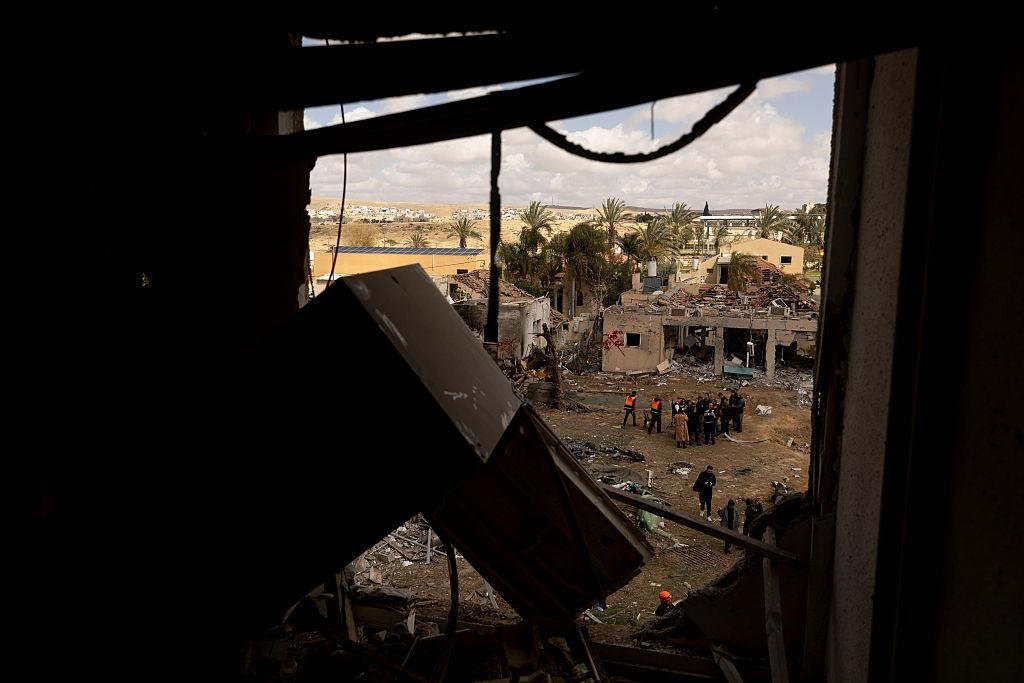
Iranian missiles have now penetrated Israeli air defenses near Dimona, striking near Israel’s main nuclear research facility — one of the most heavily defended sites in the region.
The USS Gerald Ford, the most expensive warship ever built at roughly $13 billion, has withdrawn from the theater. (See: U.S. carrier breaks under strain in Iran war.) One of the two carrier strike groups deployed to project power is no longer in position to do so.
USS Abraham Lincoln and the limits of air power
The USS Abraham Lincoln is operating in the southern Arabian Sea, outside the Persian Gulf and away from the Strait of Hormuz, kept at a distance by Iranian drones and missiles based along the coast and inside the Gulf — far enough that every combat sortie requires aerial refueling before it reaches the operational zone.
Held at that range, the carrier group is no longer a power projection platform. It is a very expensive liability. Every sortie requires tanker support. Mission cycles extend. Each day burns through munitions, aviation fuel, and aircrew readiness at a rate the U.S. military has not sustained since the Gulf War — under far more contested conditions.
Iranian radar and tracking systems have followed B-52 sorties across the theater, forcing U.S. bombers to rely on standoff strikes launched from outside heavily defended airspace. The U.S. military is built to deliver overwhelming firepower against fixed targets. It is not built to operate for long under constant missile and drone threat or absorb dispersed, decentralized resistance across Iran’s territory.
That contradiction shows up most clearly in the plans now under discussion.
The Kharg Island calculation
Military planners are reportedly considering a seizure of Kharg Island, the terminal that handles roughly 90% of Iran’s oil exports. The idea is straightforward: take Kharg, choke off exports, and force Tehran to the table while reopening the Strait of Hormuz.
The plan collapses once the geography is taken into account.
The fighting is centered in and around the Persian Gulf and the Strait of Hormuz, while U.S. carriers are being pushed farther out into the Arabian Sea.
Kharg Island sits in the northern Persian Gulf, near the Strait of Hormuz, about 15 miles off Iran’s coast. It is within range of artillery, missiles and drones from the mainland, with Iranian naval forces operating around it in the Gulf. The reported assault force is 2,500 Marines.
Even the strategic value of Kharg is now in question. Damage across the region and wider disruptions mean shutting down Iranian exports would not restore oil flows or end the crisis.
Taking the island would not reopen the Strait. It would pin U.S. troops on a small, exposed target under constant fire. Resupply would be under attack. There are no protected positions and no room to move. The position cannot be held.
U.S. troops are already reporting this from inside the war zone. Military personnel describe inadequate force protection and repeated missile and drone strikes on U.S. bases. Some units report they cannot fully defend even a single installation under sustained attack. A ground operation is being described as “an absolute disaster” with no workable plan.
The Pentagon admits that at least thirteen U.S. troops have been killed and more than 200 wounded under sustained missile and drone attacks, figures that are likely incomplete.
What asymmetric warfare actually costs
The cost of the war is already rising fast. Pentagon officials estimate daily operations at $1 billion to $2 billion. In the first 48 hours, the U.S. burned through munitions that will take years to replace. Production lines are already stretched supplying Ukraine and meeting NATO commitments.
This is the imbalance. The U.S. is fighting a high-cost war that burns through weapons and fuel. Iran is fighting a low-cost war that prolongs the conflict and forces the U.S. to keep spending.
This is the limit of U.S. military power in this war. The weapons are advanced. The supply is not. Production cannot keep pace with destruction. The U.S. can fire faster than it can rebuild.
Iran does not need to match U.S. technology. It needs to keep the U.S. spending and firing. On that terrain, the advantage shifts.
Join the Struggle-La Lucha Telegram channel